Building a tennis court is a valuable investment, whether for a private residence, school, club, resort, or commercial sports facility. A well-designed tennis court enhances property value, promotes an active lifestyle, and provides years of reliable performance when constructed correctly. This complete guide to building a tennis court covers every stage of the process, from initial planning and site selection to surface choices, construction steps, costs, and long-term maintenance.
1. Understanding the Purpose of Your Tennis Court
Before construction begins, clearly define the purpose of your tennis court. This decision influences design, surface selection, budget, and maintenance requirements.
- Private residential tennis court – Focuses on aesthetics, comfort, and moderate usage
- Club or academy tennis court – Requires durable materials for high traffic and competitive play
- School or institutional court – Emphasizes safety, cost efficiency, and low maintenance
- Professional or tournament court – Must meet international standards and precise specifications
Clarifying usage early helps avoid costly design changes later in the project.
2. Choosing the Ideal Location
Proper site selection is one of the most critical factors in tennis court construction. The ideal location should provide:
- Adequate space – A standard tennis court measures 78 feet by 36 feet for doubles play, but total area required is approximately 120 feet by 60 feet, including run-off zones
- Good drainage – Poor drainage leads to surface damage and frequent repairs
- Minimal slope – Excessive grading increases construction costs
- Correct orientation – North–South alignment reduces sun glare during play
Conducting a professional site survey ensures the land can support long-term court performance.
3. Tennis Court Dimensions and Design Standards
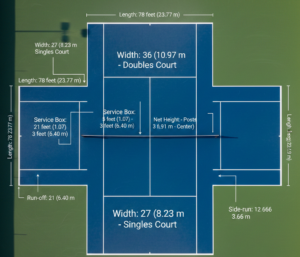
Understanding official tennis court dimensions ensures compliance with recreational or professional standards.
- Singles court width: 27 feet
- Doubles court width: 36 feet
- Court length: 78 feet
- Net height: 3 feet at the center, 3 feet 6 inches at the posts
Additional clearance space is essential for player safety and comfortable movement. Fencing, lighting, and spectator areas should also be incorporated into the design phase.
4. Selecting the Best Tennis Court Surface
Choosing the right tennis court surface is crucial for performance, durability, and maintenance. Each surface offers unique playing characteristics.
Hard Court
Hard courts are the most popular choice worldwide.
Advantages:
- Durable and long-lasting
- Suitable for all skill levels
- Low maintenance
- Consistent ball bounce
Materials used: Asphalt or concrete base with acrylic surface coatings
Clay Court
Clay courts are known for slower gameplay and higher bounce.
Advantages:
- Reduces joint stress
- Ideal for training and endurance play
Considerations: Requires daily maintenance and proper watering
Grass Court
Grass courts provide fast play and a traditional aesthetic.
Advantages:
- Soft surface
- Prestigious appearance
Considerations: High maintenance and limited durability
Synthetic or Artificial Turf
Synthetic tennis courts combine performance with reduced upkeep.
Advantages:
- All-weather usability
- Lower maintenance than natural surfaces
- Customizable playing speed
Selecting the surface depends on climate, usage frequency, maintenance capacity, and budget.
5. Tennis Court Construction Process
A structured construction process ensures quality and longevity.
Step 1: Site Preparation
- Clearing vegetation and debris
- Excavation to required depth
- Grading and leveling the base
Base Construction
- Installing a compacted stone or aggregate base
- Ensuring proper slope for water drainage
Asphalt or Concrete Layer
- Laying asphalt or reinforced concrete
- Allowing adequate curing time
Surface Coating
- Applying acrylic or specialized surface materials
- Multiple layers for durability and color consistency
Line Marking
- Using durable, slip-resistant paint
Accessories Installation
- Net systems
- Fencing
- Lighting poles
- Seating and wind screens
Each stage must be executed by experienced professionals to avoid structural issues.
6. Tennis Court Drainage and Weather Protection
Effective drainage protects the court surface and extends its lifespan.
- Perimeter drains to redirect rainwater
- Subsurface drainage layers for clay courts
- Proper slope to prevent water pooling
7. Lighting and Fencing Considerations
Tennis Court Lighting
High-quality lighting allows for evening play and improved visibility.
- LED lights for energy efficiency
- Uniform light distribution
- Minimal glare design
Tennis Court Fencing
Fencing ensures safety and ball containment.
- Standard height: 10–12 feet
- Chain-link or welded mesh options
- Optional windbreak screens for enhanced play comfort
8. Cost of Building a Tennis Court
The cost of building a tennis court varies depending on location, materials, and surface type.
Key cost factors include:
- Land preparation and excavation
- Base and surface materials
- Drainage systems
- Lighting and fencing
- Labor and professional fees
On average, a tennis court construction project can range from moderate to premium investment levels. Long-term durability should always take priority over initial cost savings.
9. Tennis Court Maintenance and Longevity
Proper maintenance preserves playing quality and appearance.
- Regular cleaning to remove debris
- Periodic resurfacing every 4–8 years for hard courts
- Crack repair and line repainting
- Net and accessory inspection
10. Sustainability and Eco-Friendly Tennis Courts
Modern tennis court construction increasingly incorporates sustainable practices.
- Permeable surfaces for improved drainage
- Recycled materials in court base layers
- Energy-efficient LED lighting
- Low-VOC surface coatings
Conclusion
Building a tennis court is a multi-step process that requires careful planning, expert design, and quality construction. By choosing the right location, surface type, and construction method, you can create a tennis court that delivers exceptional playability, durability, and long-term value.
With proper maintenance and thoughtful design, your tennis court will remain a centerpiece for recreation, fitness, and competitive play for decades to come.