Introduction
Jharkhand, with its mineral-rich soil, rolling plateaus, and growing sports culture, is steadily expanding its tennis infrastructure. Cities like Ranchi, Jamshedpur, Dhanbad, Bokaro, Hazaribagh, Deoghar, Ramgarh, and Giridih are seeing increased investments from schools, academies, clubs, government sports authorities, and private institutions.
Among all court types, clay tennis courts have become a preferred choice due to their natural comfort, slower pace, and suitability for long-term skill development. They are ideal for junior training programs, competitive training, and recreational use.
Why Clay Courts Are Ideal for Jharkhand
1. Soft & Joint-Friendly Surface
Clay absorbs pressure, making the court:
-
Easy on knees, ankles, and hips
-
Suitable for long coaching sessions
-
Safer for beginners and young athletes
2. Enhances Player Skills
Clay courts naturally slow down the game, helping players develop:
-
Strong footwork
-
Topspin-based strokes
-
Stamina and endurance
-
Sliding technique
-
Consistency over power
This makes clay the preferred surface for many training academies in Jharkhand.
3. Compatible with Local Soil Conditions
Jharkhand’s red and laterite soil regions (Ranchi, Hazaribagh, Gumla, Simdega) naturally support clay court construction, reducing material costs.
4. Climate Suitability
With moderate rainfall, warm summers, and relatively balanced humidity—clay courts perform consistently across most districts.
Challenges of Clay Courts in Jharkhand
1. Intense Summer Heat
-
Regular watering
-
Protective rolling to prevent cracking
2. Uneven Terrain in Plateau Regions
Land leveling may be required:
-
To achieve a flat play surface
-
To prevent water flow issues
3. Heavy Rainfall in Selected Areas
Clay needs to be:
-
Properly mixed with brick dust
-
Well-compacted
-
Moisture-balanced
Clay Court Construction in Jharkhand
Building a durable clay court requires strong foundational engineering and proper soil preparation.
1. Site Selection and Design
Important considerations:
-
Good sunlight exposure
-
Natural wind flow for drying
-
Elevated site to avoid water pooling
-
North–South orientation for reduced sun glare
2. Multi-Layer Court Construction Structure
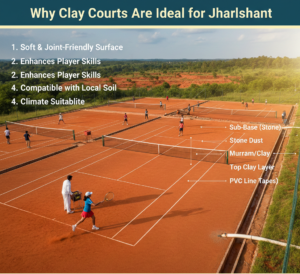
Layer 1 – Sub-Base (150–200 mm)
-
Hardcore stone base
-
Compacted for stability
-
Supports drainage
Layer 2 – Stone Dust / Fine Gravel Layer (50–80 mm)
-
Smoothens surface
-
Allows proper leveling
Murram/Clay Binding Layer (20–40 mm)
-
Absorbs moisture
-
Provides cushioning
-
Essential for firmness
Top Clay Layer (5–10 mm)
Composition:
-
Selected clay
-
Crushed brick powder
-
Fine red soil
Benefits:
-
Consistent bounce
-
Smooth sliding
-
Balanced ball speed
Line Marking
Using PVC line tapes:
-
Weather-resistant
-
Highly visible
-
Durable
Drainage System for Jharkhand Conditions
A well-designed drainage system ensures year-round usability.
Key Components
-
Side drains on both long sides
-
A 0.8–1% court slope
-
Rainwater discharge pipeline
-
Boundary slope protection
-
Drains must be cleaned regularly
-
Court may need rolling after heavy rain
Maintenance Requirements
Daily Care
-
Watering in the morning/evening
-
Drag mat smoothing
-
Cleaning debris (leaves, dust)
Weekly Care
-
Surface rolling
-
Filling depressions
-
Moisture balancing
Monthly/Seasonal Maintenance
-
Adding fresh clay where needed
-
Checking line tapes
-
Strengthening corner and baseline areas
Cost of Clay Tennis Court Construction in Jharkhand
Construction Cost Range
₹8 lakh – ₹28 lakh, depending on:
-
Ground customization
-
Soil quality
-
Drainage complexity
-
Fencing & lighting
-
Irrigation setup
-
Transportation of materials
Maintenance Cost
Moderate:
-
Clay replenishing
-
Rolling & grooming
-
Watering
-
Labor charges
Best Locations for Clay Courts in Jharkhand
Clay courts can be successfully built in:
-
Ranchi
-
Jamshedpur
-
Dhanbad
-
Bokaro
-
Hazaribagh
-
Deoghar
-
Giridih
-
Ramgarh
-
Chaibasa
-
Simdega
Districts with natural red soil offer additional cost advantages.
Advantages & Limitations Summary
| Advantages | Limitations |
|---|---|
| Great for coaching & long rallies | Requires regular watering in summer |
| Softer surface reduces injuries | Monsoon softening requires rolling |
| Local red soil reduces cost | Needs consistent grooming |
| Enhances player stamina & technique | Construction needs proper leveling |
Conclusion
Clay tennis court flooring in Jharkhand is an excellent choice for academies, schools, clubs, stadiums, and private properties. With the state’s natural red soil availability and growing sports enthusiasm, clay courts offer comfortable playability, high training value, and long-lasting performance.