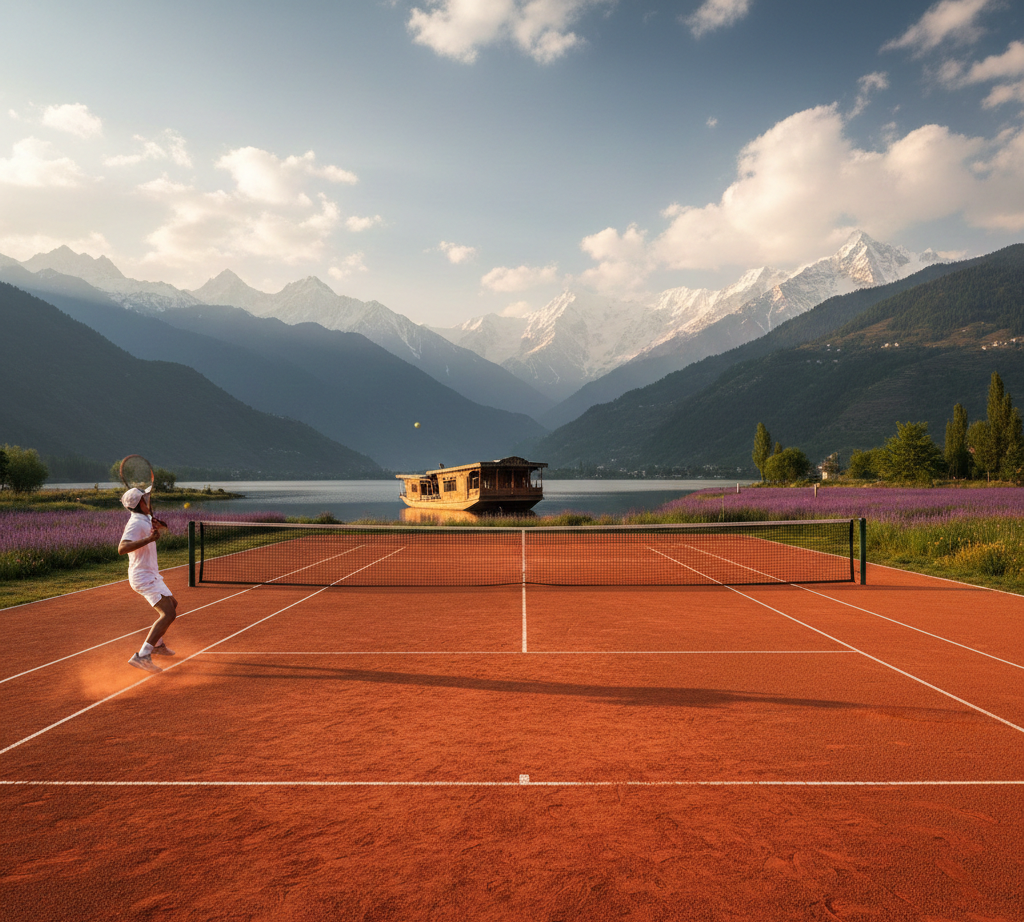
Jammu & Kashmir (J&K) is a union territory marked by dramatic topography: from the verdant valleys of Kashmir to the more temperate plains of Jammu. This varied terrain comes with a diverse climate — cold winters with occasional snow in higher altitudes, warm summers, and varying precipitation levels. These climatic conditions make the design and upkeep of sports infrastructure, including tennis courts, particularly challenging. When considering clay tennis courts in J&K, it’s essential to examine both the benefits and the constraints that this region poses.
Why Consider a Clay Tennis Court in J&K?
-
Playability and Comfort
-
Clay courts offer a softer playing surface, reducing stress on joints.
-
They provide a slower game with higher bounce, advantageous for skill-building and longer rallies.
-
-
Aesthetic Integration
-
The earthy color and texture of clay surfaces align well with the natural landscape of J&K, especially in rural or mountainous settings.
-
A clay court can blend more harmoniously into the valley environment than synthetic or hard surfaces.
-
-
Sustainability Potential
-
Local materials (like crushed brick or stone) may be used for the clay layer, potentially reducing transport costs.
-
If environmental practices are followed (e.g., sustainable brick production), clay can be a more eco‑friendly option. Notably, in J&K, there is an increasing push for eco-friendly brick kiln technologies.
-
-
Cost Considerations
-
While construction costs for clay courts may be moderate, the long-term maintenance cost is higher. In India, clay courts require consistent maintenance, which can strain budgets
-
However, for regions in J&K where other high‑tech sports surfaces are not easily accessible, clay may be one of the more feasible surfaces.
-
Key Challenges for Clay Courts in J&K
-
Water Management & Climate
-
Clay courts need regular watering to stay compact and playable. But in J&K, water management can be tricky: some regions may have limited water availability, especially outside the monsoon season.
-
During heavy precipitation (or snow melt), without good drainage, a clay court may get waterlogged or suffer damage.
-
-
Temperature Extremes
-
In colder months, especially in higher altitudes, frost or freezing can damage clay surfaces, disrupt line materials, and cause surface instability.
-
In summer, high temperatures may dry out the surface too much, making it dusty or causing cracks.
-
-
Maintenance Load
-
Clay courts require daily attention: watering, rolling, sweeping, and leveling.
-
Over time, clay may need replenishing and re-compaction.
-
-
Labor & Technical Skills
-
Constructing and maintaining a clay court demands expertise: laying a stable base, installing drainage, compacting layers, and leveling.
-
Local expertise in J&K for specialized tennis‑court construction (especially clay) may be limited.
-
-
Environmental Concerns
-
Extracting clay or crushed bricks from local sources could have ecological impacts if not done sustainably.
-
The region’s ecological sensitivity means any large-scale construction must be environmentally conscious.
-
Design & Construction Considerations for J&K
To build a robust clay tennis court in J&K, take into account the following:
-
Site Selection & Drainage
-
Choose a site with proper slope (~0.8–1%) to facilitate water runoff.
-
Include an effective sub-surface drainage system (like perforated pipes) to avoid accumulation of water during rain or snow melt.
-
-
Court Base
-
Build a stable base using compacted gravel or crushed stone.
-
Above the base, lay a prepared clay layer (crushed brick, shale, or stone) that is compacted properly for playability and durability.
-
-
Irrigation System
-
Use a sprinkler system (manual or automated) for regular watering.
-
In colder months, design the system so it can be drained or protected to avoid frost damage.
-
-
Surface Layer & Lines
-
Use high-quality crushed material for the top clay layer to ensure good play characteristics.
-
Lines can be made from canvas or synthetic strips — these are more stable on clay than painted lines and easier to maintain.
-
-
Seasonal Protection
-
Consider protective measures like temporary covers during off-season (e.g., a tarpaulin or netting) to guard against snow damage.
-
Remove or protect net posts and lines during heavy snow or frost to prevent structural damage.
-
-
Fencing & Windbreaks
-
Install fencing to contain balls and reduce clay loss.
-
Use windbreaks (trees, mesh) to minimize disruption from winds, which may be strong in valley regions.
-
Maintenance Strategy for a Clay Court in J&K
-
Daily: Water the court, sweep loose clay, roll lightly, and maintain the surface evenness.
-
Weekly: More thorough rolling, especially after heavy play or weather events.
-
Monthly: Check drainage systems, adjust the clay profile, and inspect for soft spots.
-
Seasonal:
-
Before monsoon or snow season: clear drains, re-level, and prepare surface for excess water.
-
After winter/snow: re-compact clay, repair any frost damage, and ensure lines are intact.
-
-
Annual: Replenish clay, roll deeply, and re-fix or replace wall lines if necessary.
Cost & Funding Considerations in J&K
-
While specific data for building a clay tennis court in J&K is scarce, general tennis court construction cost in India suggests a wide range depending on surface type and infrastructure.
-
Local sports bodies or the Jammu & Kashmir State Sports Council could be involved in funding or tenders. For instance, there was a tender for the construction of a tennis ground in Manigam, Kulgam, J&K.
-
Given the high-maintenance nature of clay courts, budgeting for ongoing maintenance (labor, water, clay) is critical.
Sustainability & Local Adaptation
-
Eco‑Friendly Clay Sources: Wherever possible, use locally available brick or shale to reduce transport emissions. However, ensure that brick kilns or clay sources operate sustainably. There is already growing awareness in J&K about eco-friendly brick‑kiln technology.Water Conservation: Harvest rainwater during rainy seasons to supply the irrigation system. This is especially useful in J&K, where water resources might vary regionally.
-
Community Involvement: Involve local players, schools, or clubs in court usage to justify maintenance costs and make the facility more sustainable.
-
Blending with Environment: Design ancillary structures (shade, seating, fencing) using local materials and architecture styles to maintain ecological and visual harmony.
Pros & Cons (Summary)
| Pros | Cons |
|---|---|
| Soft, joint‑friendly surface | High maintenance demand (water, labor) |
| Aesthetic fits natural landscape | Vulnerable to waterlogging, frost, and weather damage |
| Encourages tactical play & skill development | Long-term upkeep cost can be significant |
| Potentially use local materials | Need for expert labor and drainage infrastructure |
Conclusion
Building a clay tennis court in Jammu & Kashmir is a feasible but demanding undertaking. The region’s climatic diversity — from snowy winters to warm summers — means that good design, effective drainage, and a strong maintenance plan are essential. When done right, a clay court can offer a natural feel, aesthetic integration with the stunning landscape, and a highly playable surface.
To make such a project successful, stakeholders (clubs, sports councils, local government) need to weigh construction costs, long-term maintenance, water usage, and environmental impact. With thoughtful planning, community engagement, and sustainable resource use, a clay tennis court in J&K can become both a practical sports asset and a harmonious part of the local terrain.