At [sports-facility.in], we specialize in Clay Tennis Court Construction, delivering expertly crafted courts that combine classic elegance with modern engineering. Clay courts are celebrated for their slower ball speed, consistent bounce, and softer surface, offering a player-friendly experience that reduces joint strain. These qualities make them a favorite among professional athletes, tennis academies, sports clubs, and recreational enthusiasts alike.
Our mission is to design and construct clay courts that meet international standards of quality, safety, and performance. Whether it’s a private residence, sports academy, resort, or club, we provide custom-built clay courts that reflect precision, durability, and a deep understanding of the sport.
Why Choose Clay Tennis Courts?
Clay courts hold a prestigious place in the history of tennis. They are the preferred surface for many top-ranked players and professional tournaments, largely due to the strategic depth and technical control they offer. Unlike hard courts, clay surfaces slow the ball down, allowing longer rallies that emphasize precision, patience, and tactical play.
Key advantages of clay courts include:
-
Enhanced gameplay: The slower ball speed and higher bounce promote skillful, tactical play.
-
Player comfort: Soft, cushioned surfaces minimize stress on knees, ankles, and joints.
-
Durability: Properly constructed clay courts can last for decades with regular maintenance.
-
Eco-friendly: Natural materials like crushed brick or shale are non-toxic and environmentally sustainable.
-
Aesthetic appeal: Rich, earthy tones provide a professional, visually striking look.
By choosing a clay court, you’re investing in a surface that supports player development, longevity, and an authentic tennis experience.
Our Expertise in Clay Tennis Court Construction
At [sports-facility.in], we combine traditional techniques with modern construction methods to deliver superior clay courts. Our approach emphasizes meticulous planning, precision engineering, and the use of high-quality materials to ensure optimal performance and durability.
Key Features of Our Clay Courts
-
Precision Engineering: Every layer, from sub-base to top dressing, is installed to ensure smooth and uniform performance.
-
Advanced Drainage: Our systems prevent waterlogging, allowing courts to dry quickly after rainfall.
-
Consistent Bounce: Even surface texture guarantees predictable ball behavior, supporting tactical gameplay.
-
Player Comfort: Soft underfoot surfaces reduce fatigue and protect joints during long matches.
-
Natural Aesthetics: Elegant, earthy tones enhance the court’s visual appeal.
-
Eco-Conscious Materials: We prioritize sustainable materials for minimal environmental impact.
Types of Clay Tennis Courts
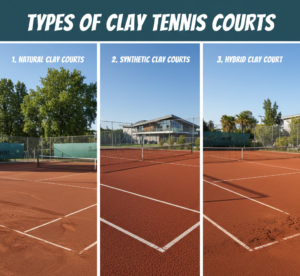
Depending on usage, maintenance requirements, and budget, we offer three primary types of clay courts:
1. Natural Clay Courts
Natural clay courts are traditionally constructed using crushed brick, shale, or other mineral aggregates. These courts provide excellent traction and an authentic playing experience, making them ideal for professional clubs and tournaments.
Benefits:
-
Superior control and ball response
-
Traditional European-style play surface
-
Preferred by professional players
2. Synthetic Clay Courts
Synthetic clay courts combine the aesthetics and playability of natural clay with reduced maintenance. These surfaces use specialized synthetic materials and infill to replicate the feel of authentic clay while requiring less water and upkeep.
Benefits:
-
Lower maintenance requirements
-
Consistent performance across seasons
-
Suitable for regions where natural clay upkeep is challenging
3. Hybrid Clay Courts
Hybrid courts blend natural and artificial materials to create a balanced surface that offers both consistent bounce and easier maintenance. These courts are ideal for indoor or outdoor settings, providing a versatile playing experience.
Benefits:
-
Durable and low-maintenance
-
Consistent ball behavior
-
Suitable for high-traffic areas
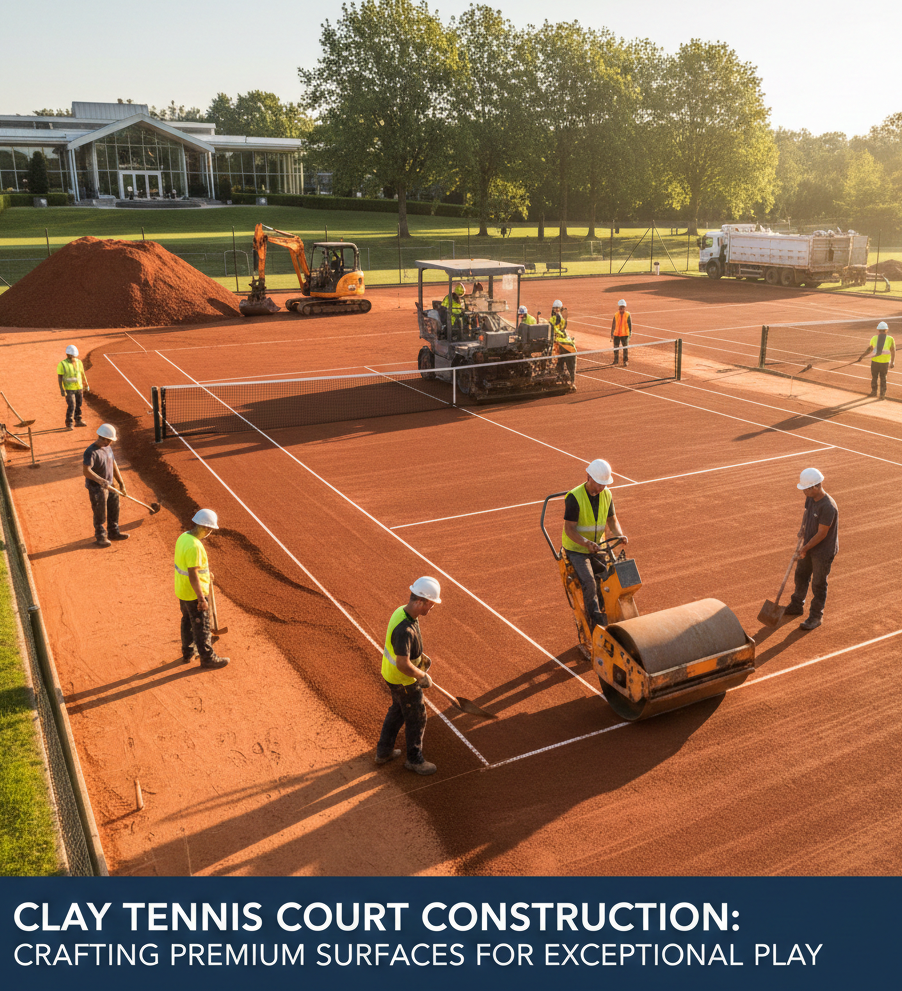
Our Clay Tennis Court Construction Process
Creating a clay tennis court requires expertise, precision, and attention to detail. Our process ensures long-lasting performance, safety, and a professional-grade finish:
-
Site Assessment & Design
We evaluate the location, soil type, and drainage conditions to design a customized layout that meets your playing requirements. -
Excavation & Base Formation
Proper excavation and sub-base compaction ensure structural stability and uniform surface height. -
Drainage System Installation
Subsurface drainage channels prevent water accumulation and protect the court from damage caused by heavy rain. -
Clay Layer Application
Multiple layers of crushed stone, brick powder, or clay aggregates are applied, leveled, and compacted to form a smooth playing surface. -
Surface Finishing & Line Marking
The court is rolled, leveled, and marked with weather-resistant lines for accurate play. -
Testing & Quality Assurance
Ball bounce, surface evenness, and overall playability are tested to ensure the court meets professional standards.
Advantages of Investing in a Clay Tennis Court
Constructing a clay tennis court offers numerous benefits for players, facility owners, and communities:
-
Enhanced Gameplay: Longer rallies and slower ball speed improve strategy and technique.
-
Player Safety: The soft surface reduces joint impact, lowering the risk of injuries.
-
Weather-Resistant: Proper drainage allows quick recovery after rainfall.
-
Environmentally Friendly: Natural materials support sustainable construction practices.
-
Cost-Effective Maintenance: With routine upkeep, clay courts maintain performance and durability for decades.
Applications of Clay Tennis Courts
Our clay court construction services cater to a wide range of clients and facilities:
-
Professional Tennis Academies: Ideal for player training and skill development.
-
Sports Clubs & Associations: Provides high-quality courts for competitive and recreational use.
-
Educational Institutions: Schools, colleges, and universities can enhance their sports infrastructure.
-
Residential Projects: Private villas and residential complexes benefit from premium recreational facilities.
-
Hospitality & Resorts: Adds value and leisure options for guests.
-
Government & Institutional Projects: Suitable for public sports infrastructure development.
Maintenance & Resurfacing Services
A clay court’s longevity and performance depend on proper maintenance. At [sports-facility.in], we offer comprehensive maintenance and resurfacing services, including:
-
Surface leveling and rolling
-
Adding or replacing top clay layers
-
Line marking and surface cleaning
-
Seasonal conditioning to optimize play quality
Regular maintenance ensures consistent ball bounce, smooth surface texture, and prolonged lifespan of your clay court.
Frequently Asked Questions (FAQ)
1. What is a clay tennis court?
A clay tennis court is a surface made from crushed stone, brick, shale, or clay, layered over a properly prepared base. It is known for slower ball speed, higher bounce, and reduced impact on players’ joints.
2. Why choose a clay tennis court over other surfaces?
Clay courts offer:
-
Better shock absorption and reduced injury risk
-
Longer rallies and improved footwork
-
Ideal training conditions for professional and amateur players
They are preferred in academies and premium sports facilities.
3. What are the standard dimensions of a clay tennis court?
The playing dimensions are the same as any standard tennis court:
-
Doubles: 78 ft × 36 ft
-
Singles: 78 ft × 27 ft
Additional run-off space around the court is required for safety.
4. How much does clay tennis court construction cost?
The cost varies based on base preparation, drainage, materials, and location. On average, clay tennis court construction ranges from ₹25 lakhs to ₹60+ lakhs.
5. How long does it take to construct a clay tennis court?
Construction typically takes 45 to 75 days, including excavation, base layers, drainage installation, clay surfacing, and curing.
6. Is proper drainage important for clay tennis courts?
Yes. Clay courts require excellent drainage systems to prevent water retention, surface damage, and uneven play conditions.
7. How much maintenance does a clay tennis court require?
Clay courts need regular maintenance, including:
-
Daily brushing and rolling
-
Periodic watering
-
Line adjustment and top-layer refilling
Proper maintenance ensures consistent play quality and surface longevity.
8. Can clay tennis courts be built indoors?
Yes. Indoor clay courts are possible and offer controlled playing conditions, reduced weather impact, and extended court life, though construction costs are higher.
9. Are clay tennis courts suitable for professional tournaments?
Yes. Clay courts are widely used in professional tournaments and are ideal for high-level training when built to international standards.
10. Is a clay tennis court a good long-term investment?
Yes. Despite higher maintenance, clay courts attract serious players, academies, and tournaments, making them a premium, long-term investment for sports facilities and clubs.