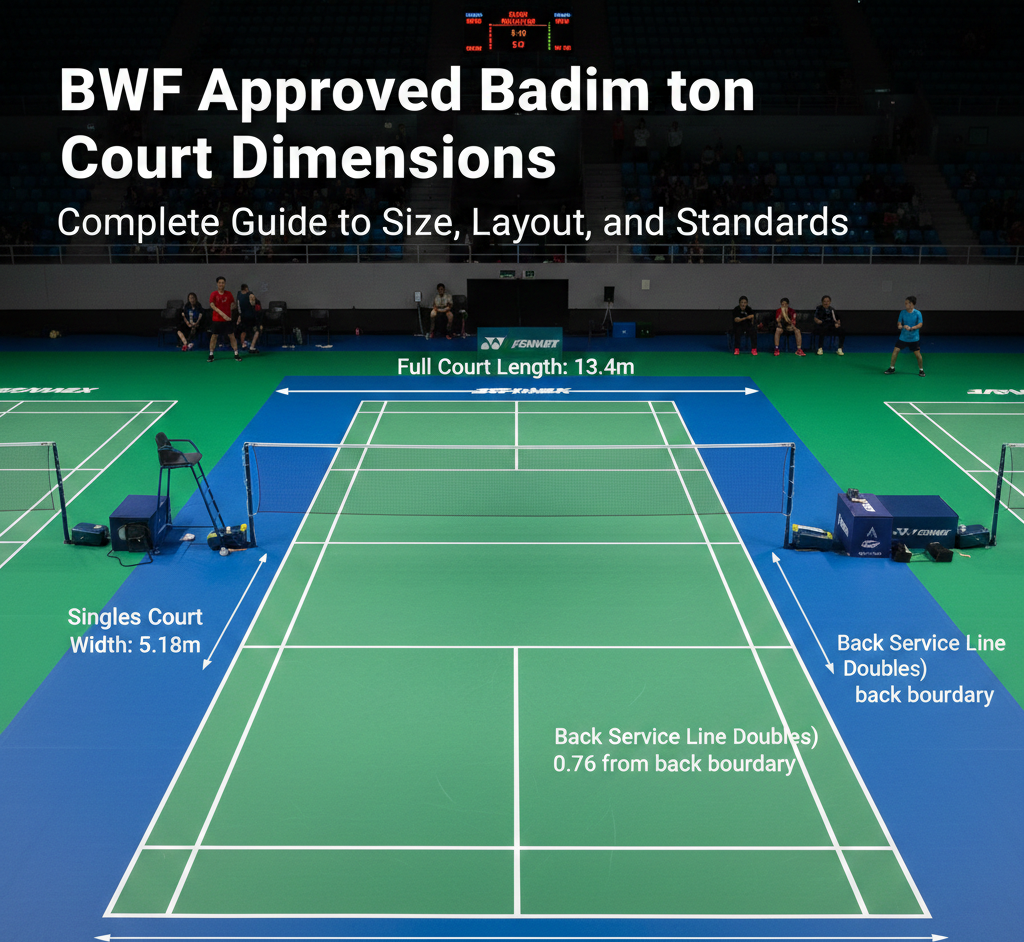
Badminton is a high-speed, precision-driven sport where even a few centimeters can influence the outcome of a rally. To maintain fairness, consistency, and safety across all levels of play, the Badminton World Federation (BWF) has defined strict guidelines for court dimensions, markings, and playing conditions.
Understanding BWF Approved Badminton Court Dimensions is essential for anyone involved in building, managing, or playing on a badminton court. Whether you are a sports infrastructure developer, academy owner, school administrator, or professional player, following these standards ensures that the court delivers an authentic and internationally accepted playing experience.
This detailed blog explains everything you need to know about BWF Approved Badminton Court Dimensions, including court size, markings, net height, flooring, lighting, and spatial requirements.
1. Why BWF Approved Badminton Court Dimensions Matter
A badminton court is not simply a rectangular floor with lines drawn on it. Every measurement is scientifically designed to balance speed, control, and player movement.
Using BWF Approved Badminton Court Dimensions ensures:
-
Equal playing conditions for singles and doubles matches
-
Accurate shuttle landing decisions
-
Proper player movement and safety
-
Compliance with national and international tournament requirements
-
Professional training conditions for athletes
Courts that do not follow BWF standards often result in inconsistent gameplay, safety risks, and disqualification from official competitions.
2. Official BWF Approved Badminton Court Size
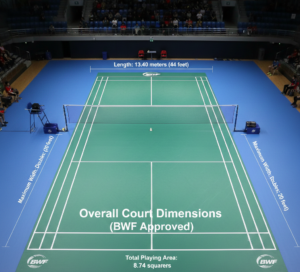
According to the Badminton World Federation, the standard badminton court dimensions remain the same worldwide.
Overall Court Dimensions (BWF Approved)
-
Length: 13.40 meters (44 feet)
-
Maximum Width (Doubles): 6.10 meters (20 feet)
-
Total Playing Area: 81.74 square meters
The length of the court remains constant for both singles and doubles, while the width varies depending on the match format.
3. Singles vs Doubles Court Dimensions (BWF Approved)
Singles Badminton Court Dimensions
-
Length: 13.40 meters (44 feet)
-
Width: 5.18 meters (17 feet)
In singles play, the court is narrower to emphasize speed, precision, and individual movement.
Doubles Badminton Court Dimensions
-
Length: 13.40 meters (44 feet)
-
Width: 6.10 meters (20 feet)
The wider court allows two players per side to cover the playing area effectively.
The difference between singles and doubles courts is defined entirely by line markings, not by changing the actual floor size.
4. BWF Approved Badminton Court Markings Explained
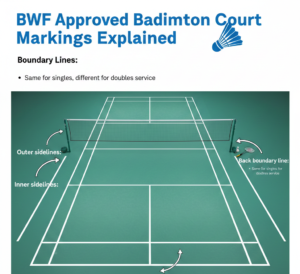
Court markings are one of the most critical aspects of BWF Approved Badminton Court Dimensions. Each line has a specific function and must be placed with absolute accuracy.
Boundary Lines
-
Outer sidelines: Used for doubles matches
-
Inner sidelines: Used for singles matches
-
Back boundary line: Same for singles, different for doubles service
All boundary lines are considered part of the playing area. If the shuttle touches the line, it is counted as “in.”
Service Court Lines
-
Short Service Line:
Located 1.98 meters (6.5 feet) from the net on both sides -
Long Service Line (Doubles):
Positioned 0.76 meters (2.5 feet) inside the back boundary line -
Long Service Line (Singles):
Same as the back boundary line -
Center Line:
Divides the left and right service courts
These lines control legal serves and rally starts, making precision absolutely essential.
5. Net Height and Net Specifications (BWF Standards)
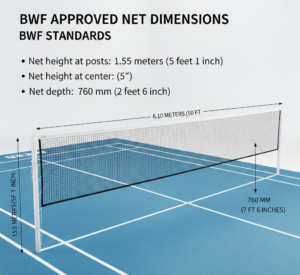
The net plays a central role in badminton and must strictly comply with BWF regulations.
BWF Approved Net Dimensions
-
Net height at posts: 1.55 meters (5 feet 1 inch)
-
Net height at center: 1.524 meters (5 feet)
-
Net length: 6.10 meters (20 feet)
-
Net depth: 760 mm (2 feet 6 inches)
The net must be made of fine, dark-colored mesh with a white tape of 75 mm across the top edge. It should be stretched firmly without sagging.
6. Minimum Clear Space and Ceiling Height
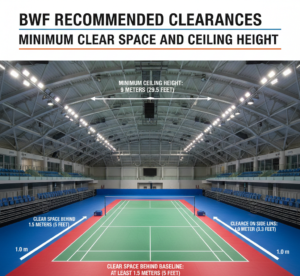
One of the most overlooked aspects of BWF Approved Badminton Court Dimensions is vertical and surrounding clearance.
BWF Recommended Clearances
-
Minimum ceiling height: 9 meters (29.5 feet)
-
Clear space behind baseline: At least 1.5 meters
-
Clear space on side lines: At least 1.0 meter
Adequate clearance ensures safe movement, unrestricted shuttle flight, and better viewing angles for officials and spectators.
7. Flooring Requirements for BWF Approved Badminton Courts
The playing surface has a major impact on speed, grip, and player safety. BWF does not mandate a single flooring type but specifies performance requirements.
BWF-Recommended Flooring Characteristics
-
Non-slip surface
-
Shock absorption for joint safety
-
Uniform texture and level finish
-
Durable under high-intensity play
Common BWF-Compatible Flooring Options
-
Wooden Sports Flooring: Traditional choice for international tournaments
-
PVC / Vinyl Badminton Flooring: Excellent cushioning and grip
-
PU (Polyurethane) Flooring: Seamless, durable, and low maintenance
-
Synthetic Acrylic Flooring: Suitable for budget indoor facilities
All flooring must have a matte finish to avoid glare.
8. Line Marking Specifications (BWF Approved)
Precision in line marking is non-negotiable for BWF compliance.
-
Line width: 40 mm (1.57 inches)
-
Color: White or yellow (must contrast with floor color)
-
Material: Durable paint or synthetic tape
Poor-quality or faded markings can lead to disputes and are unacceptable for competitive play.
9. Lighting Standards for BWF Approved Courts
Lighting significantly affects visibility and reaction time in badminton.
BWF Lighting Recommendations
-
Training courts: 500–750 lux
-
Competition courts: 1000–1500 lux
-
Uniformity ratio: Minimum 0.7
Lights should be positioned to avoid glare, shadows, and direct vision obstruction. LED lighting is now the preferred option due to energy efficiency and consistent illumination.
10. Ideal Hall Size for a Single Badminton Court
To fully comply with BWF Approved Badminton Court Dimensions, the total hall size must include clearance areas.
Recommended Hall Space (Single Court)
| Element | Measurement |
|---|---|
| Court Length | 13.40 m |
| Court Width | 6.10 m |
| Rear Clearance | 1.50 m |
| Side Clearance | 1.00 m |
| Ceiling Height | 9.00 m |
| Total Area Required | ~162 sq. m |
For multi-court halls, a minimum 2-meter gap between courts is recommended.
11. Equipment and Surrounding Area Standards
BWF also specifies guidelines for equipment placement and surroundings:
-
Net posts: Placed on doubles sidelines
-
Post height: 1.55 meters
-
Surroundings: Free from reflective surfaces
-
Background: Dark-colored walls or curtains for shuttle visibility
These elements enhance both player performance and officiating accuracy.
12. Indoor vs Outdoor Badminton Courts
While BWF Approved Badminton Court Dimensions apply primarily to indoor courts, outdoor courts may require adjustments.
Outdoor Court Considerations
-
Weather-resistant flooring
-
Enhanced drainage systems
-
Stronger lighting to counter sunlight
-
Wind protection where possible
Despite environmental adaptations, the core playing dimensions remain unchanged.
13. Conclusion: Why BWF Approved Badminton Court Dimensions Are Essential
Following BWF Approved Badminton Court Dimensions is the foundation of professional badminton infrastructure.
From court size and markings to flooring, lighting, and clearance, every specification plays a role in delivering a world-class badminton experience.
Frequently Asked Questions (FAQ)
1. What are the official BWF badminton court dimensions?
According to the Badminton World Federation (BWF):
-
Doubles court: 13.4 m (44 ft) × 6.1 m (20 ft)
-
Singles court: 13.4 m (44 ft) × 5.18 m (17 ft)
-
Net height: 1.55 m (5 ft 1 in) at the edges, 1.524 m (5 ft) at the center
2. What is the recommended clearance around a BWF court?
-
Side clearance: Minimum 2 m (6.5 ft)
-
Back clearance: Minimum 3 m (9.8 ft)
-
Height clearance: Minimum 9 m (29.5 ft) for international competitions
3. Can BWF court dimensions be used for recreational courts?
Yes. BWF-approved dimensions are ideal for professional or recreational use, but smaller spaces can use modified courts for practice or casual play.
4. What flooring is required for a BWF-approved court?
BWF-approved courts typically use:
-
PVC vinyl flooring: Shock-absorbing, slip-resistant, and widely used
-
Wooden flooring: Professional-grade, durable, suitable for tournaments
5. Are BWF dimensions different for indoor and outdoor courts?
The dimensions remain the same, but outdoor courts must account for weather-resistant flooring and proper drainage.
6. Can I build a BWF-approved badminton court in a school or academy?
Yes. Schools and academies often follow BWF standards to ensure proper training conditions and professional coaching environment.
7. How much space is required to build a BWF-approved court?
A single court requires approximately 62–65 sq. meters of playing area, but additional space is needed for seating, circulation, and safety.
8. Is lighting important for a BWF-approved court?
Yes. Uniform, glare-free LED lighting of 300–500 lux is recommended for recreational play, while professional tournaments may require 500–1000 lux.
9. How much does it cost to build a BWF-approved badminton court?
Costs vary based on flooring, indoor/outdoor setup, lighting, and location. On average:
-
Budget court: ₹3–5 lakhs
-
Professional-grade court: ₹6–15+ lakhs
10. Can a BWF-approved court be converted into multiple courts in one hall?
Yes. With careful planning, a hall can accommodate 2–4 courts while maintaining BWF clearance standards for side and back areas.