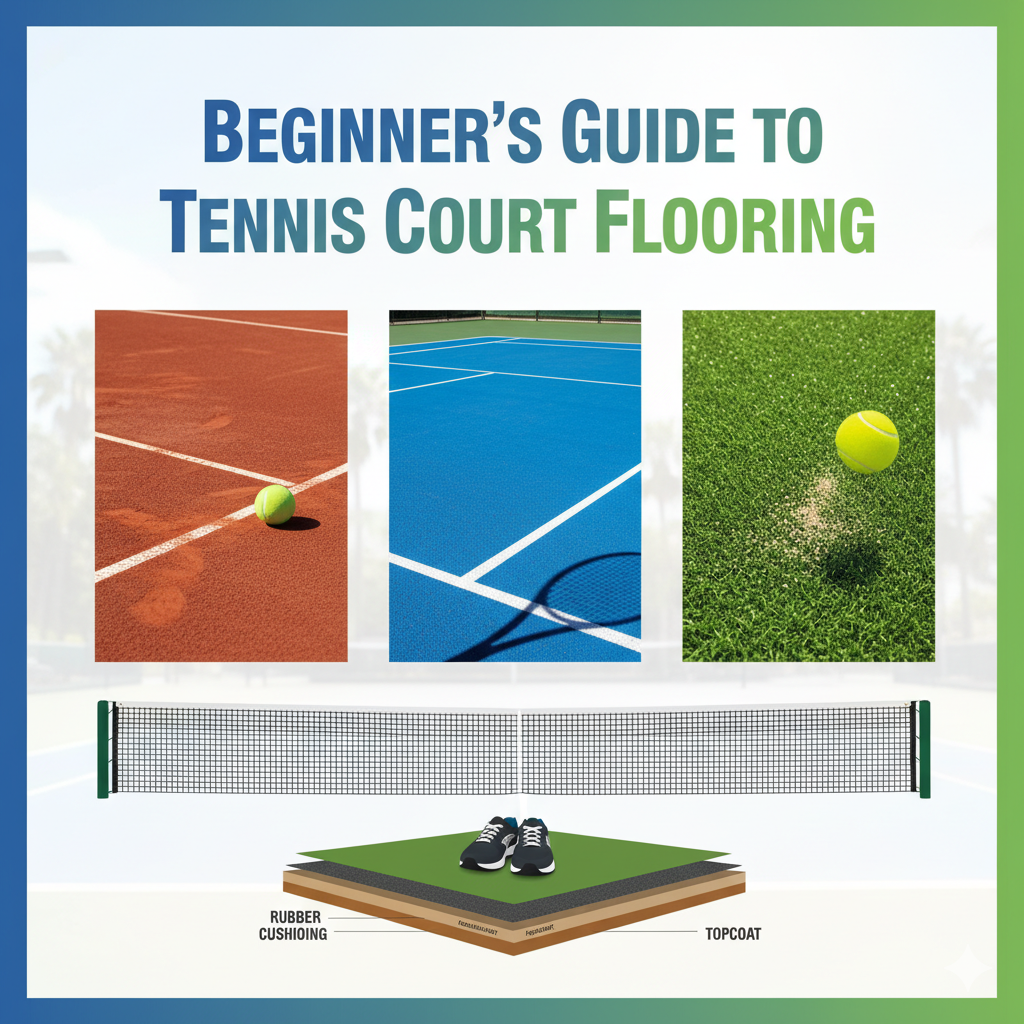
Building a tennis court is an exciting project — whether it’s for a school, sports academy, residential community, or private estate. But before a single ball is served, one crucial decision shapes everything that follows: choosing the right tennis court flooring.
If you’re new to tennis court construction, understanding the different flooring options, their materials, and their advantages is essential. The right surface can make all the difference between a court that wears out quickly and one that offers years of world-class performance.
In this beginner’s guide for tennis court flooring, we’ll walk you through everything you need to know — from court basics and flooring materials to professional tips on selection and maintenance.
1. Understanding Tennis Court Flooring Basics
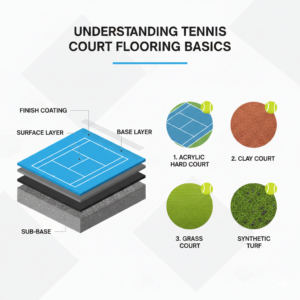
Every tennis court surface is built in layers — each with a specific role in ensuring stability, bounce consistency, and comfort. Generally, a tennis court consists of:
-
Sub-base – The foundation that provides structural stability (typically compacted soil, stone, or asphalt).
-
Base Layer – Ensures proper leveling and drainage.
-
Surface Layer – The visible playing surface, made from materials like acrylic, clay, or synthetic grass.
-
Finish Coating – Provides texture, color, and slip resistance.
The surface material determines how the ball bounces, how fast the game feels, and how comfortable it is for players’ joints. Let’s explore each type in detail.
2. Major Types of Tennis Court Flooring
When it comes to tennis court flooring materials, there are four main categories. Each offers a unique playing experience, cost structure, and maintenance level.
A. Acrylic Hard Courts
Overview:
Acrylic hard courts are the most popular choice worldwide for both professional and recreational use. Used in major tournaments like the US Open and Australian Open, this surface provides a balance between speed, control, and durability.
Construction:
Acrylic coatings are layered over an asphalt or concrete base. These layers can include cushioning systems for player comfort.
Advantages:
-
Excellent ball bounce and predictability
-
Suitable for both indoor and outdoor courts
-
UV- and weather-resistant
-
Low maintenance cost
-
Available in multiple colors and finishes
Disadvantages:
-
Slightly hard on joints if not cushioned
-
Requires a perfectly leveled sub-base
Ideal For:
Schools, clubs, residential complexes, and public sports parks.
B. Clay Courts
Overview:
Clay courts are the traditional European choice, most famously seen at the French Open (Roland Garros). They offer slower gameplay and higher bounce, making them ideal for baseline players who rely on strategy and stamina.
Construction:
Made from crushed brick, shale, or stone over a compacted base.
Advantages:
-
Soft on knees and joints
-
Encourages longer rallies and strategic play
-
Self-repairing surface (easily smoothed after play)
Disadvantages:
-
High maintenance (watering, rolling, and brushing)
-
Not suitable for wet climates
-
Slower play may not suit all players
Ideal For:
Training academies, professional players, and traditional tennis clubs.
C. Grass Courts
Overview:
Grass courts are the original tennis surface — elegant, fast-paced, and visually stunning. Known from Wimbledon, grass courts demand quick reflexes and strong serve-and-volley skills.
Construction:
A soil base covered with natural grass that needs continuous care and maintenance.
Advantages:
-
Fastest ball speed
-
Natural cushioning for player comfort
-
Luxurious and premium appearance
Disadvantages:
-
Extremely high maintenance (mowing, irrigation, and reseeding)
-
Weather-sensitive and slippery when wet
-
High installation cost
Ideal For:
Luxury sports resorts, elite clubs, and private facilities.
D. Synthetic Grass or Artificial Turf Courts
Overview:
Synthetic turf has become a modern, low-maintenance alternative to natural grass. It offers similar aesthetics with better durability and all-weather usability.
Construction:
Made from synthetic fibers filled with silica sand or rubber granules to simulate natural grass feel.
Advantages:
-
Weatherproof and durable
-
Lower upkeep than real grass
-
Comfortable and joint-friendly
-
Consistent bounce and traction
Disadvantages:
-
Bounce may differ slightly from natural grass
-
Periodic brushing needed to level infill
Ideal For:
Multi-sport complexes, schools, and residential facilities.
E. Polyurethane (PU) and Modular Surfaces
Overview:
Modern facilities often choose PU (Polyurethane) or modular interlocking tiles for indoor or semi-outdoor courts. These synthetic surfaces combine flexibility, comfort, and long-term resilience.
Advantages:
-
Excellent shock absorption
-
Non-slip and cushioned surface
-
Suitable for multiple sports
-
Easy to install and maintain
Disadvantages:
-
Slightly higher initial cost
-
Needs professional installation
Ideal For:
Indoor stadiums, multipurpose halls, and community centers.
3. Factors to Consider When Choosing Tennis Court Flooring
Selecting the perfect flooring depends on several important factors:
| Factor | What to Consider | Recommended Flooring |
|---|---|---|
| Budget | Initial cost and long-term maintenance | Acrylic or Synthetic Turf |
| Location | Indoor or Outdoor use | Acrylic (Outdoor) / PU (Indoor) |
| Climate | Hot, rainy, or humid regions | Synthetic Turf or Acrylic |
| Player Level | Beginners or Professionals | Clay (Training), Acrylic (Tournament) |
| Maintenance Ability | Time and resources for upkeep | Acrylic or PU flooring |
4. Tennis Court Flooring for Beginners – What to Choose?
If you’re setting up your first tennis court, consider these practical tips:
-
For beginners or schools: Acrylic flooring offers durability, consistent bounce, and minimal maintenance.
-
For coaching academies: Clay surfaces improve skill and endurance.
-
For premium residential projects: Synthetic turf combines beauty and comfort.
-
For indoor facilities: Polyurethane or modular tile systems offer safety and longevity.
Acrylic flooring remains the most balanced option — it’s durable, cost-effective, and performs well in almost all weather conditions.
5. Maintenance Tips for Long-Lasting Performance
Regardless of the flooring type, proper maintenance ensures your court remains safe and functional for years.
-
Clean debris and leaves regularly.
-
Repaint acrylic layers every 5–7 years for color and grip.
-
Check for water drainage issues after heavy rains.
-
Brush and level clay or synthetic turf surfaces regularly.
-
Schedule annual inspections with a professional sports flooring contractor.
A well-maintained court not only enhances performance but also reduces long-term repair costs.
6. Professional Installation Matters
Even the best material can underperform if not installed correctly. Professional tennis court builders ensure:
-
Accurate slope and drainage system
-
Proper surface layering and curing
-
Correct marking and finishing
-
Use of ITF-approved materials
Partnering with an experienced sports flooring company guarantees your court meets international standards for safety and performance.
Conclusion
Choosing the right tennis court flooring is the foundation of a great playing experience. Each surface — from acrylic and clay to grass and synthetic turf — offers unique characteristics suited for different levels, budgets, and environments.