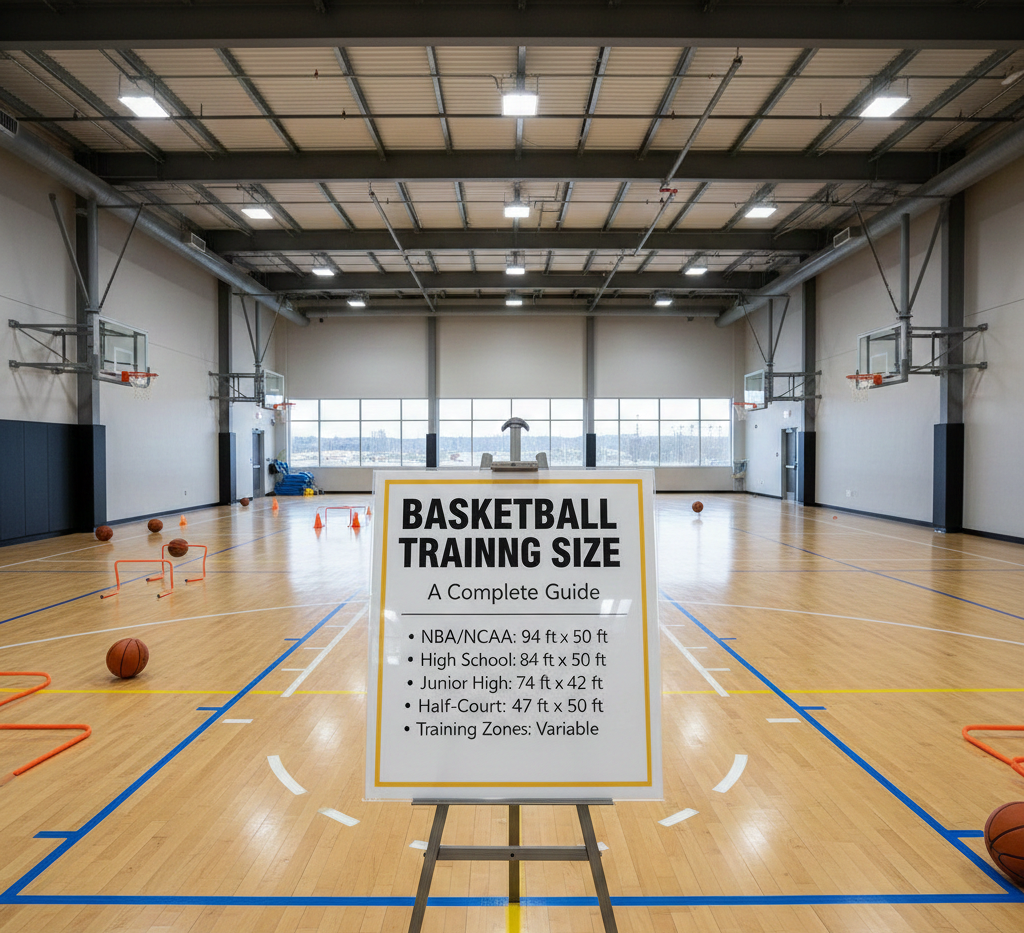
Basketball training courts are specialized spaces designed to help players improve skills, practice drills, and develop game strategies in a controlled environment. Unlike competitive courts, training courts may vary in size depending on the available space, intended use, and level of players. However, they must still provide enough area for effective practice, safety, and player movement. This guide covers the ideal dimensions, layout, and design considerations for basketball training courts.
Purpose of a Basketball Training Court
A basketball training court is primarily used for:
-
Skill development (shooting, dribbling, passing)
-
Conditioning and agility drills
-
Team practice sessions
-
Individual player improvement
Training courts allow athletes to focus on technique and repetition without the constraints of a full-sized competition court, making them essential in schools, sports academies, and professional training facilities.
Standard Dimensions for Training Courts
Training courts are typically smaller than full-sized professional courts to accommodate indoor spaces, gyms, or multipurpose facilities. Recommended dimensions include:
-
Length: 20–28 meters (65–92 feet)
-
Width: 10–15 meters (33–49 feet)
For youth training or space-limited facilities, courts can be slightly smaller, while still maintaining proportionate markings for key areas.
Key Areas and Measurements
1. The Key / Restricted Area
The key, or paint area, is essential for practicing free throws, layups, and post moves.
-
Width: 4–4.9 meters (13–16 feet)
-
Length from baseline to free-throw line: 5.8 meters (19 feet)
Scaling this area proportionally ensures players can develop close-range shooting and defensive skills effectively.
2. Free-Throw Line
-
Distance from baseline: 5.8 meters (19 feet)
-
Line Width: 10–15 cm (4–6 inches)
Free-throw practice is a core part of training, and clearly marked lines are necessary for accurate shooting drills.
3. Three-Point Line
For training purposes, the three-point line can either replicate standard competition distances or be slightly reduced for youth and beginner players:
-
FIBA standard distance: 6.75 meters (22 feet 1.7 inches)
-
NBA standard distance: 7.24 meters (23 feet 9 inches) at the top, 6.7 meters (22 feet) in corners
Adjusting the line allows players to gradually develop long-range shooting skills.
4. Basket and Backboard Placement
-
Basket Height: 3.05 meters (10 feet)
-
Backboard Width: 1.8 meters (6 feet)
-
Backboard Height: 1.05 meters (3.5 feet)
-
Distance from baseline to backboard: 1.2 meters (4 feet)
Proper basket placement ensures realistic shooting practice and helps players adjust to regulation gameplay.
5. Additional Court Features
-
Center Circle: 3.6 meters (12 feet) diameter for jump balls or warm-up drills
-
Sidelines and Baselines: Clearly defined for accurate movement and spacing drills
-
No-Charge Arc: 1.25 meters (4 feet) radius under the basket for defensive practice
Clearly marked zones improve training efficiency and help players focus on positioning, footwork, and tactical awareness.
Flooring and Surface Considerations
The flooring of a training court is crucial for player safety and performance:
-
Indoor options: Hardwood or synthetic sports flooring
-
Outdoor options: Polyurethane, modular sports tiles, or concrete with a smooth finish
-
Surface features: Non-slip coating, shock absorption, and durability
A high-quality surface reduces the risk of injuries and allows players to train intensively without compromise.
Benefits of a Dedicated Training Court
-
Skill Development: Focused environment for improving individual and team abilities.
-
Safety: Proper court size and surface reduce injury risks.
-
Adaptable Space: Courts can be scaled for different age groups or skill levels.
-
Enhanced Performance: Provides players with realistic practice conditions similar to official games.
Frequently Asked Questions (FAQ) – Basketball Training Court Size
1. What is a basketball training court?
A basketball training court is a practice area designed for drills, skill development, and team practice sessions. It can be a full-size or half-size court depending on available space and training needs.
2. What is the standard size of a basketball training court?
Training court sizes can vary, but a common standard for practice courts is half-court dimensions or a slightly smaller full court. A half court typically measures around 14m x 15m (46ft x 49ft) depending on layout and available space.
3. Can a training court be smaller than a standard court?
Yes, training courts can be customized based on space. Coaches often use smaller courts for specific drills, shooting practice, and fitness training.
4. What is the ideal court size for basketball training academies?
Basketball academies often use full-size courts (28m x 15m) or half courts, depending on the number of players and training programs. Full-size courts are best for game simulation and official practice.
5. How much space is needed for a training court including safety zones?
A training court should have at least 2m (6.5 ft) clearance around the court for player safety, referees, and benches.
6. Can I build a training court indoors and outdoors?
Yes. Training courts can be constructed both indoors and outdoors using suitable flooring materials such as synthetic acrylic, rubber, PU, or wooden flooring.
7. What flooring is best for a basketball training court?
Common flooring options include:
-
Synthetic acrylic flooring
-
PU flooring
-
Rubber flooring
-
Wooden sports flooring
Choose flooring based on usage, budget, and indoor/outdoor requirements.
8. Do you provide court markings and line painting for training courts?
Yes, we offer professional line marking and court layout services for training courts, including half-court and full-court designs.
9. Can a training court be converted into a competition court later?
Yes, training courts can be upgraded to competition standards by expanding court size, improving flooring, and adding proper markings and equipment.
10. How do I get a basketball training court size plan?
Contact us with your space dimensions and training requirements. Our team will provide a customized court layout and size plan for your facility.
Conclusion
A well-designed basketball training court is more than just a playing area—it is a controlled environment for developing skills, improving performance, and preparing athletes for competitive play. By following recommended dimensions, proper markings, and suitable flooring, training courts offer an effective and safe space for players of all levels. Whether for schools, sports academies, or professional training facilities, investing in a properly sized training court ensures long-term development and a high-quality basketball experience.