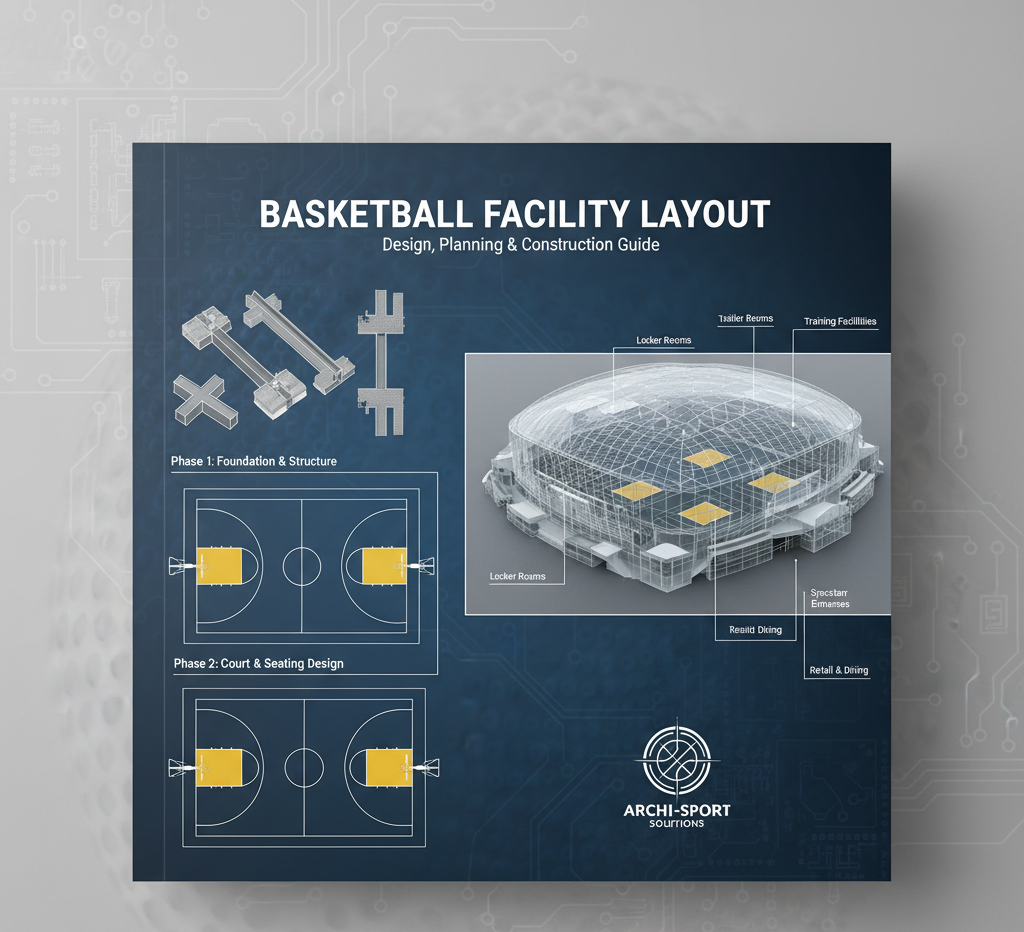
A well-designed basketball facility layout is the backbone of any successful sports infrastructure project. Whether you are planning an indoor basketball arena, school sports hall, college gymnasium, training academy, or a multi-sport recreation complex, thoughtful layout planning directly impacts player performance, safety, spectator experience, and long-term operational efficiency.
This Basketball Facility Layout: Design, Planning & Construction Guide provides a comprehensive overview of court dimensions, zoning, flooring options, lighting, ventilation, and modern construction practices—helping facility owners, architects, and sports administrators build high-performance basketball environments that meet international standards.
Importance of Basketball Facility Layout Planning
A basketball facility is more than just a playing court. Poor layout planning can lead to:
-
Player safety risks
-
Inadequate circulation and congestion
-
Substandard lighting and visibility
-
Reduced flooring lifespan
-
Inefficient use of space
A professionally planned basketball facility layout ensures:
-
Compliance with FIBA or NBA standards
-
Safe run-off areas around the court
-
Smooth movement for players, officials, and spectators
-
Optimal lighting, acoustics, and ventilation
-
Flexibility for future upgrades or multi-sport use
Standard Basketball Court Dimensions
Accurate court dimensions are the foundation of any basketball facility layout. According to FIBA (International Basketball Federation) standards:
-
Court Length: 28 meters (91.86 feet)
-
Court Width: 15 meters (49.21 feet)
-
Free-Throw Line Distance: 4.6 meters (15 feet) from the backboard
-
Three-Point Line:
-
FIBA: 6.75 meters (22.15 feet)
-
NBA: 7.24 meters (23.75 feet)
-
-
Key (Paint Area): 4.9 meters wide × 5.8 meters long
-
Basket Height: 3.05 meters (10 feet)
-
Backboard Size: 1.8 m × 1.05 m
For schools, training centers, and community courts, dimensions can be scaled proportionally while maintaining correct play geometry.
Key Zones in a Basketball Facility Layout
A complete basketball facility layout integrates multiple functional zones beyond the playing surface.
1. Playing Court Area
The court is the focal point of the facility. It must be:
-
Precisely marked with regulation lines
-
Finished with a non-slip sports surface
-
Surrounded by adequate safety clearance
Recommended run-off space:
Minimum 2 meters on all sides; professional arenas often provide 3–5 meters.
2. Player, Coach & Officials Zone
This area runs along the sidelines and includes:
-
Team benches
-
Scorer’s table
-
Technical officials’ seating
Proper spacing ensures unobstructed play and smooth match operations.
3. Spectator Seating & Viewing Area
Spectator zones vary depending on facility type:
-
Schools & clubs: 100–500 seats
-
Professional arenas: 1,000–5,000+ seats
Design considerations include:
-
Clear sightlines without visual obstructions
-
Anti-slip stairways and railings
-
Emergency exits and evacuation routes
-
Barrier-free access for differently abled spectators
4. Locker Rooms & Support Facilities
A professional basketball facility layout includes:
-
Separate locker rooms for home and visiting teams
-
Showers and restrooms
-
Referee rooms
-
First-aid and physiotherapy zones
These spaces enhance player comfort and support competitive-level events.
5. Storage & Equipment Rooms
Dedicated storage areas are essential for:
-
Basketballs and training equipment
-
Portable hoops and nets
-
Cleaning and maintenance tools
Proper storage improves organization and prolongs equipment life.
6. Lighting & Electrical Layout
Lighting design is critical for visibility, safety, and broadcast quality.
Recommended illumination levels:
-
Training & schools: 300–500 lux
-
Competitive play: 500–750 lux
-
Televised events: 1000+ lux
Best practices:
-
Use LED sports lighting
-
Ensure uniform light distribution
-
Avoid glare and shadow zones
-
Mount fixtures strategically above playing areas
7. Ventilation & HVAC Systems (Indoor Facilities)
Indoor basketball facilities require controlled air circulation to ensure:
-
Player comfort
-
Moisture control
-
Flooring longevity
Ideal conditions include:
-
Balanced air flow
-
Relative humidity between 40–60%
-
Temperature regulation suited to physical activity
Basketball Facility Flooring Options
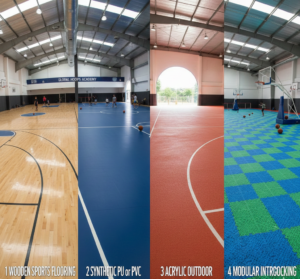
Flooring is one of the most critical elements in basketball facility construction, directly affecting performance and safety.
1. Wooden Sports Flooring (Maple or Teak)
-
Preferred for professional indoor courts
-
Excellent shock absorption and ball bounce
-
Premium aesthetics
-
Requires periodic maintenance
Widely used in international and competitive arenas.
2. Synthetic PU or PVC Flooring
-
Durable and anti-skid
-
Cost-effective solution
-
Easy maintenance
-
Suitable for schools and multi-purpose halls
Offers consistent performance across different sports.
3. Acrylic Outdoor Flooring
-
UV-resistant and weatherproof
-
Seamless finish
-
Vibrant court colors and line markings
-
Ideal for outdoor courts and training areas
4. Modular Interlocking Sports Tiles
-
Quick installation
-
Excellent drainage
-
Shock-absorbing base
-
Suitable for rooftops, temporary courts, and multi-use areas
Functional Design Considerations
To achieve a high-performance basketball facility layout, the following principles must be applied:
Player Safety
-
Non-slip flooring
-
Adequate shock absorption
-
Clear safety zones around the court
Visibility & Line of Sight
-
Uninterrupted viewing angles for spectators and cameras
Acoustic Design
-
Sound-absorbing materials for indoor arenas
-
Reduced echo to improve communication
Lighting Optimization
-
Uniform brightness
-
No glare on the court surface
Outdoor Drainage
-
Court slope of approximately 1% for water runoff
Accessibility
-
Inclusive design for players and spectators of all abilities
Basketball Facility Layout Examples
Single Indoor Basketball Facility
-
1 regulation-size court
-
Seating for 200+ spectators
-
2 locker rooms
-
Storage and administrative areas
Multi-Sport Indoor Complex
-
2–3 basketball courts with movable dividers
-
Shared lighting and acoustic ceiling
-
Multi-line markings for volleyball and badminton
Outdoor Community Basketball Facility
-
Acrylic or modular flooring
-
LED lighting poles
-
Chain-link fencing
-
Branding and sponsorship panels
Sustainability in Basketball Facility Design
Modern basketball facilities increasingly focus on sustainability and energy efficiency.
Key green practices include:
-
LED lighting to reduce energy consumption
-
Rainwater harvesting and reuse
-
Recyclable flooring materials
-
Energy-efficient HVAC systems
Eco-friendly design not only benefits the environment but also significantly reduces long-term operational costs.
Why Choose Sports-Facility.in for Basketball Facility Construction
As a leading sports infrastructure company in India, Sports-Facility.in delivers turnkey basketball facility solutions—from concept to completion.
Our Expertise Includes:
-
FIBA-standard basketball facility layout design
-
2D and 3D court planning
-
High-performance sports flooring systems
-
Lighting, drainage, and fencing solutions
-
Custom branding and color schemes
-
Nationwide installation and after-sales support
We combine technical expertise, premium materials, and industry best practices to create basketball facilities that perform at the highest level.
Frequently Asked Questions (FAQ) – Basketball Facility Layout
1. What is a basketball facility layout?
A basketball facility layout is a detailed plan showing the court placement, seating areas, safety zones, entry/exit points, and equipment arrangement for a sports complex or gym.
2. Why is a proper basketball facility layout important?
A well-designed layout ensures player safety, proper court dimensions, smooth movement of spectators, and efficient use of space. It also helps in meeting regulation standards for tournaments and competitions.
3. What are the standard basketball court dimensions?
A standard basketball court measures 28 meters (91.86 ft) in length and 15 meters (49.21 ft) in width for international play (FIBA). NBA courts are slightly different in size.
4. What is the required clearance around a basketball court?
The recommended clearance around the court is at least 2 meters (6.5 ft) on all sides to ensure player safety and space for referees and benches.
5. How much space is needed for a basketball facility?
A full basketball facility typically needs at least 34m x 19m including the court, safety zones, and some seating. This may vary based on seating capacity and additional amenities.
6. Can you design a basketball facility layout for small spaces?
Yes. We can customize layouts for smaller spaces by optimizing court size, seating, and safety zones while still maintaining essential regulations and player safety.
7. What factors are considered in basketball facility layout planning?
Key factors include:
-
Court dimensions and orientation
-
Player and spectator safety
-
Lighting and ventilation
-
Seating and access points
-
Flooring type and drainage (for outdoor courts)
-
Storage and equipment placement
8. Do you provide layout designs for both indoor and outdoor courts?
Yes, we offer layout designs for both indoor and outdoor basketball facilities, including court markings, flooring recommendations, and overall facility planning.
9. Can the layout be customized for schools and clubs?
Absolutely. We provide customized basketball facility layouts based on the client’s space, budget, and usage requirements such as training, competitions, or recreational play.
10. How do I get a basketball facility layout plan?
You can contact us with your space dimensions and requirements. Our team will provide a detailed layout plan and recommendations for court construction and installation.
Conclusion
A professionally planned Basketball Facility Layout: Design, Planning & Construction Guide is essential for creating a safe, durable, and high-performance sports environment. From accurate court dimensions and flooring selection to lighting, ventilation, and spectator planning, every detail contributes to the overall success of the facility.