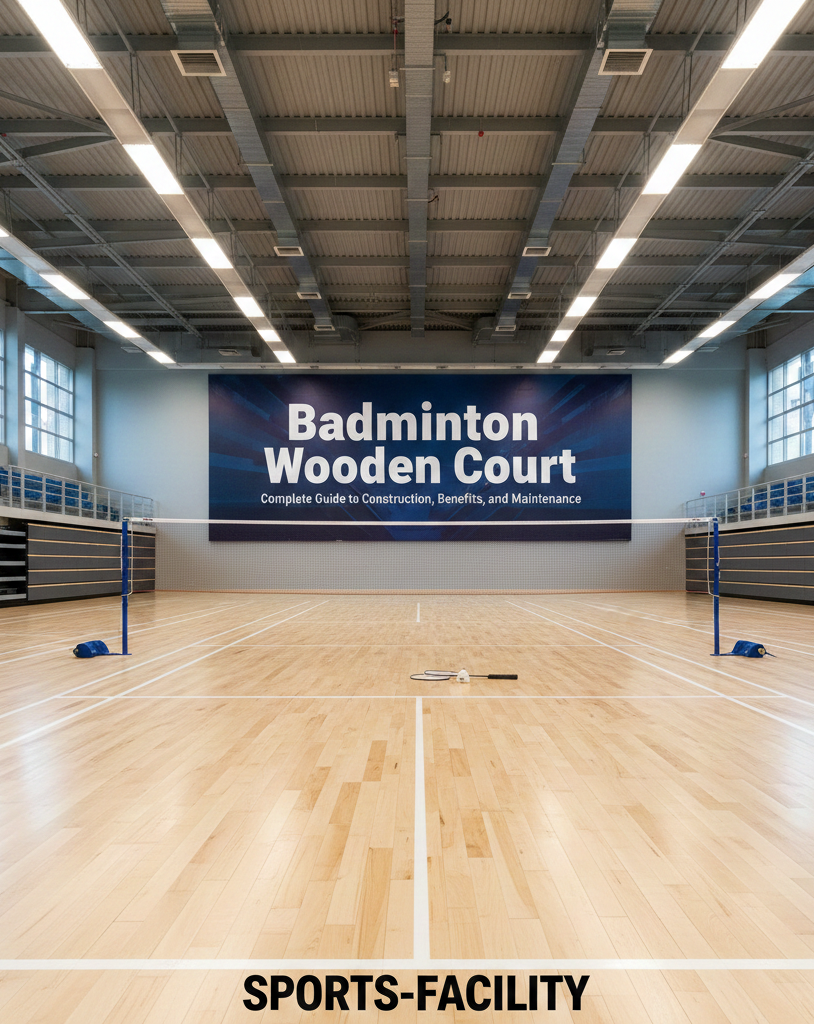
Badminton is one of India’s fastest-growing indoor sports, widely played in schools, sports clubs, residential complexes, and professional academies. While there are multiple flooring options available, the wooden badminton court remains the gold standard for professional and competitive play.
A well-constructed wooden court provides players with a consistent bounce, superior grip, and excellent shock absorption, all of which are crucial for fast rallies, sudden directional changes, and high-speed footwork. Recognized by the Badminton World Federation (BWF), wooden flooring is preferred in tournaments and professional arenas for its durability, comfort, and performance reliability.
This comprehensive guide covers everything you need to know about badminton wooden courts — from construction and materials to types, benefits, pricing, and maintenance tips.
What is a Badminton Wooden Court?
A badminton wooden court is a specialized sports flooring system made from high-quality hardwood planks, most commonly Maple, Teak, or Beech. These planks are installed over a resilient understructure designed to absorb shock and provide a balanced level of flexibility.
Key Features of Wooden Badminton Courts
-
Consistent Bounce: The natural elasticity of hardwood ensures uniform shuttle bounce.
-
Superior Grip: The PU-finished surface provides perfect friction for quick footwork.
-
Shock Absorption: Reduces stress on knees, ankles, and joints.
-
Durability: Properly installed courts last more than a decade.
-
Aesthetic Appeal: Offers a premium look with polished wooden surfaces.
The surface is coated with polyurethane (PU) finish, which not only enhances aesthetics but also ensures anti-slip performance and long-lasting protection.
Structure of Wooden Badminton Court Flooring
A professional wooden badminton court consists of multiple layers, each serving a specific purpose for performance and safety:
-
Concrete Base: A level, moisture-free RCC foundation provides stability.
-
Polythene Moisture Barrier: Prevents moisture transfer from the base to the wooden structure.
-
Resilient Underframe / Air Cushion System: Made from pinewood sleepers or rubber pads, providing flexibility and shock absorption.
-
Hardwood Surface Layer: High-quality Maple or Teak wood planks (typically 18–22mm thick) installed and fastened with precision.
-
Sanding & PU Finish: Sanding ensures a smooth surface, followed by PU coating for durability, friction control, and shine.
This layered system guarantees player safety, comfort, and long-lasting performance, making it ideal for both recreational and professional badminton.
Types of Wooden Flooring for Badminton Courts
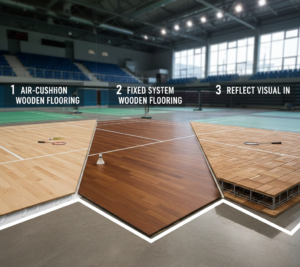
There are primarily two types of wooden flooring systems used in badminton court construction:
1. Air-Cushion Wooden Flooring
-
Includes rubber or foam padding beneath the wood surface.
-
Provides superior shock absorption and joint protection.
-
Ideal for professional academies and sports complexes.
Key Features:
-
Exceptional shock absorption
-
Comfortable and resilient surface
-
Long lifespan (10–15 years)
-
Professional-grade performance
2. Fixed System Wooden Flooring
-
Traditional wooden flooring fixed directly over sleepers on the base.
-
Cost-effective and suitable for schools, residential clubs, and multi-purpose halls.
Key Features:
-
Economical installation
-
Stable and long-lasting
-
Moderate shock absorption
-
Suitable for multi-purpose use
Features of a High-Quality Badminton Wooden Court
A BWF-approved wooden badminton court should meet the following standards:
-
Anti-Slip Surface Finish for player safety
-
Superior Shock Absorption and Comfort
-
Consistent Bounce and Grip
-
Moisture and Termite Resistance with proper treatment
-
Easy Maintenance and Longevity
-
Visually Aesthetic PU Finish
-
Durable Hardwood Material for weather stability
These features make wooden flooring the preferred choice for professional tournaments worldwide.
Advantages of Wooden Flooring for Badminton Courts
1. Excellent Shock Absorption
The natural elasticity of wood cushions the impact on knees, ankles, and joints, reducing the risk of injuries during rapid movements and jumps.
2. Optimal Grip and Control
The PU-coated surface provides the perfect balance between glide and friction, allowing players to execute swift footwork without slipping.
3. Natural Elasticity and Comfort
Wood flexes slightly under impact, giving players a soft, responsive feel that enhances overall playability compared to synthetic surfaces.
4. Long Durability
With proper care and maintenance, wooden badminton courts can last over 15 years, making them a long-term investment.
5. Aesthetic Appeal
The polished wooden surface offers a premium visual appeal, elevating the look of indoor sports arenas.
6. BWF-Approved Standards
Wooden courts meet international tournament standards, ensuring consistent performance and professional compliance.
Badminton Wooden Court Construction Process
Constructing a professional wooden court requires precision, expertise, and adherence to standards.
Step 1: Site Preparation
-
Level the concrete base
-
Ensure moisture-free RCC foundation
-
Install polythene moisture barrier
Installing Resilient Underframe
-
Use pinewood sleepers or rubber pads for shock absorption
-
Ensure uniform spacing for consistent bounce
Hardwood Surface Layer
-
Install premium Maple, Teak, or Beech planks
-
Ensure precise alignment and nailing for stability
Sanding and PU Finish
-
Sand the surface for smoothness
-
Apply polyurethane coating for durability, anti-slip grip, and shine
Court Marking
-
Use BWF-compliant paint for service lines and boundaries
-
Ensure high visibility and proper thickness for long-term use
Dimensions of a Standard Badminton Wooden Court
According to BWF standards:
-
Length: 13.40 meters (44 feet)
-
Width (Singles): 5.18 meters (17 feet)
-
Width (Doubles): 6.10 meters (20 feet)
-
Net Height: 1.55 meters (5 feet 1 inch)
Proper dimensioning and markings are crucial for professional-level play.
Badminton Wooden Court Flooring Price in India (2025)
Pricing depends on wood type, underframe system, and finish quality:
| Wood Type | Approximate Cost (Per Court) | Usage Level |
|---|---|---|
| Indian Teak Wood | ₹6.5 – ₹7.5 lakh | Schools & clubs |
| Maple Wood (Imported) | ₹8.5 – ₹9.5 lakh | Professional academies |
| Beech Wood | ₹7.0 – ₹8.0 lakh | Multi-purpose halls |
Note: Prices include supply, installation, and line marking. Costs may vary based on site conditions and additional requirements.
Maintenance Tips for Wooden Badminton Courts
Proper maintenance ensures longevity and consistent performance:
-
Clean daily using a dry mop; avoid wet mopping
-
Maintain humidity levels between 40–60%
-
Re-polish every 3–5 years
-
Restrict footwear to non-marking badminton shoes
-
Regularly inspect for loose boards or nails
With proper care, wooden courts can remain premium and functional for over a decade.
Applications of Wooden Sports Flooring
Wooden flooring is not limited to badminton. It is versatile and used in:
-
Basketball courts
-
Volleyball courts
-
Multi-purpose indoor arenas
-
Gymnasiums and fitness centers
-
Dance and yoga studios
This versatility makes wooden flooring a long-term investment in sports infrastructure.
Why Choose Us for Wooden Badminton Court Construction
As a trusted sports infrastructure company in India, we specialize in BWF-compliant wooden badminton courts.
Our Expertise
-
100+ courts constructed across India
-
BWF-approved wooden systems
-
Use of premium Maple and Teak wood
-
Expert design, installation, and PU finishing
-
Custom solutions for schools, academies, and stadiums
-
Timely project delivery with quality assurance
Conclusion
A badminton wooden court is more than a playing surface—it is an investment in performance, safety, and aesthetics.
-
Offers superior shock absorption
-
Ensures consistent bounce and grip
-
Provides long-term durability and premium look
-
Complies with BWF standards for competitive play