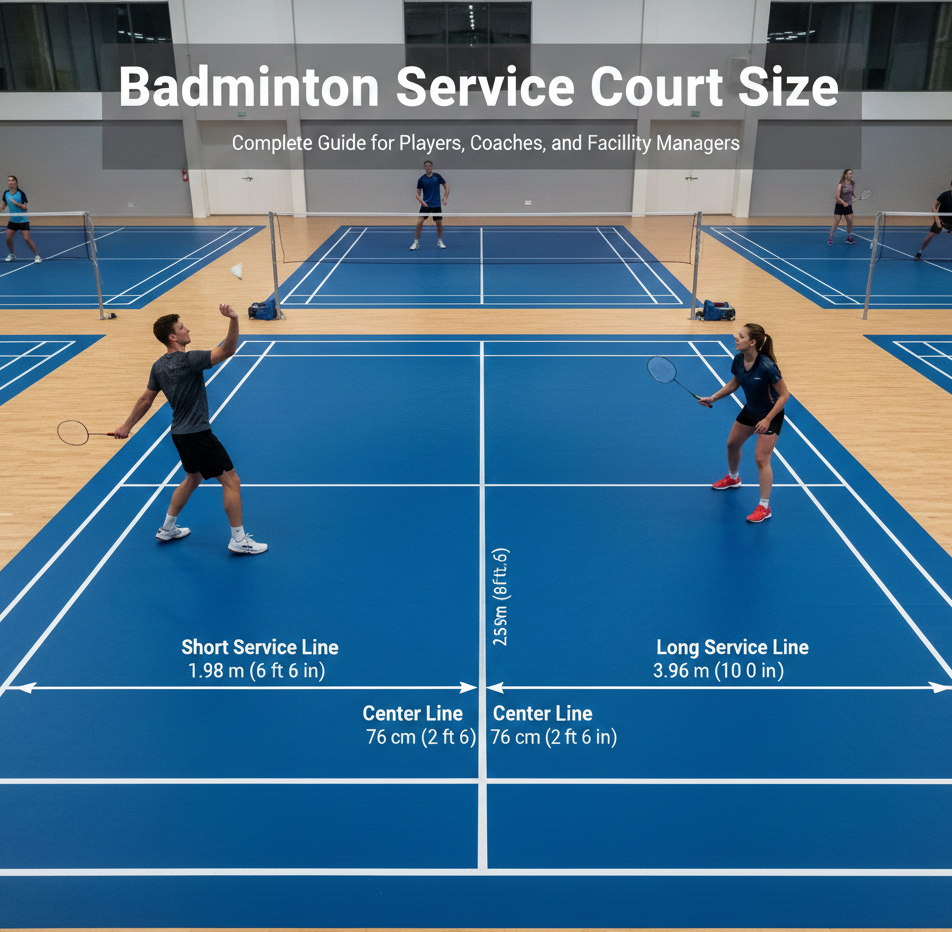
Badminton is a fast-paced, strategic sport where precision and timing can determine the outcome of a match. Among the many technical aspects of the game, the service court size is one of the most crucial. Understanding the dimensions, rules, and proper usage of the service court is essential for players, coaches, referees, and sports facility managers. Accurate service court markings ensure fair play, compliance with international standards, and a better overall playing experience.
This comprehensive guide explores badminton service court size, including standard measurements, types of service courts for singles and doubles, court markings, rules, and professional tips for effective use.
1. Understanding the Badminton Service Court
The badminton court is divided into several sections:
-
Singles court
-
Doubles court
-
Back boundary lines
-
Service courts
The service court is the area where the shuttlecock must land during a serve. Serves that do not land within the correct service court are considered faults, giving points to the opponent. Proper understanding of the service court is vital for both singles and doubles matches, as it affects serve accuracy, match strategy, and overall game flow.
The court is further divided into left and right service courts on each side, ensuring clarity for serving positions based on the score and match format.
2. Standard Badminton Service Court Size
The Badminton World Federation (BWF) defines precise service court dimensions to maintain uniformity in competitions and training.
Singles Service Court Dimensions
-
Width: 5.18 meters (17 feet) – identical to the singles court width
-
Length: From the short service line to the back boundary line
-
Short Service Line Distance from Net: 1.98 meters (6 ft 6 in)
-
Long Service Line for Singles: Coincides with the back boundary line
The singles service court is narrower than the doubles court, emphasizing accuracy and precision in serving.
Doubles Service Court Dimensions
-
Width: 6.10 meters (20 feet) – same as the doubles court width
-
Length: From the short service line to the long service line for doubles
-
Short Service Line Distance from Net: 1.98 meters (6 ft 6 in)
-
Long Service Line for Doubles: 0.76 meters (2 ft 6 in) inside the back boundary line
The doubles service court is slightly wider than singles to accommodate two players per side. The shorter long service line ensures fairness in doubles play and encourages strategic placement of serves.
3. Types of Service Courts
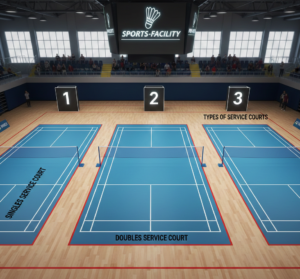
1. Singles Service Court
-
Smaller in width compared to doubles.
-
Players alternate between left and right service courts based on their score (even/odd).
-
Focuses on targeting specific areas of the opponent’s court with accuracy.
2. Doubles Service Court
-
Wider than singles to suit two players on each side.
-
Serves must land within the long service line for doubles.
-
Emphasizes team coordination, angled shots, and strategic placement.
4. Service Court Lines and Markings
Accurate line marking is critical to ensure that players serve within legal boundaries. Key lines include:
-
Short Service Line:
-
1.98 meters from the net.
-
Shuttle must cross this line for a valid serve.
-
-
Long Service Line:
-
Singles: At the back boundary line.
-
Doubles: 0.76 meters inside the back boundary line.
-
-
Center Line:
-
Divides the court into left and right service courts.
-
Ensures players serve from the correct side depending on the score.
-
-
Side Lines:
-
Defines legal boundaries for serves and landings.
-
Correct and visible markings improve accuracy, reduce disputes, and enhance gameplay.
5. Rules Governing Service Court Usage
Understanding service court rules is essential for fair play:
Serving Position
-
Players must serve from within their designated service court.
Shuttle Landing
-
The shuttle must land within the opponent’s diagonal service court.
-
Serves that land outside the service court are faults.
Rotation Rules
-
Singles: Players rotate between left and right service courts depending on their score (even/odd).
-
Doubles: Rotation is based on server and receiver positions, requiring coordination between teammates.
Common Faults
-
Serving outside the service court boundaries.
-
Shuttle not crossing the net or landing outside the diagonal service area.
Adhering to these rules ensures fairness, consistency, and BWF compliance.
6. Importance of Understanding Service Court Size
Accurate knowledge of service court dimensions offers several advantages:
-
Improves Accuracy: Players can serve precisely to target weak areas of the opponent’s court.
-
Reduces Faults: Knowledge of boundaries prevents invalid serves and lost points.
-
Strategic Advantage: Helps players plan serves to exploit opponent weaknesses.
-
Professional Compliance: Ensures training and gameplay meet BWF standards.
7. Professional Tips for Effective Service Court Use
-
Practice Diagonal Serves: Always aim diagonally to land within the opponent’s service court.
-
Observe Opponent Positioning: Target areas where the opponent struggles to reach.
-
Use Short and Long Serves Strategically: Short serves for net play, long serves to push opponents back.
-
Footwork Training: Maintain proper stance, balance, and avoid stepping outside the service court.
Effective service court usage can enhance match strategy, control rallies, and give a competitive edge.
8. Badminton Court Construction Considerations
-
Ensure short and long service lines follow BWF standards.
-
Divide the court into left and right service courts with clear contrasting colors.
-
Indoor courts should have non-glare lighting for line visibility.
-
Flooring must provide adequate grip and smooth movement for safe serving and receiving.
Attention to service court construction guarantees professional-level play, player safety, and long-term durability.
9. Common Mistakes in Service Court Design
-
Using incorrect measurements for singles and doubles service courts.
-
Failing to account for line thickness in total dimensions.
-
Poor contrast between lines and flooring, causing visibility issues.
Correcting these mistakes ensures the court meets BWF regulations and professional standards.
10. Conclusion
The badminton service court size is a fundamental aspect of the sport, governing serving accuracy, rotations, and fair play.
-
Singles: 5.18 meters wide, from short service line to back boundary.
-
Doubles: 6.10 meters wide, from short service line to long service line (0.76 meters inside back boundary).