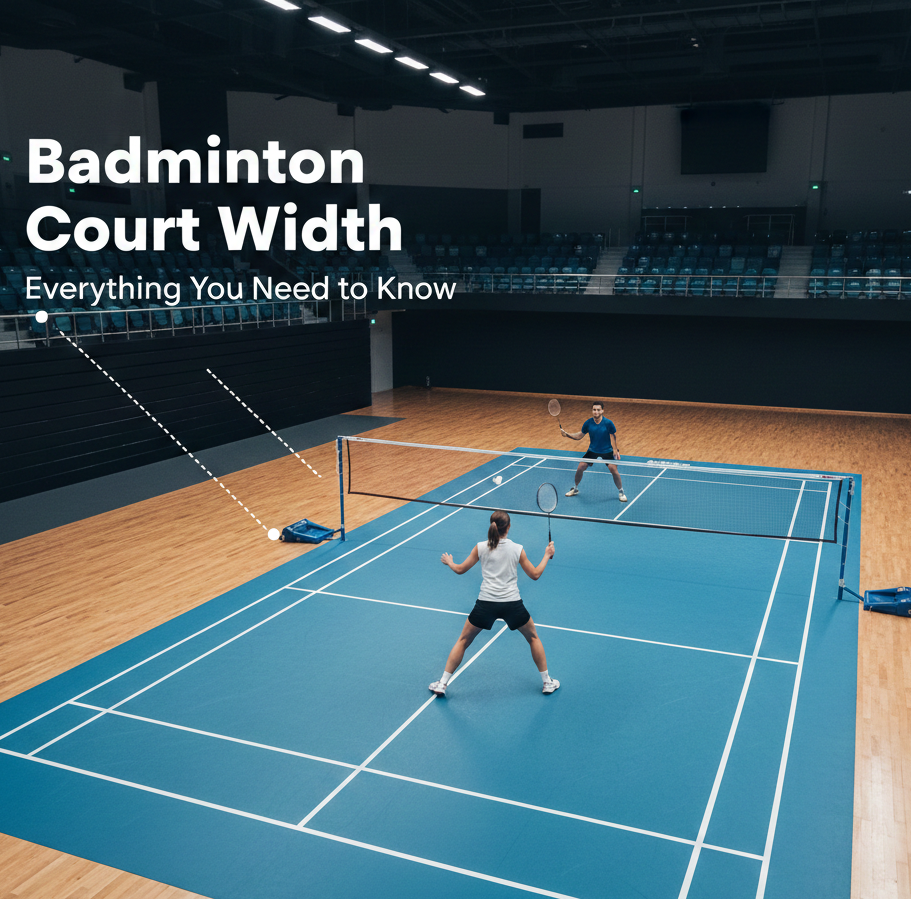
Badminton is one of the fastest racquet sports in the world, demanding precision, agility, strategy, and endurance. While players focus on footwork, smashes, and rallies, one of the most critical aspects of the game often overlooked is the badminton court width. The correct width ensures fair play, consistent performance, and adherence to international standards set by the Badminton World Federation (BWF).
Whether you are a professional athlete, a coach, or a recreational player, understanding badminton court width is essential for proper training, competition, and court construction. In this comprehensive guide, we’ll cover the official dimensions, differences between singles and doubles, importance of correct width, court marking techniques, maintenance tips, and common mistakes.
1. Understanding the Layout of a Badminton Court
A standard badminton court is a rectangular playing area divided by a net at the center. Each side accommodates one player in singles or two players in doubles. The court is defined by a series of lines, including sidelines, baselines, service lines, and center lines.
The BWF regulates all court dimensions to ensure consistency across all levels of play — from local tournaments to international competitions like the Olympics. Every measurement, including the width, length, and service boxes, directly influences player movement, shot placement, and overall gameplay strategy.
2. Official Badminton Court Dimensions
The width of a badminton court varies depending on whether it is used for singles or doubles matches. According to BWF standards:
-
Full Court Dimensions (Doubles):
-
Length: 13.40 meters (44 feet)
-
Width: 6.10 meters (20 feet)
-
-
Singles Court Dimensions:
-
Length: 13.40 meters (44 feet)
-
Width: 5.18 meters (17 feet)
-
This difference in width ensures a fair and balanced game. In doubles, players cover a wider area, requiring broader movement and coordination, while singles players operate within a narrower space, focusing on accuracy, endurance, and court coverage.
3. Singles vs. Doubles Court Width
Singles Court Width
-
Width: 5.18 meters (17 feet)
-
Boundary Lines: Only the inner sidelines are used.
-
Gameplay Impact:
-
Encourages longer rallies and precision-based shots.
-
Players must cover the entire court length, relying on stamina and strategic shot placement.
-
Doubles Court Width
-
Width: 6.10 meters (20 feet)
-
Boundary Lines: The outermost sidelines define the playable area.
-
Gameplay Impact:
-
Promotes fast-paced action, teamwork, and aggressive shots.
-
Allows players to exploit wider angles and develop tactical formations.
-
Note: Regardless of singles or doubles, the length of the court remains 13.40 meters, emphasizing that width is the primary variable affecting game dynamics.
4. Importance of Correct Court Width

Maintaining the official badminton court width is critical for several reasons:
a. Ensures Fair Competition
Standardized dimensions allow all players to compete on equal grounds, whether at local, national, or international levels.
b. Influences Shot Placement and Strategy
Players design smashes, clears, drops, and net shots based on court width. A non-standard width can alter shot effectiveness and strategy.
c. Reduces Disputes
Clearly defined sidelines minimize confusion during matches, preventing arguments over in/out calls.
d. Supports Consistent Training
Athletes training on correctly sized courts can transition smoothly into official competitions without adjusting their footwork or shot depth.
e. Safety and Space Optimization
Proper width ensures adequate space for movement, reducing risks of collisions with other courts, walls, or obstacles.
5. How to Measure and Mark Badminton Court Width
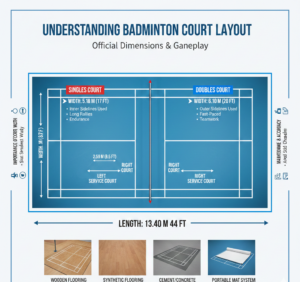
Accurate marking of the court width is essential when constructing or maintaining a badminton court.
Steps to Mark Width Lines:
-
Measure Total Width:
-
Doubles: 6.10 meters (20 feet)
-
Singles: 5.18 meters (17 feet)
-
-
Draw Sidelines:
Use chalk, tape, or temporary markers to create straight lines from one baseline to the other. -
Ensure Symmetry:
The centerline dividing service boxes must align perfectly in the middle of the court. -
Double-Check Measurements:
Confirm dimensions using a measuring tape before permanent painting. -
Maintain Line Width Consistency:
All boundary lines should have uniform thickness, usually around 40 mm, to comply with BWF standards.
6. Court Surface and Width Alignment
The type of flooring affects the accuracy of court width marking and overall gameplay. Common surfaces include:
-
Wooden Flooring:
Preferred for professional indoor courts; provides excellent grip, bounce, and durability. -
Synthetic Flooring (PVC/PU):
Durable, easy to maintain, and allows precise line marking. -
Cement/Concrete:
Often used for outdoor courts; may require frequent repainting. -
Mat Systems:
Portable mats come pre-marked with standard court width, ideal for schools and temporary events.
7. Understanding Court Width Zones
The badminton court width is divided into specific zones influencing gameplay and service rules:
-
Left and Right Service Courts: Divided by the centerline; each measures 2.59 meters (8.5 feet) wide for singles.
-
Sidelines for Singles vs. Doubles:
-
Singles: Inner line 5.18 meters apart
-
Doubles: Outer line 6.10 meters apart
-
Understanding these zones helps players develop better positioning, court awareness, and strategic shot selection.
8. Common Mistakes in Court Width Measurement
Errors in court width can lead to gameplay disruption and unfair play. Common mistakes include:
-
Incorrect conversion between meters and feet
-
Neglecting line thickness in total width calculation
-
Uneven floors causing asymmetrical markings
-
Confusion between singles and doubles sidelines
Avoiding these mistakes ensures courts are competition-ready and safe.
9. Maintenance of Court Lines and Width Accuracy
Over time, foot traffic and cleaning can fade or damage court lines, affecting court width perception and accuracy. Proper maintenance includes:
-
Repainting lines every 6–12 months depending on usage
-
Regular inspections to ensure accurate width
-
Anti-skid paint to maintain safety and durability
-
Avoiding harsh chemicals that erode line markings
Maintaining precise court width ensures official compliance and optimal player performance.
10. Conclusion
The badminton court width is far more than a simple measurement — it is a critical element in the sport’s structure, fairness, and strategy.
-
Singles width: 5.18 meters (17 feet)
-
Doubles width: 6.10 meters (20 feet)
Proper width alignment, accurate line marking, and routine maintenance support fair play, player safety, and consistent training. Athletes and organizers must adhere to BWF standards to maintain the sport’s integrity.
By understanding and implementing the correct badminton court width, players can enjoy optimized gameplay, precise shot execution, and a professional sporting environment — whether in schools, clubs, or international arenas.