Badminton is a sport that combines agility, precision, and strategy — and the foundation of every great game lies in the court design and dimensions. A correctly sized badminton court not only ensures fair play but also enhances player performance and safety. Whether for recreational play, school facilities, or professional tournaments, understanding the badminton court size and layout is essential before construction begins.
This comprehensive guide explains everything you need to know about badminton court size, layout marking, design guidelines, and technical specifications, as per the Badminton World Federation (BWF) standards.
1. Introduction: Why Court Size Matters
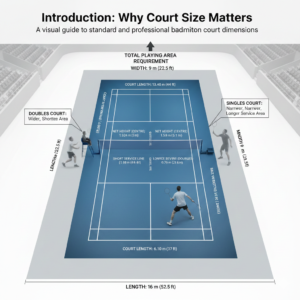
The size of a badminton court determines how the game is played. If the court dimensions are not accurate, it can affect player movement, service accuracy, and overall gameplay experience.
A professional badminton court is built according to BWF (Badminton World Federation) guidelines to ensure consistency across all international tournaments. For school or recreational use, slightly smaller spaces may be acceptable, but the playing area should always maintain proportionate dimensions for safety and balance.
In addition, proper spacing around the court allows players to move freely without obstruction, which is especially important in doubles matches.
2. Standard Badminton Court Size (BWF Approved)
According to the official BWF specifications, the badminton court dimensions are standardized globally for both singles and doubles play.
Here’s a detailed breakdown of the measurements:
| Parameter | Measurement (Meters) | Measurement (Feet) |
|---|---|---|
| Court Length | 13.40 m | 44 ft |
| Court Width (Singles) | 5.18 m | 17 ft |
| Court Width (Doubles) | 6.10 m | 20 ft |
| Short Service Line (from Net) | 1.98 m | 6 ft 6 in |
| Back Boundary Line (for Singles) | 0.76 m (inside doubles line) | 2 ft 6 in |
| Service Court Length | 3.96 m | 13 ft |
| Net Height at Posts | 1.55 m | 5 ft 1 in |
| Net Height at Centre | 1.524 m | 5 ft |
✅ Total Playing Area Requirement
To provide adequate clearance for player movement, the recommended overall area for one badminton court is:
-
Length: 16 m (52.5 ft)
-
Width: 9 m (29.5 ft)
-
Minimum Ceiling Height: 9 m (29.5 ft)
This ensures the shuttlecock does not strike the ceiling during high shots and clears smashes easily.
3. Layout and Marking Details
A badminton court layout includes various lines and divisions that define the playing zones. Every line must be clearly visible and consistent in width.
Court Lines
-
All lines should be 40 mm (1.57 inches) wide.
-
Lines should be painted white or yellow on a dark surface (green, blue, or wooden finish) for contrast.
-
The outermost boundary lines mark the limits of play for doubles.
Court Zones
A standard badminton court consists of several key zones:
-
Back Boundary Lines: Define the far ends of the court.
-
Side Lines for Singles: The inner side boundary used during singles play.
-
Side Lines for Doubles: The outer boundary for doubles matches.
-
Short Service Line: Marks the minimum distance a shuttle must travel during service.
-
Centre Line: Divides the service area into left and right courts.
-
Long Service Line for Doubles: Marks the farthest distance a serve can land in doubles.
-
Net Line: Divides the two halves of the court.
Each of these markings is essential to define service rules and in-play boundaries.
4. Understanding Court Design for Singles vs. Doubles
Although singles and doubles are played on the same court, the effective playing area differs slightly.
Singles Court
-
Width: 5.18 m (17 ft)
-
Service Area: Longer and narrower.
-
Back Boundary Line: Used as the outermost limit.
Doubles Court
-
Width: 6.10 m (20 ft)
-
Service Area: Shorter and wider.
-
Long Service Line for Doubles: 0.76 m inside the back boundary line.
This difference ensures balanced gameplay for both formats, as doubles players cover a wider area but shorter length.
5. Net and Pole Specifications
The badminton net plays a crucial role in defining the court’s functionality. The BWF provides strict guidelines for its placement and height.
-
Net Height at Posts: 1.55 m (5 ft 1 in)
-
Net Height at Centre: 1.524 m (5 ft)
-
Net Width: 760 mm (2 ft 6 in)
-
Net Length: 6.10 m (20 ft)
Material:
-
The net should be made of dark-colored fine cord (typically nylon).
-
The top edge is bordered by a 75 mm (3 in) white tape.
-
The net should be tightly stretched between two posts without sagging.
Post Placement:
-
Positioned on the doubles side lines, even when playing singles.
-
The posts must not intrude into the court area.
6. Space Around the Court
To ensure player comfort and safety, extra space is recommended beyond the court boundaries.
| Area Type | Minimum Clearance (Meters) | Purpose |
|---|---|---|
| Behind Each Baseline | 1.5 m – 2.0 m | Player movement & run-off space |
| On Each Side Line | 1.0 m | Side clearance |
| Above the Court | 9.0 m | Shuttle trajectory clearance |
These measurements are essential when designing indoor badminton facilities, particularly for tournaments or multi-court layouts.
7. Flooring Recommendations
While the size of the court remains the same, the flooring type greatly influences player performance and comfort.
A. Wooden Flooring
-
Ideal for indoor courts.
-
Provides shock absorption, uniform bounce, and excellent grip.
-
Preferred by professional academies and tournament venues.
-
Typically built using maple, teak, or beech wood with a rubber underlay.
B. Synthetic Flooring (PVC or PU)
-
Available in modular rolls or sheets.
-
Provides a non-slip surface, ideal for both indoor and semi-outdoor setups.
-
Easy to install and maintain.
C. Concrete or Acrylic Surface
-
Suitable for outdoor recreational play.
-
Durable and weather-resistant, but less cushioning compared to wooden or PVC floors.
Each flooring system should maintain perfect flatness to ensure accurate bounce and safe footwork.
8. Lighting and Ceiling Design
Lighting plays a critical role in the visibility of shuttle movement.
-
Recommended Illumination: 500–750 lux for recreational use; up to 1000 lux for tournaments.
-
Light Placement: Fixtures should be mounted 25–30 ft above the court, evenly distributed to prevent shadows or glare.
-
Use non-reflective walls and light-colored ceilings for better visual comfort.
9. Multi-Court Layout Considerations
In professional badminton complexes or academies, multiple courts are often constructed side by side.
Spacing Guidelines:
-
Minimum distance between adjacent courts: 2 m (6.5 ft).
-
Side aisles and walkways: 1.5 m minimum.
-
For spectators or coaching areas, allocate an additional 2–3 m along the longer sides.
These distances prevent player interference and allow comfortable movement during training or tournaments.
10. Construction Tips for Accurate Court Size
-
Always use BWF-approved drawings for layout reference.
-
Verify measurements with a laser level before final marking.
-
Maintain surface level tolerance within ±3 mm.
-
Choose high-quality marking paint resistant to wear and moisture.
-
For indoor courts, ensure adequate ventilation to prevent moisture buildup on wooden surfaces.
Accurate marking is the key to achieving a professional-grade playing environment.
Badminton Court Size — FAQ
1. What is the standard badminton court size?
A standard badminton court size is:
-
Length: 13.40 meters (44 feet)
-
Width: 6.10 meters (20 feet)
This is the official size for doubles play.
2. What is the badminton court size for singles?
For singles play, the court size is:
-
Length: 13.40 meters (44 feet)
-
Width: 5.18 meters (17 feet)
The singles court uses the inner side lines.
3. What is the size of the net in badminton?
The net size is:
-
Length: 6.10 meters (20 feet) (covers the width of the court)
-
Height:
-
1.55 meters (5 feet 1 inch) at the posts
-
1.524 meters (5 feet) at the center
-
4. What is the height of the badminton court?
The minimum ceiling height for indoor badminton is:
-
9 meters (29.5 feet)
This ensures the shuttle does not hit the ceiling during high shots.
5. How much space is needed around the court?
For safe play, you need at least:
-
2 meters of free space around all sides
This provides enough room for players to move without hitting walls or obstacles.
6. What is the size of the service courts?
Each side of the court has two service courts:
-
Left service court
-
Right service court
These are separated by the center line and defined by the front service line and long service line.
7. What is the distance of the front service line from the net?
The front service line is:
-
1.98 meters (6 feet 6 inches) from the net on both sides.
8. What is the distance of the long service line for doubles?
In doubles, the long service line is:
-
2.13 meters (7 feet) inside from the back boundary line.
9. What is the distance of the long service line for singles?
In singles, the long service line is the:
-
back boundary line (full court length)
10. How wide are the court lines?
Standard line width is:
-
40 mm (4 cm)
Lines should be clear, even, and visible.
11. Are court lines considered in or out?
Yes. In badminton, any shuttle touching the line is considered “in.”
So if the shuttle hits the line, it is a valid point.
12. What is the total area required for one badminton court including free space?
Including the safety run-off space:
-
Approximately 18 m × 10 m
This area is recommended for safe movement and player comfort.
13. Can the court size be reduced for smaller spaces?
Yes, for practice or recreational use, courts can be smaller, but official matches must use standard dimensions.
Smaller courts are suitable for:
-
Home setups
-
Small academies
-
Recreational play
14. What is the official badminton court size for tournaments?
Tournament courts must follow BWF rules, which require:
-
13.40 m × 6.10 m (doubles)
-
Proper line markings and net height
-
Clear overhead space and lighting
11. Conclusion
The badminton court size and design form the backbone of every great game — ensuring fairness, precision, and consistency. Following BWF standards guarantees that players experience the same conditions everywhere, whether in a school gymnasium or an international tournament arena.
To summarize:
-
The official court size is 13.4 m × 6.1 m, with specific markings for singles and doubles.
-
Ceiling height should be at least 9 meters, and extra clearance around the court ensures safety.
-
Accurate markings, quality flooring, and proper lighting transform a simple court into a world-class badminton facility.
Building a badminton court is not just about space — it’s about creating an environment where skill, strategy, and sportsmanship thrive. Whether you’re designing for a local academy or a professional venue, adhering to correct badminton court size and layout standards ensures long-lasting performance and player satisfaction.