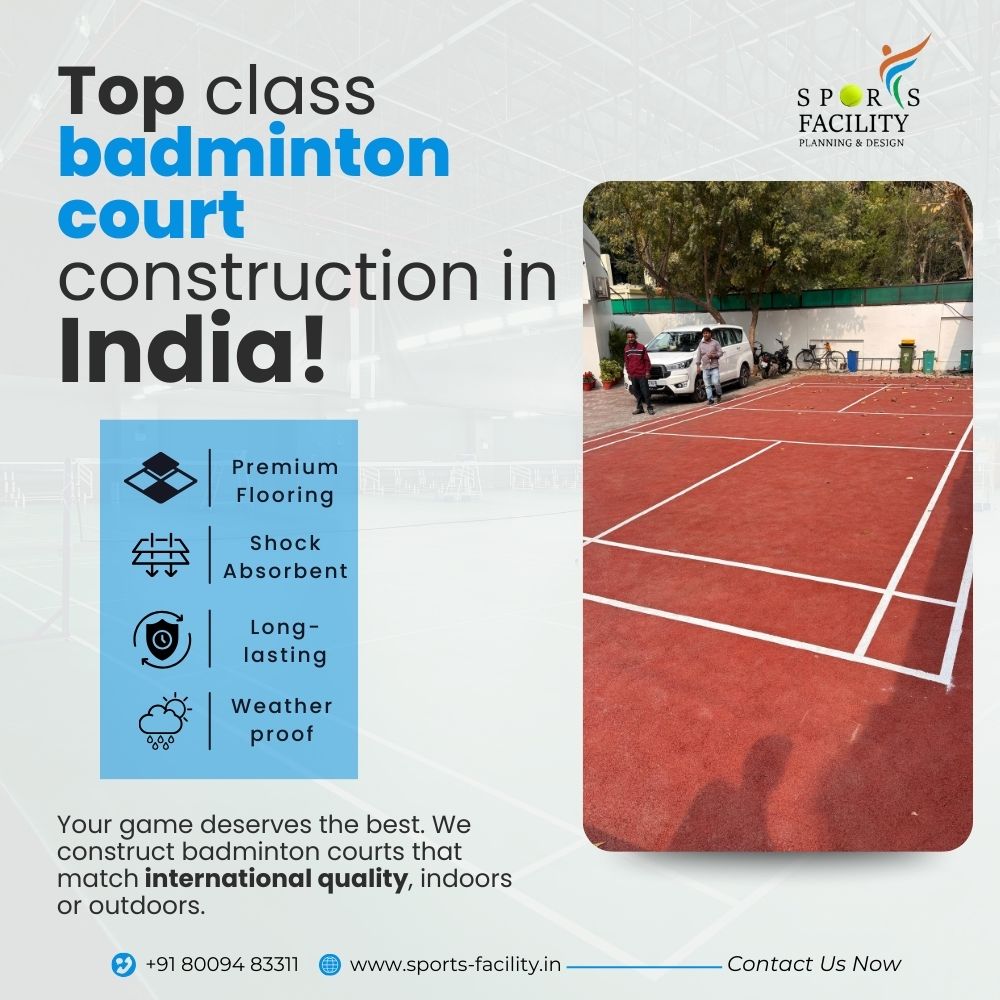
Badminton has emerged as one of India’s fastest-growing indoor sports, witnessing unprecedented popularity over the last decade. From schools and universities to residential societies, sports academies, and professional training centers, the demand for high-quality badminton courts is stronger than ever. The sport’s accessibility, low space requirements, suitability for all age groups, and India’s consistent international performance have made badminton a preferred choice for both recreational and professional sports infrastructure.
Badminton court construction in India is no longer limited to basic recreational setups. Today, institutions, housing societies, and academies aim to build courts that meet BWF (Badminton World Federation) standards, ensuring safety, performance, and tournament eligibility. Whether the goal is student fitness, community recreation, or nurturing future champions, a well-constructed badminton court represents a long-term investment in sports infrastructure.
This comprehensive guide provides a complete overview of badminton court construction in India—from standards and flooring options to cost, construction steps, maintenance, and professional services.
Why Badminton Court Construction Is Booming in India
Badminton is uniquely suited to Indian conditions. Unlike outdoor sports, badminton can be played year-round indoors, unaffected by monsoons, extreme heat, or pollution. The sport requires relatively compact space, making it ideal for urban schools, colleges, and residential societies while offering intense cardiovascular activity, hand-eye coordination development, and agility training.
For educational institutions and residential communities, a badminton court is more than a playing surface—it serves as a hub for:
- Physical fitness programs
- Coaching sessions and training camps
- Inter-school and inter-college competitions
- Weekend leagues and friendly matches
- Professional-level training and district tournaments
A properly constructed court can remain functional for decades, requiring only routine maintenance and periodic upgrades. This longevity, combined with its versatility, explains the surge in demand for high-quality badminton court construction across India.
Standard Badminton Court Dimensions in India
Professional badminton courts in India follow BWF standards to ensure consistency, fair play, and tournament eligibility. Adhering to these dimensions is critical for academies, schools, and professional facilities.
Official BWF Court Dimensions
| Specification | Measurement |
|---|---|
| Total Court Length | 13.40 meters |
| Court Width (Doubles) | 6.10 meters |
| Court Width (Singles) | 5.18 meters |
| Short Service Line | 1.98 meters from the net |
| Long Service Line (Doubles) | 0.76 meters inside the back boundary |
| Net Height at Posts | 1.55 meters |
| Net Height at Center | 1.52 meters |
Safety & Clearance Requirements
- Side and Back Clearance: Minimum 1.5–2.0 meters
- Recommended Ceiling Height:
- Minimum: 7.5 meters
- Tournament Standard: 9–12 meters
Adequate clearance allows safe movement, ensures professional gameplay, and accommodates competitive events in the future.
Indoor vs Outdoor Badminton Court Construction in India
Choosing between indoor and outdoor court construction depends on budget, intended use, and location.
Indoor Badminton Courts
Indoor courts are preferred for professional academies, schools, and sports clubs.
Advantages:
- Playable throughout the year
- Weather-resistant (no interference from rain, heat, or dust)
- Superior playing conditions with controlled lighting and ventilation
- Mandatory for professional coaching and official tournaments
Limitations:
- Higher initial construction cost
- Requires a hall structure, lighting, and ventilation system
Outdoor Badminton Courts
Outdoor courts are ideal for residential societies, recreational parks, and casual play.
Advantages:
- Lower construction cost
- Faster installation
- Suitable for recreational and casual use
Limitations:
- Affected by sunlight, rain, and dust
- Flooring lifespan is shorter
- Less suitable for professional-level training
Flooring Options for Badminton Court Construction in India
The flooring system is the most critical aspect of badminton court construction. It affects player safety, comfort, performance, and maintenance costs.
1. Wooden Sprung Flooring (Professional Indoor Courts)
Wooden floors are the gold standard for professional badminton facilities.
Features:
- Constructed using maple or engineered hardwood
- Installed over a shock-absorbing substructure
- Provides excellent grip, energy return, and joint protection
- Preferred for international-level training
Maintenance:
- Requires polishing or recoating every 3–5 years
2. Synthetic PVC or PU Flooring (Most Popular Choice)
Synthetic badminton flooring is widely used in India for schools, academies, and clubs.
Features:
- PVC mats (4.5 mm to 7 mm thickness)
- Installed over RCC or wooden base
- Anti-slip, cushioned, and durable
- Long lifespan and cost-effective
Advantages:
- Lower maintenance compared to wood
- Consistent playing performance
- Suitable for multi-purpose indoor courts
3. Concrete-Based Courts (Budget Option)
Concrete courts are mainly used for recreational purposes.
Features:
- RCC slab with painted court markings
- Low construction cost
- Hard surface with limited shock absorption
Note: Concrete courts are not recommended for professional play but can be upgraded later with synthetic mats.
Base Construction & Moisture Control
A strong foundation is vital for a long-lasting court. Flooring failures often originate from a poorly constructed base.
Recommended Base Specifications:
- RCC slab thickness: 100–125 mm
- Sub-base: Well-compacted granular layer
- Moisture barrier: Mandatory for indoor courts
- Outdoor slope: ~1% for drainage
Proper moisture protection prevents warping, bubbling, and adhesive failure, ensuring wooden or synthetic floors last longer.
Lighting Requirements for Badminton Courts
Lighting is crucial for visibility, player comfort, and performance.
Recommended Illumination Levels:
- Recreational / Training courts: 300–500 lux
- Professional / Tournament courts: 750–1000 lux
Key Points:
- Evenly distributed light avoids shadows and glare
- Anti-glare fixtures prevent visual discomfort
- Proper lighting placement enhances gameplay quality
Equipment & Accessories
A complete badminton court setup in India requires:
- BWF-standard net and poles
- Accurate court markings
- Safety buffer zones
- Optional seating/viewing areas
- Scoreboards and storage
- Ventilation or air-conditioning (for indoor courts)
Cost of Badminton Court Construction in India (2025 Estimates)
The cost depends on flooring type, base construction, and accessories. Approximate rates:
| Flooring / Court Type | Cost (₹ per sq. ft) / Total |
|---|---|
| Synthetic PVC flooring | ₹75 – ₹110 per sq. ft |
| Wooden flooring (shock absorption) | ₹180 – ₹250 per sq. ft |
| Complete indoor court (turnkey) | ₹6 – ₹12 lakhs per court |
| Outdoor RCC court | ₹3 – ₹5 lakhs per court |
Average Cost: ₹7–₹10 lakhs for a standard indoor court including base, flooring, lighting, and equipment.
Step-by-Step Badminton Court Construction Process
- Site Evaluation & Planning – Soil testing, space measurement, ceiling height analysis
- Base Preparation – Excavation, compaction, and sub-base formation
- RCC Slab Construction – Reinforced concrete slab with proper leveling
- Moisture Barrier Installation – Essential for indoor courts
- Flooring Installation – Wooden or synthetic flooring system
- Court Marking & Equipment Setup – BWF-compliant lines and net installation
- Lighting & Finishing Work – Fixtures, seating, ventilation
- Testing & Final Handover – Surface checks, bounce testing, quality inspection
Maintenance & Long-Term Care
Routine maintenance extends the life of a badminton court:
- Daily: Dry mopping to remove dust
- Weekly: Light wet cleaning (avoid excess water)
- Annual: Inspection for cracks, wear, and surface degradation
Lifecycle Expectations:
- Wooden floors: Recoating every 3–5 years
- Synthetic floors: Replacement after 7–10 years
Common Mistakes to Avoid:
- Ignoring moisture barriers
- Poor slab leveling
- Using low-quality PVC or wood
- Incorrect lighting placement
Avoiding these mistakes ensures safety, durability, and professional performance.
Frequently Asked Questions (FAQs)
1. What are the standard dimensions for badminton courts in India?
- 13.40 m length; 6.10 m width for doubles, 5.18 m for singles.
2. Can outdoor courts be used for tournaments?
- Outdoor courts are primarily recreational; indoor courts are mandatory for professional play.
3. Which flooring is best for professional badminton?
- Wooden sprung flooring with shock absorption is preferred for professional indoor courts.
4. What is the recommended clearance around a court?
- Minimum 1.5–2.0 meters on sides and back; ceiling 9–12 meters for tournaments.
5. How long does a synthetic court last?
- With proper care, 7–10 years before major replacement.
Conclusion
Badminton court construction in India is a long-term investment in sports, fitness, and community development. Whether building a single court for recreational use or a multi-court facility for professional academies, success depends on proper planning, adherence to BWF standards, flooring selection, and expert execution.
A well-constructed badminton court enhances player safety, provides an excellent training environment, and supports competitive performance for decades. For anyone planning badminton court construction in India, partnering with experienced sports infrastructure specialists ensures an end-to-end solution—from site planning to final handover—delivering a facility that meets international standards and local requirements.
Investing in a professionally designed badminton court today lays the foundation for future champions and fosters a culture of fitness and sportsmanship across communities in India.