Badminton has emerged as one of the most popular indoor sports in India, played across schools, colleges, residential complexes, sports academies, and professional clubs. The rise of Indian badminton stars like P.V. Sindhu and Kidambi Srikanth has inspired millions, increasing the demand for high-quality badminton courts nationwide.
If you are planning to construct a badminton court, understanding the construction estimate is critical for budgeting, planning, and ensuring a top-tier facility. This comprehensive guide provides insights into cost factors, flooring options, indoor vs. outdoor setups, additional features, and expert tips to help you create a professional-grade badminton court in India.
Factors Affecting Badminton Court Construction Cost
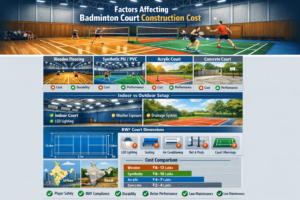
The overall cost of constructing a badminton court depends on multiple factors. Understanding these factors is essential to prepare an accurate budget.
1. Type of Court Flooring
The flooring type has a direct impact on cost, performance, and player safety. Options include:
- Wooden Flooring – Offers professional-level bounce and shock absorption.
- Synthetic Flooring (PU/PVC) – Durable, skid-resistant, and low-maintenance.
- Acrylic Flooring – Weather-resistant, suitable for outdoor courts.
- Concrete Base Courts – Budget-friendly and long-lasting.
2. Indoor vs. Outdoor Setup
- Indoor Courts require roofing, ventilation, lighting, and sometimes air-conditioning.
- Outdoor Courts need weatherproofing, UV protection, and proper drainage.
3. Court Dimensions and BWF Compliance
Constructing a court according to Badminton World Federation (BWF) standards ensures professional usability. Extra safety zones, ceiling height, and spacing may increase costs.
4. Additional Facilities
Features like LED lighting, seating arrangements, net posts, and ventilation systems influence the overall cost.
5. Location & Site Preparation
City, terrain, soil type, and accessibility affect labor, material delivery, and groundwork costs.
6. Quality of Materials
High-grade flooring, posts, and accessories increase upfront investment but provide long-term durability and reduced maintenance costs.
Standard Badminton Court Dimensions
For professional or recreational play, BWF standards must be followed:
- Court Length: 13.40 meters (44 feet)
- Court Width (Doubles): 6.10 meters (20 feet)
- Court Width (Singles): 5.18 meters (17 feet)
- Short Service Line: 1.98 meters from the net
- Long Service Line (Doubles): 0.76 meters inside the baseline
- Net Height at Posts: 1.55 meters
- Net Height at Center: 1.524 meters
- Minimum Clearance Around Court: 2 meters
Proper adherence to these dimensions ensures fair play and safety.
Types of Badminton Court Flooring and Cost Estimates
1. Wooden Flooring
- Material: Maple or Teak wood with cushioned underlay.
- Benefits: Superior bounce, professional-grade performance, and shock absorption.
- Best For: Indoor academies, professional tournaments, and training centers.
- Estimated Cost: ₹8 – ₹12 Lakhs per court.
2. Synthetic Flooring (PU/PVC)
- Material: Multi-layered PU or PVC sheets installed over a concrete base.
- Benefits: Durable, skid-resistant, low maintenance, suitable for high-traffic usage.
- Best For: Schools, sports clubs, and indoor recreational courts.
- Estimated Cost: ₹6 – ₹10 Lakhs per court.
3. Acrylic Flooring
- Material: Acrylic coating applied on concrete surfaces.
- Benefits: Weather-resistant, UV-protected, ideal for outdoor environments.
- Best For: Residential societies, parks, and community centers.
- Estimated Cost: ₹4 – ₹7 Lakhs per court.
4. Concrete Base Courts
- Material: Cement/concrete slab, optionally coated with synthetic layers.
- Benefits: Cost-effective, long-lasting, minimal maintenance.
- Best For: Schools, public spaces, and rural areas.
- Estimated Cost: ₹2 – ₹4 Lakhs per court.
Indoor vs. Outdoor Badminton Court Construction Estimates
Indoor Courts
- Flooring: Wooden or synthetic PU/PVC.
- Additional Features: LED lighting, ventilation, air-conditioning for professional facilities.
- Estimated Cost: ₹10 – ₹15 Lakhs per court.
Outdoor Courts
- Flooring: Acrylic or synthetic coating over concrete base.
- Features: Weatherproofing, UV protection, proper drainage.
- Estimated Cost: ₹4 – ₹8 Lakhs per court.
Cost Breakdown of Additional Features
| Feature | Approximate Cost | Details |
|---|---|---|
| LED Lighting | ₹50,000 – ₹2,00,000 | Non-glare, uniform illumination for indoor courts |
| Seating Arrangements | ₹1,00,000 – ₹5,00,000 | For academies, schools, or societies |
| Air Conditioning | ₹3,00,000 – ₹8,00,000 | For indoor professional courts |
| Net Posts & Nets | ₹20,000 – ₹50,000 | BWF-approved |
| Court Markings | ₹15,000 – ₹30,000 | Accurate paint for singles & doubles |
Step-by-Step Construction Process
1. Site Survey and Planning
Assess available space, soil, sunlight, drainage, and accessibility.
2. Foundation and Base Construction
Level the ground, construct reinforced concrete slabs, and prepare for flooring.
3. Flooring Installation
Install wooden planks, synthetic PU/PVC layers, or acrylic coatings with proper cushioning.
4. Line Marking
Paint accurate lines for singles, doubles, service areas, and safety boundaries.
5. Net Installation
Install posts and net at BWF-approved height and tension.
6. Lighting & Ventilation
Install LED lighting, ceiling fans, or air-conditioning to enhance playing conditions.
7. Final Inspection
Check for BWF compliance, safety, surface evenness, and player-friendly bounce.
Factors Influencing the Final Estimate
- Location: Metro cities such as Delhi, Mumbai, Bengaluru, Hyderabad, Kolkata, Chennai have higher labor and material costs.
- Material Quality: Premium flooring and accessories increase upfront costs but reduce maintenance.
- Indoor vs Outdoor: Indoor courts require roofing, AC, and lighting, increasing the investment.
- Customization: Additional seating, coaching facilities, and aesthetic enhancements may add to costs.
Tips to Optimize Badminton Court Construction Costs
- Choose Off-Season Construction: Material and labor costs may be lower.
- Select Synthetic or Acrylic Flooring: Budget-friendly without compromising quality.
- Consider Modular Courts: Temporary or portable solutions for multi-purpose use.
- Hire Experienced Contractors: Reduces mistakes and rework costs.
- Plan for Long-Term Maintenance: Investing in premium flooring saves future expenses.
Benefits of Investing in a Professionally Constructed Badminton Court
✅ Safe playing conditions with anti-slip, shock-absorbing surfaces.
✅ BWF-compliant dimensions for fair competitive play.
✅ Long-lasting durability with minimal maintenance.
✅ Enhanced player experience, speed, and performance.
✅ Adds value to schools, residential societies, academies, or commercial projects.
✅ Attracts tournaments, events, and players to your facility.
Conclusion
Constructing a badminton court in India typically ranges from ₹2 Lakhs to ₹15 Lakhs per court, depending on flooring type, indoor/outdoor setup, and additional features.
- Wooden and synthetic courts are ideal for professional indoor use.
- Acrylic and concrete courts are cost-effective for outdoor and recreational purposes.
Hiring an experienced badminton court construction company ensures:
- Accurate BWF-compliant dimensions
- Proper flooring installation
- Player safety and performance
- Long-term durability and low maintenance
Whether you are building for schools, clubs, residential complexes, or sports academies, a professionally constructed badminton court is a valuable investment that promotes fitness, sports culture, and community engagement.
Frequently Asked Questions (FAQ) – Futsal Facilities
1. What is the standard futsal court dimension?
A professional futsal court is rectangular, typically 38–42 meters in length and 18–22 meters in width. For schools or recreational facilities, a flexible range of 25–42 meters long and 16–25 meters wide can be used, ensuring safe and competitive gameplay.
2. What materials are used for futsal court surfaces?
Common surfaces include polyurethane (PU) flooring, PVC vinyl, wooden indoor courts, and artificial turf. These materials provide traction, shock absorption, uniform ball bounce, and long-term durability.
3. Why is accurate futsal court dimension important?
Proper court dimensions ensure safe movement, balanced gameplay, and compliance with international standards. Correct sizing also optimizes space utilization and enhances player performance during fast-paced matches.
4. What is futsal turf construction?
Futsal turf construction involves installing high-density synthetic grass over a prepared base with shock-absorbing layers. This creates a durable, low-maintenance, and visually appealing surface for both indoor and outdoor use.
5. How is a futsal court constructed?
Futsal court construction includes sub-base preparation, leveling, shock-absorbing layers, surface installation, line marking, and additional infrastructure such as goalposts, fencing, and drainage systems. Precision ensures safety, performance, and durability.
6. Can futsal courts be built indoors and outdoors?
Yes. Indoor courts focus on traction, stability, and smooth ball movement, while outdoor courts include drainage systems and weather-resistant surfaces to maintain performance in all conditions.