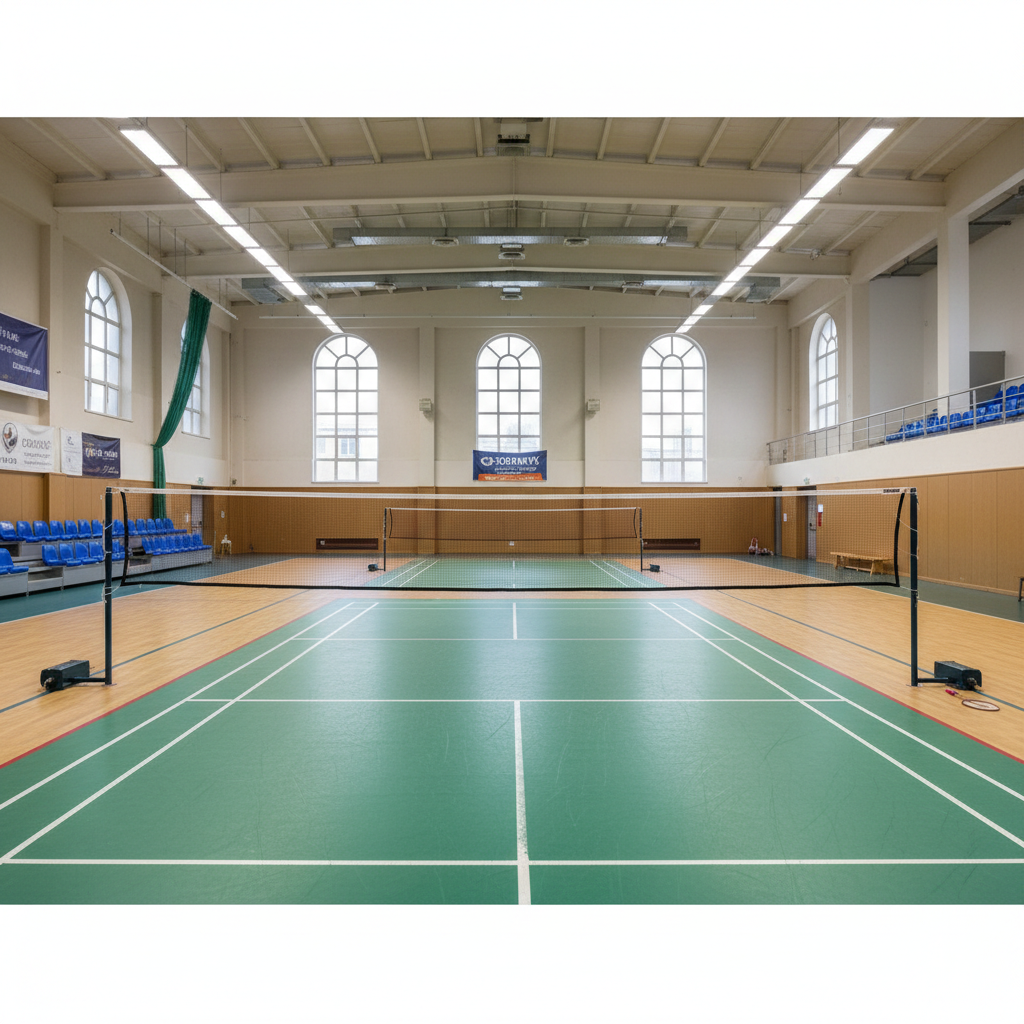
Badminton is one of the fastest-growing sports in India and across the world. Known for its speed, agility, and precision, the game has become a popular choice among schools, sports clubs, fitness centers, and residential communities. With the rise of professional academies and government sports initiatives, the demand for high-quality badminton court construction has surged across cities and towns.
Whether you are planning to build a badminton court for commercial, institutional, or recreational purposes, understanding the technical specifications, flooring options, construction process, and cost is crucial. This comprehensive guide covers every detail you need to know about badminton court construction — from design standards to installation and maintenance.
1. Introduction: The Importance of a Well-Built Badminton Court
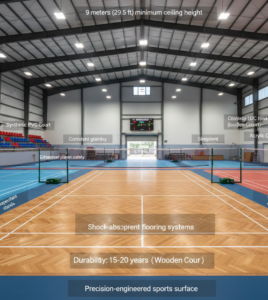
A badminton court is not just a marked floor — it’s a precision-engineered sports surface that ensures consistent bounce, grip, and player comfort. A professionally built court enhances game quality, reduces injury risks, and provides a long-lasting sports experience.
Key benefits of a professional court include:
-
Consistent gameplay with even surface and accurate markings.
-
Enhanced player safety with shock-absorbent flooring systems.
-
Longevity and durability with proper materials and installation.
-
All-weather playability for indoor and synthetic options.
Whether for training, tournaments, or community recreation, a well-constructed court adds immense value to any sports facility.
2. Standard Badminton Court Dimensions (BWF Specifications)
The Badminton World Federation (BWF) specifies official court dimensions that must be maintained for professional and competitive play.
| Parameter | Measurement (Meters) | Measurement (Feet) |
|---|---|---|
| Court Length | 13.40 m | 44 ft |
| Court Width (Singles) | 5.18 m | 17 ft |
| Court Width (Doubles) | 6.10 m | 20 ft |
| Service Court Length | 3.96 m | 13 ft |
| Short Service Line Distance | 1.98 m | 6.5 ft |
| Net Height (Centre) | 1.524 m | 5 ft |
| Net Height (Posts) | 1.55 m | 5 ft 1 in |
The total area for one badminton court (including clearance and run-off space) should be at least 16 m × 9 m (≈ 50 ft × 30 ft).
For indoor courts, the ceiling height must be a minimum of 9 meters (29.5 ft) to allow shuttle clearance.
3. Types of Badminton Courts
There are several types of badminton courts depending on the playing environment and purpose. The main types include:
A. Wooden Badminton Court (Indoor)
-
Preferred for: Indoor stadiums, academies, and clubs.
-
Structure: Rubber padding base + wooden underframe + maple/pine surface planks.
-
Features: Superior grip, natural bounce, shock absorption.
-
Durability: 15–20 years with proper maintenance.
-
Compliance: BWF-approved for international play.
B. Synthetic Badminton Court (Indoor or Outdoor)
-
Material: PVC, Vinyl, or PU (Polyurethane).
-
Advantages: Anti-slip surface, easy to maintain, water-resistant.
-
Installation: Can be laid on concrete or wooden base.
-
Durability: 8–10 years.
-
Ideal for: Multi-purpose sports halls, schools, and fitness centers.
C. Cement or Concrete Court (Outdoor)
-
Most economical option, commonly used for outdoor recreational play.
-
Offers durability but lacks cushioning, so not suitable for professional games.
-
Can be converted later into a synthetic surface.
D. Acrylic Court
-
A layered synthetic system similar to tennis court flooring, used for both indoor and outdoor setups.
-
UV-resistant and weatherproof, ideal for long-term use.
4. Construction Process of a Badminton Court
Constructing a badminton court requires technical precision and adherence to international standards. The process includes several key steps:
Step 1: Site Preparation and Base Construction
-
The area should be levelled and compacted properly.
-
A RCC or PCC base of 100–150 mm thickness is recommended for stability.
-
A moisture barrier (plastic or chemical) should be applied before laying flooring.
Step 2: Flooring System Installation
Depending on the chosen surface type:
A. Wooden Flooring
-
Install rubberized underlay for cushioning.
-
Add pinewood sleepers in a grid pattern.
-
Fix maple or teak wood planks on top.
-
Apply anti-skid polish and line markings.
B. Synthetic Flooring
-
Clean and smooth the concrete base.
-
Apply adhesive evenly.
-
Lay multi-layer PVC or PU rolls.
-
Press and seal joints, then mark lines.
Step 3: Lighting and Ceiling
-
For indoor courts, use non-reflective lighting of 500–750 lux.
-
LED floodlights or high bay lights are recommended.
-
Ensure no direct glare on players’ eyes.
Step 4: Accessories Installation
-
Install net posts, nets, boundary lines, and seating arrangements.
-
For professional setups, provide spectator stands, changing rooms, and storage space.
5. Cost of Badminton Court Construction in India (2025 Estimate)
The cost of constructing a badminton court varies based on location, flooring material, and quality standards.
| Type of Court | Approx. Cost per Court (INR) |
|---|---|
| Cement Court (Outdoor) | ₹2 lakh – ₹3 lakh |
| Synthetic PVC Court | ₹3.5 lakh – ₹5 lakh |
| Wooden Court (BWF Approved) | ₹6 lakh – ₹8 lakh |
| Acrylic or PU Court | ₹5 lakh – ₹7 lakh |
Additional Costs
-
Lighting setup: ₹80,000 – ₹1.5 lakh
-
Net posts and accessories: ₹20,000 – ₹30,000
-
Painting and finishing: ₹40,000 – ₹60,000
-
Civil structure (for indoor halls): ₹4 lakh – ₹10 lakh
Thus, a complete indoor badminton facility (with one court) can range from ₹10 lakh to ₹15 lakh, depending on materials and design.
6. Maintenance and Lifespan
A well-constructed badminton court can last decades with proper care.
Wooden Courts
-
Sweep regularly to remove dust.
-
Re-polish every 3–5 years.
-
Avoid water exposure or high humidity.
Synthetic Courts
-
Clean with mild detergent and soft brushes.
-
Check adhesive and joint conditions periodically.
-
Replace surface after 8–10 years if needed.
Expected Lifespan:
-
Wooden Court: 15–20 years
-
Synthetic Court: 8–12 years
-
Cement/Acrylic: 10–15 years
7. Key Factors Influencing Construction Cost
-
Flooring Material Quality – Imported, BWF-approved flooring costs more but ensures superior performance.
-
Indoor vs. Outdoor Setup – Indoor facilities require additional investment in structure and lighting.
-
Number of Courts – Multi-court complexes reduce per-court cost due to shared infrastructure.
-
Lighting Standards – Higher lux levels and LED fixtures increase overall costs.
-
Geographical Location – Material and labor rates vary across cities and regions.
8. Benefits of Professional Badminton Court Construction
Investing in professional-grade construction ensures:
-
Player safety and comfort through cushioned, non-slip surfaces.
-
Enhanced facility reputation – attracts athletes and tournaments.
-
Long-term savings with durable materials and lower maintenance.
-
Consistent performance that meets international standards.
A properly designed court also boosts the aesthetic and commercial value of the sports complex or academy.
9. Choosing the Right Contractor
When selecting a badminton court construction company, consider:
-
Experience with BWF-certified flooring systems.
-
Proven portfolio of indoor and outdoor courts.
-
Use of branded materials and proper installation techniques.
-
After-sales service and maintenance support.
A professional contractor ensures that the court meets all technical, safety, and performance standards, avoiding costly rework later.
10. Conclusion
Building a badminton court is a smart and long-term investment in sports infrastructure. Whether for schools, universities, sports academies, or private clubs, the key to success lies in precision, quality materials, and expert construction.
By adhering to BWF guidelines, using premium flooring systems, and ensuring proper lighting and ventilation, you can create a facility that stands out for both performance and aesthetics.
A professionally constructed court doesn’t just serve as a play area — it becomes a platform for nurturing the next generation of athletes and promoting a culture of sports excellence.