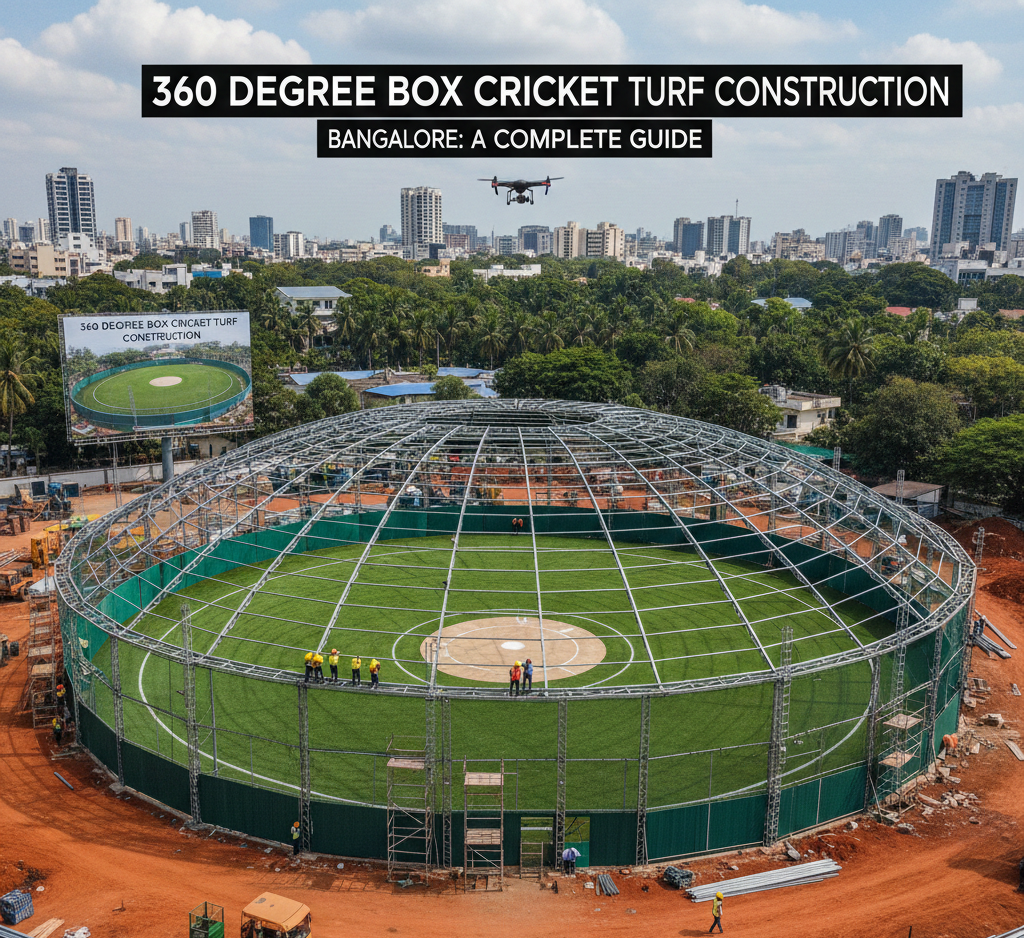
Bangalore — India’s Silicon Valley — is not only a tech powerhouse but also a fast‑emerging hub for sports infrastructure and leisure facilities. Among rising trends, 360 degree box cricket turf construction has become one of the most sought‑after investments for sports promoters and real estate developers. Designed to deliver unmatched play quality, durability, and community appeal, a 360 degree box cricket turf offers immersive cricket experiences in limited spaces, with high returns on engagement and revenue. In this detailed blog, we explore everything — from planning and design to materials, installation, regulations, cost, and future prospects — relevant specifically to Bangalore.
What is a 360 Degree Box Cricket Turf?
A 360 degree box cricket turf is an enclosed cricket playing field where players can hit or bowl in all directions, without dead zones or fixed boundary lines typical of traditional nets. Instead of confined nets on either side, this design wraps turf and protective mesh around a central playing area, offering a fully rounded play experience.
Key benefits include:
✔ Optimized space utilization
✔ Enhanced safety for players and spectators
✔ Better ball rebound and play consistency
✔ Suitable for all age groups and skill levels
✔ Ideal for leagues, practice sessions, corporate events
In Bangalore — where land is at a premium — the 360 degree box cricket model maximizes play area without extending footprint.
Why Build a Box Cricket Turf in Bangalore?
1. Booming Cricket Culture
Cricket in India isn’t just a sport — it’s a lifestyle. In Bangalore, active leagues, corporate teams, student clubs, and weekend warriors create constant demand for quality playing surfaces.
2. Urban Space Constraints
With real estate costs high, conventional large grounds are impractical. Box cricket combines performance with compact dimensions — typically between 12m × 24m to 18m × 36m, depending on site availability.
3. High Market Demand for Organized Play
From casual pickup games to franchise leagues, box cricket turfs attract bookings seven days a week — making them commercially attractive ventures.
4. Year‑Round Use
Bangalore’s moderate climate allows turf usage throughout the year. Combined with good drainage and weather‑resistant materials, turf fields stay active even during monsoons.
Planning & Site Considerations
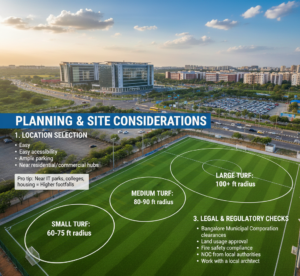
1. Location Selection
Choose a site that:
-
Has easy accessibility
-
Offers ample parking
-
Is near residential or commercial hubs
-
Avoids low‑lying waterlogged areas
Pro tip: Properties near IT parks, colleges, and high‑density housing yield higher footfalls.
2. Size & Dimensions
The ideal turf radius depends on budget and space. Common standards:
-
Small Turf: 60 – 75 feet radius
-
Medium Turf: 80 – 90 feet radius
-
Large Turf: 100 feet + radius
While smaller turfs are cheaper to build, larger turfs offer better playability and more diverse game formats.
3. Legal & Regulatory Checks
Bangalore Municipal Corporation requires clearances like:
-
Land usage approval
-
Fire safety compliance
-
NOC from local authorities for public gatherings
Work with a local architect to ensure compliance with all bylaws.
Design & Structural Elements
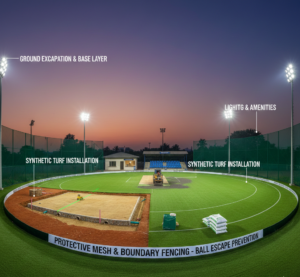
A fully functional 360 degree turf includes:
1. Ground Excavation & Base Layer
Start with soil assessment — Bangalore’s red soil requires careful compaction and leveling.
Steps:
-
Excavate to desired depth
-
Lay a compacted sand and stone base
-
Install a perforated drainage system
-
Apply laser‑level precision grading
This ensures even ball roll and prevents waterlogging.
2. Synthetic Turf Installation
Synthetic turf is the heart of the facility. High‑quality turf delivers:
-
Consistent bounce and roll
-
Low maintenance
-
Shock absorption
-
UV protection
Best practices:
✔ Use polypropylene or polyethylene fibers
✔ Choose a pile height of 10–14 mm for cricket
✔ Ensure even infill (sand + rubber granules)
✔ Seam joins must be strong and seamless
3. Protective Mesh & Boundary Fencing
360° turfs require netting or mesh fencing that:
-
Prevents ball escape
-
Enhances player safety
-
Withstands weather and impact
Select galvanized steel poles with heavy‑duty polypropylene mesh.
4. Lighting & Amenities
To operate evening matches, install LED floodlights with:
✔ Uniform illumination
✔ Minimum shadow zones
✔ Energy‑efficient performance
Include amenities like:
-
Changing room
-
Washrooms
-
Spectator seating
-
Refreshment counter
Materials & Technology
Choosing the right materials determines longevity and play quality.
1. Turf Quality
Look for:
-
High‑density yarns
-
UV‑resistant coatings
-
Anti‑static and anti‑fungal properties
Quality turfs last 5–8 years with proper care.
2. Shock Pads
Adding shock pads under the turf:
✔ Reduces injury risk
✔ Enhances ball response
✔ Increases overall comfort
3. Eco‑Friendly Options
Newer turfs now use recycled materials, reducing environmental impact — a growing consideration for Bengaluru clients.
Installation Process (Step‑by‑Step)
-
Site Survey & Measurement
-
Soil Testing & Drainage Planning
-
Land Clearing & Base Preparation
-
Drainage Pipe Placement
-
Installation of Hardcore & Stone Base
-
Laser Grading
-
Laying Turf and Infill
-
Mesh & Fencing
-
Lighting & Electrical Setup
-
Final Quality Checks
Certified supervisors should monitor every stage to ensure industry standards are met.
Maintenance Fundamentals
Proper maintenance ensures longevity and peak performance:
✔ Regularly brush turf to prevent matting
✔ Remove debris and leaves daily
✔ De‑compaction every 3–4 months
✔ Check drainage peaks after heavy rain
✔ Promptly repair wear patches
Budget 8–10% of your annual revenue for turf upkeep and lighting maintenance.
Cost Overview (Estimated for Bangalore)
Cost varies by size and materials. Typical ballpark figures:
| Component | Cost Range (INR) |
|---|---|
| Land preparation | 5–10 lakh |
| Synthetic turf | 10–20 lakh |
| Drainage system | 3–7 lakh |
| Mesh & fencing | 4–8 lakh |
| Lighting | 5–15 lakh |
| Amenities | 3–10 lakh |
Total: ₹30 lakh – ₹70+ lakh depending on scale and features.
Monetization Strategies
To maximize returns:
1. Hourly Bookings
Charge per hour for practice or team play.
2. League & Tournament Hosting
Organize weekly or seasonal leagues.
3. Coaching Programs
Tie up with coaches for skill development camps.
4. Corporate Packages
Offer team‑building and corporate cricket events.
5. Sponsorship & Ads
Brand boards, digital ads, and booth spaces add revenue.
Case for Bangalore’s Future
Bangalore’s young population, active lifestyle communities, and growing appetite for organized sports make it a fertile ground for 360 degree box cricket turfs. With increased spending power and leisure time, families and professionals seek sport alternatives beyond mere gyms or traditional parks. In response, quality turfs become both social hubs and sports ecosystems.
Moreover, technological integrations — such as performance tracking cameras, LED scoreboards, and booking apps — can turn a simple turf into a “smart sports destination,” attracting tech‑savvy customers.
Conclusion
Building a 360 degree box cricket turf in Bangalore is more than a construction project — it’s an investment in community engagement, sports culture, and sustainable business growth. With smart site selection, quality materials, precise execution, and solid marketing, a box cricket turf becomes a lively space where players of all ages find joy and competition. From project start to daily operations, attention to detail is paramount — but so is vision: to transform a patch of land into a thriving cricket nucleus.