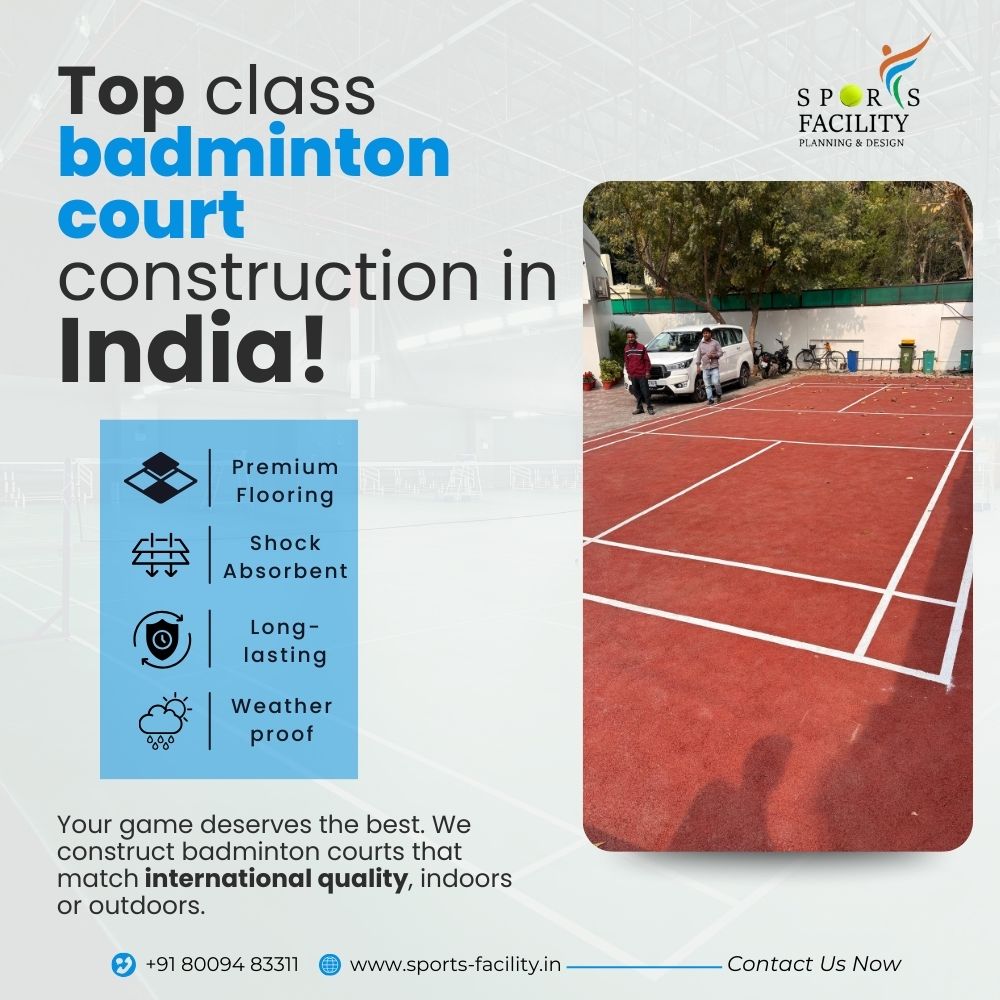
Introduction
Badminton has become one of the most widely played and rapidly growing sports in India, appealing to people of all age groups and skill levels. From school competitions and residential societies to elite academies and international tournaments, the demand for high-quality badminton infrastructure has increased significantly over the past decade.
As this demand continues to grow, badminton court construction in India has evolved from simple recreational setups into highly specialized, performance-oriented facilities. Today, modern courts are designed according to global standards, ensuring safety, durability, and professional-level gameplay.
A properly constructed badminton court is more than just a playing surface—it is a carefully engineered space that influences player performance, reduces injury risks, and supports long-term usage. Whether you are planning a single indoor court or a multi-court sports complex, understanding the construction process, flooring options, and technical standards is essential.
This comprehensive guide covers everything you need to know about badminton court construction in India, including dimensions, flooring systems, installation steps, costs, maintenance, and expert recommendations.
Why Badminton Court Construction Is Growing Rapidly in India
Badminton is uniquely suited to Indian conditions, particularly because it is primarily played indoors and requires relatively less space compared to many other sports. This makes it ideal for urban areas where land availability is limited.
Key Reasons for Growing Demand
1. Indoor Compatibility
Badminton courts can be used year-round without being affected by weather conditions such as rain, heat, or pollution.
2. Space Efficiency
The compact size of a badminton court makes it suitable for schools, residential complexes, and indoor sports halls.
3. Rising Sports Culture
India’s success in international badminton has inspired increased participation at grassroots and professional levels.
4. Multi-Use Facilities
Badminton courts can be integrated into multi-sport complexes, increasing their utility.
5. Long-Term Investment
A well-constructed court can last for many years with minimal maintenance, making it cost-effective over time.
Standard Badminton Court Dimensions in India
Adhering to official specifications is crucial for ensuring fair play and compatibility with professional standards.
Official Court Dimensions
- Total Length: 13.40 meters
- Width (Doubles): 6.10 meters
- Width (Singles): 5.18 meters
- Net Height at Posts: 1.55 meters
- Net Height at Center: 1.52 meters
Clearance Requirements
- Side and Back Clearance: Minimum 1.5 to 2 meters
- Ceiling Height:
- Minimum: 7.5 meters
- Ideal for tournaments: 9–12 meters
Adequate clearance ensures player safety and allows for high-quality gameplay.
Indoor vs Outdoor Badminton Court Construction in India
Choosing between indoor and outdoor courts depends on your budget, purpose, and long-term goals.
Indoor Badminton Courts
Indoor courts are the preferred choice for professional and semi-professional use.
Advantages:
- Weather-independent gameplay
- Controlled lighting and ventilation
- Suitable for tournaments and coaching
Limitations:
- Higher initial investment
- Requires structural construction
Outdoor Badminton Courts
Outdoor courts are suitable for recreational purposes.
Advantages:
- Lower construction cost
- Quick installation
- Ideal for casual play
Limitations:
- Affected by weather conditions
- Shorter lifespan
- Not suitable for professional competitions
Flooring Options for Badminton Court Construction in India
The choice of flooring plays a critical role in determining performance, safety, and durability.
1. Wooden Sprung Flooring
Wooden flooring is considered the premium option for professional badminton courts.
Features:
- Made from high-quality hardwood such as maple
- Installed over a shock-absorbing substructure
- Provides excellent grip and natural bounce
- Reduces stress on joints
Best For:
Professional indoor courts, academies, and tournaments
2. Synthetic PVC or PU Flooring
Synthetic flooring is the most widely used option in India.
Features:
- Available in roll form (4.5 mm to 7 mm thickness)
- Anti-slip surface with good cushioning
- Durable and cost-effective
- Easy to maintain
Best For:
Schools, clubs, and multi-purpose indoor facilities
3. Concrete Flooring (Basic Option)
Concrete courts are typically used for budget-friendly setups.
Features:
- RCC base with painted markings
- Low cost
- Hard surface with minimal cushioning
Best For:
Recreational use only
Base Construction and Foundation Requirements
A strong base is essential for the durability and performance of the court.
Key Elements of Base Construction
- RCC Slab Thickness: 100–125 mm
- Sub-base: Compacted granular layer
- Moisture Barrier: Essential for indoor courts
- Slope (Outdoor Courts): Around 1% for drainage
Proper base construction prevents issues such as cracks, uneven surfaces, and moisture damage.
Lighting Requirements for Badminton Courts
Lighting plays a crucial role in visibility and player performance.
Recommended Lighting Levels
- Recreational Use: 300–500 lux
- Professional Use: 750–1000 lux
Key Considerations
- Uniform light distribution
- Anti-glare fixtures
- Proper positioning to avoid shadows
Step-by-Step Badminton Court Construction Process
A professional construction process ensures quality and long-term performance.
1. Site Inspection and Planning
Assessment of space, soil condition, and intended use.
2. Base Preparation
Excavation, leveling, and compaction.
3. RCC Slab Construction
Concrete base with proper reinforcement and leveling.
4. Moisture Protection
Installation of vapor barriers for indoor courts.
5. Flooring Installation
Application of wooden or synthetic flooring systems.
6. Court Marking
Accurate marking as per standard dimensions.
7. Equipment Installation
Net, poles, and accessories setup.
8. Final Inspection
Quality checks for surface, alignment, and performance.
Cost of Badminton Court Construction in India
The cost varies depending on materials, location, and design.
Estimated Cost Breakdown
- Synthetic Flooring: ₹75 – ₹110 per sq ft
- Wooden Flooring: ₹180 – ₹250 per sq ft
- Complete Indoor Court: ₹6 – ₹12 lakhs
- Outdoor Court: ₹3 – ₹5 lakhs
Factors Affecting Cost
- Flooring type
- Base construction
- Lighting and accessories
- Indoor vs outdoor setup
Maintenance and Longevity
Proper maintenance ensures long-term performance.
Maintenance Tips
- Regular cleaning to remove dust
- Avoid excess water on surfaces
- Inspect for wear and tear
- Recoat or replace flooring when needed
Lifespan
- Wooden Flooring: 15–25 years (with maintenance)
- Synthetic Flooring: 7–10 years
Common Mistakes to Avoid
- Poor base preparation
- Ignoring moisture barriers
- Using low-quality materials
- Incorrect lighting setup
- Improper court dimensions
Avoiding these mistakes ensures a safe and durable court.
Benefits of Professional Badminton Court Construction in India
- Enhanced player safety
- Improved gameplay experience
- Long-term cost savings
- Compliance with international standards
- Increased property value
Conclusion
Badminton court construction in India is a strategic investment in sports infrastructure, fitness, and community development. With proper planning, high-quality materials, and expert execution, a badminton court can deliver exceptional performance and durability for years.
Whether you are building a court for a school, academy, or residential complex, focusing on standards, flooring quality, and professional construction ensures long-term success. By choosing the right approach, you create not just a playing surface but a space that encourages fitness, skill development, and competitive excellence.
Frequently Asked Questions (FAQs)
1. What is the standard size of a badminton court in India?
The standard size is 13.40 meters in length and 6.10 meters in width for doubles.
2. Which flooring is best for badminton courts?
Wooden sprung flooring is ideal for professional courts, while synthetic PVC flooring is widely used for schools and academies.
3. How much does badminton court construction cost in India?
Costs range from ₹3 lakh for basic courts to ₹12 lakh or more for professional indoor courts.
4. Can badminton courts be built outdoors?
Yes, but outdoor courts are mainly suitable for recreational use.
5. What is the ideal ceiling height?
Minimum 7.5 meters, with 9–12 meters recommended for professional courts.
6. How long does it take to construct a badminton court?
Construction typically takes 3 to 8 weeks depending on complexity.
7. Is maintenance expensive?
No, maintenance is minimal and mainly involves cleaning and periodic inspection.