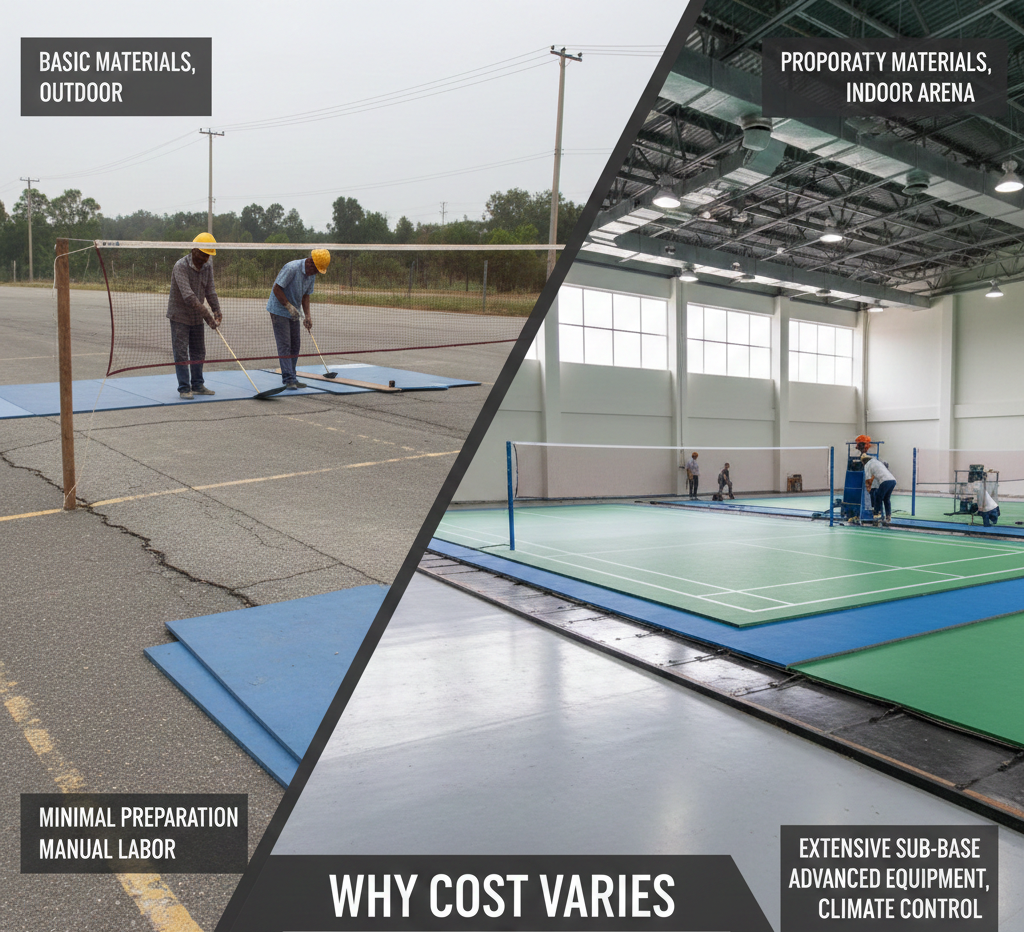
Before we talk numbers, it’s important to understand what drives the cost of building a badminton court. Several factors significantly affect the budget:
Type: Indoor vs Outdoor – Indoor courts generally cost more because they require proper flooring, roofing/structure (walls/roof or shed), lighting, ventilation, possibly air circulation, and overall finishing. Outdoor courts skip some of these, but need weather-resistant surface and drainage/flooring that can withstand rain/heat.
Before we talk numbers, it’s important to understand what drives the cost of building a badminton court. Several factors significantly affect the budget:
-
Type: Indoor vs Outdoor – Indoor courts generally cost more because they require proper flooring, roofing/structure (walls/roof or shed), lighting, ventilation, possibly air circulation, and overall finishing. Outdoor courts skip some of these, but need weather-resistant surface and drainage/flooring that can withstand rain/heat. blog.sports-facility.in+2sports-facility.in+2
-
Flooring Material & Surface Type – Flooring is perhaps the most important cost factor. Choices include wooden flooring, synthetic (PU/PVC), acrylic coatings, or simple concrete base. Quality, longevity, cushioning (for shock absorption), slip resistance — all vary by material. manufacturing.sports-facility.in+2blog.sports-facility.in+2
-
Base and Ground Preparation – A good foundation/ground base is essential for safe, even play. This includes leveling, concrete base (if required), drainage (especially for outdoor), sub-floor preparation. pacecourt.com+2manufacturing.sports-facility.in+2
-
Accessories & Finishing – Net posts & net, court markings, boundary lines, seating (if required), fencing (for outdoor with open surroundings), lighting (especially indoor), and other amenities (changing rooms, storage, ventilation) add to cost. blog.sports-facility.in+2manufacturing.sports-facility.in+2
-
Labor, Installation, Location & Local Factors – Labour charges, transport of materials, availability of skilled workers, cost of materials in your region, and any structural work (roofing, walls, shed) vary heavily by location; these influence total cost. manufacturing.sports-facility.in+2manufacturing.sports-facility.in+2
-
Purpose & Quality Level – A basic recreational court will cost much less than a “professional-grade” indoor court meant for coaching, tournaments or academy use. Higher quality materials, better flooring, proper structure, lighting, and finishing all push cost up.
Because of these variables, cost estimates tend to be wide — so it helps to know the ranges depending on what you want.
Standard Court Size & What It Means for Cost
A standard badminton court (singles/doubles) has official dimensions roughly: 13.4 m (44 ft) in length and 6.1 m (20 ft) width (doubles)
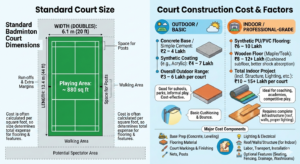
— that translates to about 880 sq ft area for the playing zone. blog.sports-facility.in+1
However, when constructing a court, you also need some clearance around the court (run-offs, extra margins), space for posts, walking area, and possibly spectator area or seating. So the actual “footprint” may be somewhat larger depending on layout. manufacturing.sports-facility.in+1
Because cost is often calculated per square foot (or per court), the standard court size helps estimate total expenses based on chosen flooring and features.
Typical Cost Ranges in India (Indoor vs Outdoor, by Quality)
Based on recent data and industry-standard estimates, here’s what you might expect to pay if you’re building a badminton court in India around 2024–2025:
✅ Outdoor / Basic / Budget-Friendly Courts
-
Concrete base / simple cement court: ~ ₹2,00,000 – ₹4,00,000 per court (basic, minimal setup) manufacturing.sports-facility.in+2manufacturing.sports-facility.in+2
-
Outdoor court with acrylic or synthetic coating (better surface than raw concrete): around ₹4,00,000 – ₹7,00,000 per court. manufacturing.sports-facility.in+2sports-facility.in+2
-
If using lower-cost synthetic flooring materials (PVC, basic PU, acrylic), and skipping heavy structural work or extra amenities — total for a single outdoor court often falls in ₹3–6 lakh range. manufacturing.sports-facility.in+2blog.sports-facility.in+2
These kinds of courts are common for recreational play: schools, housing societies, parks, or informal clubs. They are cost-effective, and while surface may not offer “professional-grade” bounce or cushioning, they work well for casual play.
🏠 Indoor / Professional-Grade Courts
If you aim for an indoor court — for training, coaching, club or academy use — with proper flooring, structure, lighting etc., costs increase significantly. Typical ranges:
-
Indoor synthetic/PU/PVC flooring courts: often around ₹6 – 10 lakh per court, depending on flooring quality, finishing, and included features. manufacturing.sports-facility.in+2manufacturing.sports-facility.in+2
-
Indoor wooden-floor courts (maple/teak, cushioned subfloor, better bounce & shock absorption — ideal for competitive training) tend to be more expensive: ₹8 – 12 lakh (or more) per court depending on finish. manufacturing.sports-facility.in+2arcylicflooring.in+2
-
If you add full structure: roofing or shed, walls (or partial walls if required), proper lighting (LED floodlights), ventilation or air circulation (fans or exhaust), nets/poles, court markings, and other finishing — total project cost per indoor court (standard size) can go up to ₹10–15 lakh (or slightly above), particularly in urban or high-spec setups. sports-facility.in+2manufacturing.sports-facility.in+2
Some sources even show variation depending on the comprehensiveness of design: base preparation, installation, labor, lighting, finishing — which may push costs higher. blog.sports-facility.in+2arcylicflooring.in+2
Cost Breakdown — What You Pay For
To get clarity, here’s roughly how the major cost components distribute when you build a court:
| Component / Feature | What it includes / Why it’s needed |
|---|---|
| Ground/base preparation & leveling | Excavation (if required), soil leveling, concrete base (for synthetic/acrylic or indoor courts), sub-floor — ensures even, stable surface. |
| Flooring / Surface | Wooden planks (maple/teak) for professional indoor courts; synthetic PU/PVC sheets or acrylic coatings for indoor/outdoor; cushioning layer, adhesives, subflooring or padding. |
| Court markings & finishing | Lines for singles, doubles, service zones; anti-slip coatings or top coats (especially for synthetic or acrylic surfaces). |
| Net posts & net | BWF-standard posts and durable net — essential equipment. |
| Lighting & electrical (mostly indoor) | LED or flood lighting to ensure visibility, especially for evening games or indoor halls. |
| Structure/roof/walls/ventilation (for indoor) | Roofing/shed or enclosed hall, walls or side panels (if needed), ventilation or fans/air-circulation for player comfort. |
| Accessories & optional features | Seating for spectators, boundary fencing (outdoor), changing rooms / storage / washrooms, drainage (for outdoor), etc. |
| Labor, transport, installation, finishing | Skilled labor, installation work, material transport, finishing touches — labor costs vary by location and contractor. |
Depending on what level of quality or amenities you want, each of these can add significantly to the budget.
What You Should Plan for (If You Are Budgeting a Court)
If you are thinking of building a badminton court — whether for personal use, club/academy, school, or housing complex — here are some planning recommendations based on cost and quality trade-offs:
-
Decide upfront: Indoor or Outdoor — If it’s a recreational court at a school, society or park, an outdoor synthetic or acrylic court may suffice. If you want frequent play, training, or professional-level use — indoor setup pays off.
-
Choose flooring based on use — For casual play, synthetic (PU/PVC) or acrylic outdoor court is economical and durable. For serious training/club use, wooden flooring (indoor) gives better performance, comfort, and longevity.
-
Allocate budget for accessories & finishing — Don’t overlook net posts, proper court marking, lighting (for indoor), safety (non-slip surface), ventilation or shading (indoor), drainage & fencing (outdoor) — these add value and usability.
-
Get professional contractors / good materials — Quality of base and installation matters; a poorly installed court (uneven floor, bad surface, poor drainage) will degrade quickly and may become unsafe.
-
Consider long-term maintenance & durability — Synthetic or coated courts need occasional maintenance (resurfacing, repainting lines), wooden courts need care (polishing, avoiding water exposure), outdoor courts need weather-resistant materials. Over time, better materials may save money from repairs or rework.
-
Budget for regional cost variation — Depending on where you are (city, local labor costs, material availability, transport), costs may vary. What is quoted in one city may differ in another. Always get local quotes.
Example Scenarios: What You Might Spend
Here are a few hypothetical but realistic scenarios for building a badminton court — to help you plan according to your budget and needs:
-
Scenario A — Budget Outdoor Court (for recreational play in school or society)
-
Simple concrete base → concrete or cement flooring → minimal finishing → net and posts
-
Estimated cost: around ₹2–4 lakh (basic concrete foot court) or up to ₹4–7 lakh if you go for a synthetic/acrylic surfaced outdoor court.
-
-
Scenario B — Standard Outdoor Synthetic Court (better surface, more durability)
-
Ground preparation + synthetic/acrylic surface + court marking + net + boundary (if needed)
-
Estimated cost: around ₹5–7 lakh per court (sometimes up to ₹8–10 lakh depending on materials and finishing).
-
-
Scenario C — Basic Indoor Court (synthetic flooring, minimal structure)
-
Base + PU/PVC flooring + net + posts + indoor lighting + basic structure / shelter / shade
-
Estimated cost: around ₹6–10 lakh per court (depending on quality of flooring, materials, labor).
-
-
Scenario D — Professional Indoor Court (wooden flooring, full finishing, good amenities)
-
Proper base + wooden floor (maple/teak) + cushioned sub-floor + good lighting + walls/roof/shed + ventilation + court accessories and finishing
-
Estimated cost: ₹8–12 lakh (or more) per court; in some cases, with high-end materials or added amenities, cost per court may reach ₹10–15 lakh.
-
Common Mistakes / Pitfalls to Avoid
While building a court, many people — especially first-timers — make avoidable mistakes. Here’s what to watch out for:
-
Going cheap on base preparation or leveling — a poor base means uneven surface, poor bounce, risk of injury, quick wear.
-
Using low-quality flooring or improper installation — leads to quick damage, slippery surface, frequent maintenance.
-
Skipping finishings like anti-slip coatings, proper line markings, drainage (for outdoor), lighting (for indoor) — this degrades usability and safety.
-
Not planning for space clearance — too tight a court leaves no room to move, no sidelines/run-offs, and can reduce player safety.
-
Ignoring maintenance & re-coating schedule — synthetic or PU surfaces require periodic maintenance or recoating; wooden floors need care; otherwise, durability suffers.
What to Do If You Want to Build a Court in a City like Yours (e.g. Prayagraj / other Smaller/Midsize Cities)
Since you are based in Prayagraj (or a similar city in India), here are some practical suggestions when you plan a court:
-
Contact local contractors with sports-flooring experience — labour and material costs are often cheaper in smaller cities compared to metros.
-
Opt for synthetic/acrylic surface for outdoor court if you just want recreational play or a small club — good balance of cost and durability.
-
If planning indoor court, try to get PU/PVC flooring (less expensive than wood) but ensure installation quality — gives fair comfort and durability at moderate cost.
-
Compare multiple vendor quotes — ask for itemized quotes: base work, flooring, installation, finishing, net & posts, lighting (if indoor) — helps avoid hidden costs.
-
Understand long-term maintenance costs — ask vendors about recommended maintenance, resurfacing frequency, and cost — so you are prepared.
-
Consider multi-use design (if budget-constrained) — for example, a court that doubles as multipurpose hall or can host other sports — improves utilization.
Building a badminton court is a significant but worthwhile investment — whether for personal use, a housing society, a school or a sports club. The cost can vary widely depending on what you want: from a simple concrete or acrylic-based outdoor court for ₹3–7 lakh, to a fully equipped indoor court with wooden flooring and amenities for ₹8–15 lakh (or more) per court.
The key lies in making informed decisions: selecting appropriate flooring based on intended use, ensuring proper base/preparation and installation, planning for accessories (net, lighting, drainage, ventilation), and budgeting for maintenance.
If you plan carefully — and perhaps engage a reputed local contractor — you can build a durable, safe and enjoyable badminton court even in a non-metro city without overshooting budget.
Flooring Material & Surface Type – Flooring is perhaps the most important cost factor. Choices include wooden flooring, synthetic (PU/PVC), acrylic coatings, or simple concrete base. Quality, longevity, cushioning (for shock absorption), slip resistance — all vary by material. manufacturing.sports-facility.in+2blog.sports-facility.in+2
Base and Ground Preparation – A good foundation/ground base is essential for safe, even play. This includes leveling, concrete base (if required), drainage (especially for outdoor), sub-floor preparation. pacecourt.com+2manufacturing.sports-facility.in+2
Accessories & Finishing – Net posts & net, court markings, boundary lines, seating (if required), fencing (for outdoor with open surroundings), lighting (especially indoor), and other amenities (changing rooms, storage, ventilation) add to cost. blog.sports-facility.in+2manufacturing.sports-facility.in+2
Labor, Installation, Location & Local Factors – Labour charges, transport of materials, availability of skilled workers, cost of materials in your region, and any structural work (roofing, walls, shed) vary heavily by location; these influence total cost. manufacturing.sports-facility.in+2manufacturing.sports-facility.in+2
Purpose & Quality Level – A basic recreational court will cost much less than a “professional-grade” indoor court meant for coaching, tournaments or academy use. Higher quality materials, better flooring, proper structure, lighting, and finishing all push cost up.
Because of these variables, cost estimates tend to be wide — so it helps to know the ranges depending on what you want.
Standard Court Size & What It Means for Cost
A standard badminton court (singles/doubles) has official dimensions roughly: 13.4 m (44 ft) in length and 6.1 m (20 ft) width (doubles) — that translates to about 880 sq ft area for the playing zone. blog.sports-facility.in+1
However, when constructing a court, you also need some clearance around the court (run-offs, extra margins), space for posts, walking area, and possibly spectator area or seating. So the actual “footprint” may be somewhat larger depending on layout. manufacturing.sports-facility.in+1
Because cost is often calculated per square foot (or per court), the standard court size helps estimate total expenses based on chosen flooring and features.
Typical Cost Ranges in India (Indoor vs Outdoor, by Quality)
Based on recent data and industry-standard estimates, here’s what you might expect to pay if you’re building a badminton court in India around 2024–2025:
✅ Outdoor / Basic / Budget-Friendly Courts
-
Concrete base / simple cement court: ~ ₹2,00,000 – ₹4,00,000 per court (basic, minimal setup) manufacturing.sports-facility.in+2manufacturing.sports-facility.in+2
-
Outdoor court with acrylic or synthetic coating (better surface than raw concrete): around ₹4,00,000 – ₹7,00,000 per court. manufacturing.sports-facility.in+2sports-facility.in+2
-
If using lower-cost synthetic flooring materials (PVC, basic PU, acrylic), and skipping heavy structural work or extra amenities — total for a single outdoor court often falls in ₹3–6 lakh range. manufacturing.sports-facility.in+2blog.sports-facility.in+2
These kinds of courts are common for recreational play: schools, housing societies, parks, or informal clubs. They are cost-effective, and while surface may not offer “professional-grade” bounce or cushioning, they work well for casual play.
🏠 Indoor / Professional-Grade Courts
If you aim for an indoor court — for training, coaching, club or academy use — with proper flooring, structure, lighting etc., costs increase significantly. Typical ranges:
-
Indoor synthetic/PU/PVC flooring courts: often around ₹6 – 10 lakh per court, depending on flooring quality, finishing, and included features. manufacturing.sports-facility.in+2manufacturing.sports-facility.in+2
-
Indoor wooden-floor courts (maple/teak, cushioned subfloor, better bounce & shock absorption — ideal for competitive training) tend to be more expensive: ₹8 – 12 lakh (or more) per court depending on finish. manufacturing.sports-facility.in+2arcylicflooring.in+2
-
If you add full structure: roofing or shed, walls (or partial walls if required), proper lighting (LED floodlights), ventilation or air circulation (fans or exhaust), nets/poles, court markings, and other finishing — total project cost per indoor court (standard size) can go up to ₹10–15 lakh (or slightly above), particularly in urban or high-spec setups. sports-facility.in+2manufacturing.sports-facility.in+2
Some sources even show variation depending on the comprehensiveness of design: base preparation, installation, labor, lighting, finishing — which may push costs higher. blog.sports-facility.in+2arcylicflooring.in+2
Cost Breakdown — What You Pay For
To get clarity, here’s roughly how the major cost components distribute when you build a court:
| Component / Feature | What it includes / Why it’s needed |
|---|---|
| Ground/base preparation & leveling | Excavation (if required), soil leveling, concrete base (for synthetic/acrylic or indoor courts), sub-floor — ensures even, stable surface. |
| Flooring / Surface | Wooden planks (maple/teak) for professional indoor courts; synthetic PU/PVC sheets or acrylic coatings for indoor/outdoor; cushioning layer, adhesives, subflooring or padding. |
| Court markings & finishing | Lines for singles, doubles, service zones; anti-slip coatings or top coats (especially for synthetic or acrylic surfaces). |
| Net posts & net | BWF-standard posts and durable net — essential equipment. |
| Lighting & electrical (mostly indoor) | LED or flood lighting to ensure visibility, especially for evening games or indoor halls. |
| Structure/roof/walls/ventilation (for indoor) | Roofing/shed or enclosed hall, walls or side panels (if needed), ventilation or fans/air-circulation for player comfort. |
| Accessories & optional features | Seating for spectators, boundary fencing (outdoor), changing rooms / storage / washrooms, drainage (for outdoor), etc. |
| Labor, transport, installation, finishing | Skilled labor, installation work, material transport, finishing touches — labor costs vary by location and contractor. |
Depending on what level of quality or amenities you want, each of these can add significantly to the budget.
What You Should Plan for (If You Are Budgeting a Court)
If you are thinking of building a badminton court — whether for personal use, club/academy, school, or housing complex — here are some planning recommendations based on cost and quality trade-offs:
-
Decide upfront: Indoor or Outdoor — If it’s a recreational court at a school, society or park, an outdoor synthetic or acrylic court may suffice. If you want frequent play, training, or professional-level use — indoor setup pays off.
-
Choose flooring based on use — For casual play, synthetic (PU/PVC) or acrylic outdoor court is economical and durable. For serious training/club use, wooden flooring (indoor) gives better performance, comfort, and longevity.
-
Allocate budget for accessories & finishing — Don’t overlook net posts, proper court marking, lighting (for indoor), safety (non-slip surface), ventilation or shading (indoor), drainage & fencing (outdoor) — these add value and usability.
-
Get professional contractors / good materials — Quality of base and installation matters; a poorly installed court (uneven floor, bad surface, poor drainage) will degrade quickly and may become unsafe.
-
Consider long-term maintenance & durability — Synthetic or coated courts need occasional maintenance (resurfacing, repainting lines), wooden courts need care (polishing, avoiding water exposure), outdoor courts need weather-resistant materials. Over time, better materials may save money from repairs or rework.
-
Budget for regional cost variation — Depending on where you are (city, local labor costs, material availability, transport), costs may vary. What is quoted in one city may differ in another. Always get local quotes.
Example Scenarios: What You Might Spend
Here are a few hypothetical but realistic scenarios for building a badminton court — to help you plan according to your budget and needs:
-
Scenario A — Budget Outdoor Court (for recreational play in school or society)
-
Simple concrete base → concrete or cement flooring → minimal finishing → net and posts
-
Estimated cost: around ₹2–4 lakh (basic concrete foot court) or up to ₹4–7 lakh if you go for a synthetic/acrylic surfaced outdoor court.
-
-
Scenario B — Standard Outdoor Synthetic Court (better surface, more durability)
-
Ground preparation + synthetic/acrylic surface + court marking + net + boundary (if needed)
-
Estimated cost: around ₹5–7 lakh per court (sometimes up to ₹8–10 lakh depending on materials and finishing).
-
-
Scenario C — Basic Indoor Court (synthetic flooring, minimal structure)
-
Base + PU/PVC flooring + net + posts + indoor lighting + basic structure / shelter / shade
-
Estimated cost: around ₹6–10 lakh per court (depending on quality of flooring, materials, labor).
-
-
Scenario D — Professional Indoor Court (wooden flooring, full finishing, good amenities)
-
Proper base + wooden floor (maple/teak) + cushioned sub-floor + good lighting + walls/roof/shed + ventilation + court accessories and finishing
-
Estimated cost: ₹8–12 lakh (or more) per court; in some cases, with high-end materials or added amenities, cost per court may reach ₹10–15 lakh.
-
Common Mistakes / Pitfalls to Avoid
While building a court, many people — especially first-timers — make avoidable mistakes. Here’s what to watch out for:
-
Going cheap on base preparation or leveling — a poor base means uneven surface, poor bounce, risk of injury, quick wear.
-
Using low-quality flooring or improper installation — leads to quick damage, slippery surface, frequent maintenance.
-
Skipping finishings like anti-slip coatings, proper line markings, drainage (for outdoor), lighting (for indoor) — this degrades usability and safety.
-
Not planning for space clearance — too tight a court leaves no room to move, no sidelines/run-offs, and can reduce player safety.
-
Ignoring maintenance & re-coating schedule — synthetic or PU surfaces require periodic maintenance or recoating; wooden floors need care; otherwise, durability suffers.
What to Do If You Want to Build a Court in a City like Yours (e.g. Prayagraj / other Smaller/Midsize Cities)
Since you are based in Prayagraj (or a similar city in India), here are some practical suggestions when you plan a court:
-
Contact local contractors with sports-flooring experience — labour and material costs are often cheaper in smaller cities compared to metros.
-
Opt for synthetic/acrylic surface for outdoor court if you just want recreational play or a small club — good balance of cost and durability.
-
If planning indoor court, try to get PU/PVC flooring (less expensive than wood) but ensure installation quality — gives fair comfort and durability at moderate cost.
-
Compare multiple vendor quotes — ask for itemized quotes: base work, flooring, installation, finishing, net & posts, lighting (if indoor) — helps avoid hidden costs.
-
Understand long-term maintenance costs — ask vendors about recommended maintenance, resurfacing frequency, and cost — so you are prepared.
-
Consider multi-use design (if budget-constrained) — for example, a court that doubles as multipurpose hall or can host other sports — improves utilization.
Conclusion
Building a badminton court is a significant but worthwhile investment — whether for personal use, a housing society, a school or a sports club. The cost can vary widely depending on what you want: from a simple concrete or acrylic-based outdoor court for ₹3–7 lakh, to a fully equipped indoor court with wooden flooring and amenities for ₹8–15 lakh (or more) per court.
The key lies in making informed decisions: selecting appropriate flooring based on intended use, ensuring proper base/preparation and installation, planning for accessories (net, lighting, drainage, ventilation), and budgeting for maintenance.