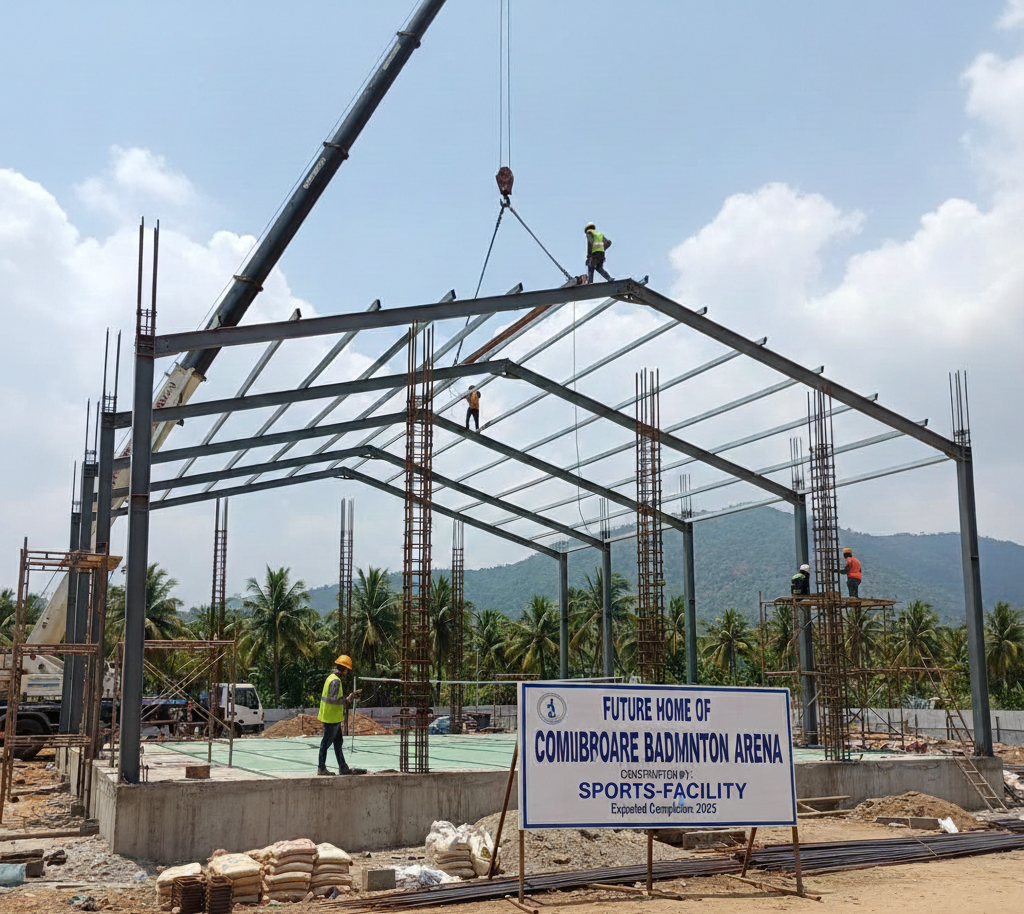
Introduction: Why Build a Court in Coimbatore
Coimbatore, with its growing enthusiasm for sports and recreation, offers a promising environment for badminton facilities. Given fluctuating weather, humidity, and the mix of indoor/outdoor needs, constructing a dedicated badminton court — whether indoor or outdoor — requires thoughtful planning. A well-built court in Coimbatore can serve sports‑clubs, residential complexes, schools, or community centers, providing year‑round access regardless of weather or season.
Building a court here involves balancing standard sport‑specifications, local climate realities (heat, humidity, rain), and cost‑effective construction. This guide outlines all necessary considerations so you can set up a long‑lasting, comfortable, and regulation‑compliant badminton facility in Coimbatore.
Understanding Standard Requirements for a Badminton Court
Before site‑specific adjustments, the facility must meet globally accepted standards for badminton court dimensions and layout:
-
Playing court dimensions (for doubles): 13.40 meters length × 6.10 meters width.
-
Total playable area with clearances for safe movement: For indoor courts, many designs suggest a floor‑space of roughly 18 m × 10 m per court to include run‑offs, safe zones around the court, and sufficient walkways.
-
Ceiling / overhead clearance (for indoor courts): To allow high clears and smashes without interference, overhead clearance should be enough so flight of the shuttle won’t hit beams, lights or roof. Industry guidelines often recommend lights and other fixtures mounted high to avoid obstruction.
Meeting these basic requirements ensures the court is suitable for regular play and possibly tournaments or coaching sessions.
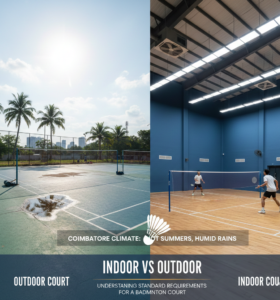
Choosing Between Indoor vs Outdoor Court (Considering Coimbatore’s Climate)
In Coimbatore, weather and seasons often influence when and how people play. Thus, whether you build an indoor or outdoor court will depend on usage goals, budget, and maintenance commitment.
Outdoor Court Pros & Cons
-
Pros: Lower construction cost compared to an indoor hall; natural ventilation; easier access and simpler structure.
-
Cons / Risks: Exposure to sun, rain, humidity can damage surface, cause water accumulation, affect grip, and shorten lifespan. Proper site planning (avoiding flood‑prone areas), drainage, and weather‑resistant flooring are critical.
-
Best for: Residential complexes, schools, parks, or casual/recreational use where heavy maintenance is manageable and usage might be intermittent.
Indoor Court Pros & Cons
-
Pros: Controlled environment — protection from rain, sun, high humidity; stable flooring conditions; better lighting and ventilation possible; usable year‑round including during monsoon or peak summer.
-
Cons: Higher upfront cost due to structure (roof, walls), proper flooring, lighting, ventilation / HVAC; need for drainage or humidity control in humid climate zones like Coimbatore.
-
Best for: Sports clubs, coaching centers, schools wanting consistent year‑round court availability; multi‑court facilities; tournaments and regular play regardless of weather.
Given Coimbatore’s climate — with hot summers and significant humidity during rains — an indoor court often yields better long‑term playability and lower maintenance hassles if you can invest upfront.
Site Preparation: Ground, Drainage, and Foundation
Whether indoor or outdoor, proper site preparation is critical for durability and safety. Key steps:
-
Ground clearing and leveling: Remove debris, level ground; ensure soil compaction (targeting adequate density) to prevent subsidence or unevenness over time.
-
Drainage arrangement (especially for outdoor courts): Provide gentle slope or drainage system to avoid water pooling after rain — vital in monsoon or post‑rain periods.
-
Moisture‑proofing / waterproof membrane (for indoor courts): Given humidity and possible condensation, a moisture‑proof barrier beneath flooring (or within subfloor structure) helps prevent damage and prolong court life.
-
Strong and level foundation: If constructing an indoor hall, concrete base or proper sub-base is recommended; this supports flooring, net‑posts, lighting rigs, and ensures structural stability.
A sound foundation and site prep reduce long‑term maintenance, prevent warping or cracks, and safeguard players from injuries due to surface irregularities.
Flooring & Surface Material: Matching Use and Budget
Selecting the right flooring material is perhaps the most important decision affecting play quality — grip, shock absorption, safety, maintenance. Options typically used in India (and suitable for Coimbatore) include:
-
Wooden Flooring (sprung / maple / pine-based sports flooring): Often used in professional indoor courts; offers excellent shock absorption, good feel underfoot, and consistent bounce — ideal for clubs, academies or serious players.
-
Effective and relatively easier to maintain than wood; suitable for indoor courts on budget, or multi‑purpose halls. Provides grip and durability, though may be less “premium” feel compared to wood.
-
Outdoor Acrylic / Weather‑Resistant Surfaces (for open‑air courts): If you plan an outdoor court, coatings that resist UV, rain, and weather are essential. But such surfaces are more prone to wear and require regular maintenance, especially under Coimbatore’s sunshine/humidity.
Your choice should depend on budget, intended use (casual vs professional), maintenance capacity, and whether the court is indoor or outdoor.
Lighting, Ventilation and Environmental Comfort — Critical in a Place Like Coimbatore
Especially for indoor courts in a city like Coimbatore, designing for comfort and performance is vital:
-
Lighting: Use LED lighting with uniform distribution to avoid glare or shadows. For recreational play, around 500–750 lux is recommended; for more serious or competitive use, aim higher (e.g. 750–1000 lux). Lights should be mounted high enough above the court to avoid interfering with shuttle path.
-
Ventilation / Air Circulation: Given Coimbatore’s warm weather and humidity, good airflow is essential. Use exhaust fans or HVAC systems if indoors, and ensure air‑vents or grilles are placed so they don’t cause unpredictable drafts that disturb shuttle flight.
-
Temperature & Humidity Control: Indoor halls should aim to maintain moderate temperature and humidity — too hot/humid conditions make play uncomfortable and could affect floor condition; a well‑insulated or ventilated hall helps prolong life of flooring and ensures comfort.
-
Wall Finishes & Acoustics (for indoor halls): Matte, non-reflective paint on walls (e.g. dark or neutral colors) helps with shuttle visibility. Acoustic treatment may also be considered to reduce echo, improving comfort during training or events.
Proper environmental controls make the court usable year‑round and enhance player experience, which is especially important in hot or humid climates like that of Coimbatore.
Compliance, Permits & Local Regulations
Before constructing a court in Coimbatore (or anywhere), it’s wise to check local zoning laws, building permits, and any municipal requirements — especially for indoor halls or structures.
Obtaining clearances and complying with regulations helps avoid legal complications, ensures safety standards, and often brings long‑term benefits, such as property value or eligibility for sports‑facility certification.
Cost Considerations & Budgeting (In Indian Context)
Cost of building a badminton court varies depending on specifications: flooring type, indoor vs outdoor, quality of materials, lighting/ventilation, etc. Rough guidelines observed in India:
-
Basic outdoor court (with acrylic/PU surface, minimal structure): lower cost — perhaps suitable for recreational use.
-
Indoor court with synthetic flooring: moderate cost — mid‑range option for clubs or community halls.
-
Indoor court with professional wooden flooring, proper lighting, ventilation, structural hall: higher cost, but offers longevity, comfort, and better playing experience.
When budgeting, also factor in long-term maintenance (cleaning, floor re‑coating, ventilation upkeep), utilities (electricity for lighting, fans or AC), and possible water drainage or moisture control — especially relevant in humid or rainy seasons typical to Coimbatore.
Maintenance & Longevity: Keeping the Court Fit for Years
A well-constructed court still needs regular maintenance to ensure safety and longevity — more so in a climate with high humidity and seasonal rains:
-
Clean flooring regularly; avoid moisture accumulation. For outdoor courts, ensure drainage works well and water does not stagnate.
-
Inspect flooring and structure periodically for wear, warping, or damage — especially in synthetic / vinyl or acrylic surfaces.
-
Maintain ventilation and lighting systems; check for wiring, fixture safety, and proper light distribution.
-
If outdoors, repaint boundary lines / markings when they fade; for indoor flooring, re‑coating or sealing may be needed periodically.
Proper maintenance increases lifespan, keeps play safe, and ensures a good experience for players year after year.
Suitability and Use Cases in Coimbatore — Who Should Build What
Given all above, here are some recommendations for different scenarios in Coimbatore:
| Use Case / Client | Recommended Court Type & Features |
|---|---|
| Residential complexes, housing societies, small clubs | Outdoor court with weather‑resistant surface + drainage; economical flooring (acrylic/PU); basic net & boundary setup. |
| Schools, colleges, coaching institutes | Indoor court with synthetic or wooden flooring; good lighting and ventilation; basic amenities (storage, benches). |
| Professional clubs, sports academies, tournaments | Full indoor hall: sprung wooden floor, proper run‑offs and clearances, LED lighting, ventilation/HVAC, high‑quality nets/fixtures. |
| Multipurpose community halls (sports + events) | Modular indoor hall with synthetic flooring; flexibility for conversion; removable net setup; provisions for lighting/ventilation; storage space. |
Tailor the design based on usage frequency, budget, and long‑term vision.
Conclusion
Constructing a badminton court in Coimbatore involves more than just laying a playing surface — it demands a balance between sport standards, local climate, material selection, structural planning, and long-term maintenance. By carefully selecting between indoor and outdoor setups, preparing the site properly, choosing suitable flooring, and incorporating lighting, ventilation, and drainage, you can create a durable, comfortable, regulation-compliant badminton facility.
Whether you aim to build a simple recreational court or a full-fledged indoor hall for coaching and tournaments, this guide provides the foundation (both literally and figuratively) to plan effectively in Coimbatore. With thoughtful design and maintenance, your badminton court can become a hub of sport, fitness, and community engagement for years to come.