Tennis is a sport where precision, speed, and strategy intersect. While athletic skill and training are essential, the quality of the playing surface plays an equally critical role in determining performance, safety, and enjoyment. Premium tennis court surfaces are not merely construction elements—they are long-term investments that define how the game is played, how players feel, and how a facility is perceived.
From professional tournaments and sports academies to schools, clubs, resorts, and private residences, premium tennis court surfaces deliver consistent playability, enhanced safety, and superior durability. This comprehensive guide explores everything you need to know about premium tennis court surfaces, including types, benefits, selection factors, installation, and maintenance.
Why Premium Tennis Court Surfaces Are Essential
A tennis court surface directly influences ball bounce, speed, grip, and player movement. Inferior surfaces can lead to inconsistent play, increased injury risk, and higher maintenance costs over time. Premium tennis court surfaces are engineered to meet professional standards while offering long-term value.
Key Advantages of Premium Tennis Court Surfaces
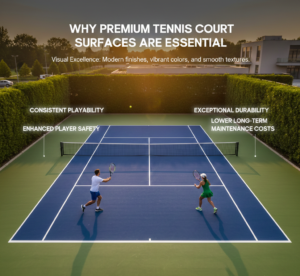
Consistent Playability
Premium surfaces provide uniform ball bounce and predictable speed, allowing players to focus on technique and strategy rather than surface irregularities.
Enhanced Player Safety
High-quality materials improve traction and shock absorption, reducing stress on joints, muscles, and ligaments. This is especially important for frequent players and competitive athletes.
Exceptional Durability
Premium tennis court surfaces are designed to withstand heavy usage, weather fluctuations, and UV exposure, maintaining performance for decades with proper care.
Visual Excellence
Modern finishes, vibrant colors, and smooth textures elevate the overall appearance of sports facilities and private properties.
Lower Long-Term Maintenance Costs
Advanced surface technologies resist cracking, fading, and erosion, reducing repair frequency and operational expenses.
Types of Premium Tennis Court Surfaces
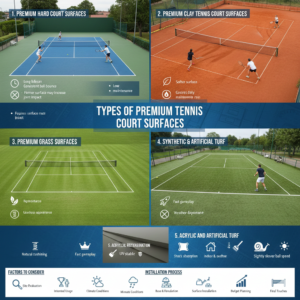
Selecting the right surface depends on playing style, climate, maintenance capacity, and budget. Below are the most widely used premium tennis court surfaces.
1. Premium Hard Court Surfaces
Hard courts are the most common and versatile option worldwide. They are typically constructed with asphalt or concrete and finished with acrylic or polyurethane coatings.
Benefits
-
Long lifespan with minimal structural wear
-
Consistent ball bounce suitable for all playing levels
-
Ideal for tournaments, clubs, and residential courts
-
Customizable surface speed and color combinations
-
Low maintenance compared to clay or grass
Considerations
-
Firmer surface may increase joint impact over long sessions
-
Requires periodic resurfacing to maintain performance
2. Premium Clay Tennis Court Surfaces
Clay courts are renowned for slower gameplay and extended rallies, promoting tactical skill and endurance.
Benefits
-
Softer surface reduces impact on knees and ankles
-
Encourages strategic and defensive play
-
Cooler surface temperature in hot climates
-
Classic, natural aesthetic
Considerations
-
Requires daily maintenance such as watering and rolling
-
Sensitive to rain without proper drainage
-
Higher maintenance costs compared to hard courts
3. Premium Grass Tennis Court Surfaces
Grass courts represent tradition and prestige, offering fast play and low ball bounce.
Benefits
-
Natural cushioning minimizes joint stress
-
Fast, professional-level gameplay
-
Visually striking and luxurious appearance
Considerations
-
High maintenance including mowing and irrigation
-
Weather-dependent performance
-
Significant installation and upkeep investment
4. Synthetic and Artificial Turf Tennis Courts
Modern synthetic tennis court surfaces combine durability, comfort, and reduced maintenance.
Benefits
-
Cushioned layers improve shock absorption
-
Suitable for indoor and outdoor installations
-
Lower maintenance than natural grass
-
Customizable colors and textures
Considerations
-
Slightly slower ball speed
-
High-quality systems require higher initial investment
5. Acrylic and Polyurethane Tennis Court Coatings
These coatings are often applied over hard court bases to enhance grip, aesthetics, and durability.
Benefits
-
Excellent traction and slip resistance
-
UV-stable and weather-resistant
-
Adjustable surface speed for different playing levels
-
Smooth, professional-grade finish
Considerations
-
Requires periodic recoating
-
Professional application is essential for uniformity
Factors to Consider When Choosing Premium Tennis Court Surfaces
Choosing the right premium tennis court surface involves balancing performance expectations with practical considerations.
Intended Usage
-
Competitive training and tournaments benefit from hard or acrylic surfaces
-
Recreational play may prioritize comfort with clay or synthetic turf
Climate Conditions
-
Hot climates favor clay or cushioned synthetic systems
-
Rain-prone areas require advanced drainage solutions
Maintenance Capabilities
-
Hard and synthetic courts offer low maintenance
-
Clay and grass demand regular, hands-on care
Budget Planning
-
Hard courts provide strong long-term value
-
Clay and grass involve higher installation and ongoing costs
Player Demographics
-
Professionals prefer predictable speed and bounce
-
Casual players often favor softer, forgiving surfaces
Installation Process for Premium Tennis Court Surfaces
Proper installation is critical to achieving the full benefits of premium tennis court surfaces.
Site Evaluation and Design
-
Soil testing, drainage planning, and surface orientation
-
Layout compliance with ITF and regional standards
Base and Foundation Construction
-
Excavation and leveling
-
Installation of crushed stone sub-base for stability
Surface Installation
-
Hard courts: Asphalt or concrete with acrylic layers
-
Clay courts: Multiple compacted clay layers
-
Grass courts: Turf with engineered base systems
-
Synthetic courts: Artificial turf with shock-absorbing infill
Final Touches
-
Accurate line marking
-
Net post installation
-
Optional lighting, fencing, and landscaping
Maintenance of Premium Tennis Court Surfaces
Regular care ensures optimal performance and long lifespan.
-
Hard Courts: Cleaning, crack inspection, periodic resurfacing
-
Clay Courts: Daily watering, rolling, brushing
-
Grass Courts: Mowing, irrigation, reseeding
-
Synthetic Courts: Brushing, infill adjustment, washing
With proper maintenance, premium tennis court surfaces can last 15–25 years or more.
Long-Term Benefits of Premium Tennis Court Surfaces
-
Professional-level playing experience
-
Reduced injury risk for players
-
Elevated facility aesthetics
-
Increased property and facility value
-
Sustainable construction with longer replacement cycles
Selecting the Right Tennis Court Contractor
A professional contractor ensures:
-
Compliance with international standards
-
High-quality materials and installation
-
Effective drainage and leveling
-
Long-term durability
-
Expert maintenance guidance
Conclusion
tennis court surfaces are the backbone of exceptional tennis experiences. They enhance performance, protect players, elevate aesthetics, and provide lasting value. Whether you are building a professional facility, sports academy, school court, or private residence, investing in tennis court surfaces ensures quality, safety, and longevity.
Premium Tennis Court Surfaces – FAQs
1. What are premium tennis court surfaces?
Premium tennis court surfaces are high-performance playing systems designed to deliver superior ball bounce, player comfort, durability, and safety. They are built using advanced materials and precise installation methods to meet professional, training, and recreational standards.
2. What types of premium tennis court surfaces are available?
Common premium tennis court surface options include:
-
Acrylic tennis court surfaces
-
Cushioned acrylic systems
-
Synthetic turf tennis courts
-
Clay-based (artificial clay) systems
-
PU or modular sports flooring (indoor use)
Each surface offers different playing speeds, comfort levels, and maintenance requirements.
3. Which tennis court surface is considered the best overall?
Acrylic tennis court surfaces are the most widely used premium option worldwide. They offer:
-
Consistent ball bounce
-
Excellent grip and slip resistance
-
Weather and UV resistance
-
Low maintenance and long lifespan
They are suitable for both recreational and professional play.
4. What is a cushioned tennis court surface?
A cushioned tennis court includes elastic shock-absorbing layers beneath the acrylic topcoat. These layers:
-
Reduce impact on joints and knees
-
Lower injury risk
-
Improve comfort during long matches
Cushioned systems are ideal for academies, clubs, and high-usage courts.
5. How does the tennis court surface affect gameplay?
The surface directly influences:
-
Ball speed and bounce
-
Player movement and grip
-
Joint stress and fatigue
For example, acrylic courts provide medium-fast play, cushioned courts add comfort, and synthetic turf slows the game slightly.
6. Are premium tennis court surfaces suitable for outdoor use?
Yes. Outdoor premium tennis court surfaces are designed to be:
-
UV-resistant
-
Weatherproof
-
Slip-resistant
-
Durable under temperature variations
Proper drainage and base preparation are essential for outdoor performance.
7. What surfaces are best for indoor tennis courts?
Indoor tennis courts often use:
-
PU (Polyurethane) sports flooring
-
Modular sports tiles
-
Synthetic turf systems
These provide controlled playing conditions, shock absorption, and consistent performance.
8. What base is required for premium tennis court surfaces?
A strong and level concrete or asphalt base is required. Proper base construction ensures:
-
Uniform ball bounce
-
Crack resistance
-
Long-term durability
Base quality plays a major role in overall court performance.
9. How long do premium tennis court surfaces last?
With proper installation and maintenance:
-
Acrylic surfaces: 8–12 years
-
Cushioned acrylic systems: Similar lifespan with better comfort
-
Synthetic turf courts: 6–10 years depending on usage
Regular maintenance can extend surface life.
10. What maintenance do premium tennis courts require?
Maintenance typically includes:
-
Regular cleaning and debris removal
-
Periodic inspection for cracks or wear
-
Recoating acrylic surfaces every few years
-
Line repainting when required
Premium surfaces are designed for low ongoing maintenance.