. Introduction
-
Importance of quality cricket turf for professional and amateur cricket.
-
Benefits of proper turf: player safety, game quality, aesthetics.
-
Overview of the process and timeline.
2. Understanding Cricket Turf
-
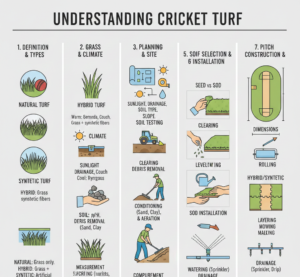
Definition of cricket turf.
-
Difference between natural turf, hybrid turf, and synthetic turf.
-
Types of grass suitable for cricket pitches (Bermuda, Ryegrass, Couch, etc.).
-
Climate and soil considerations for different regions.
3. Planning and Site Assessment
-
Selecting a site: sunlight, drainage, soil type, and slope.
-
Measuring the area for the cricket pitch and outfield.
-
Soil testing: pH levels, nutrient content, compaction.
-
Environmental factors: rainfall, humidity, and temperature.
4. Soil Preparation
-
Clearing existing vegetation.
-
Removing rocks, debris, and old roots.
-
Soil conditioning: adding sand, clay, or loam.
-
Levelling and grading the ground.
-
Importance of proper compaction and aeration.
5. Turf Selection
-
Choosing the right grass species.
-
Seed vs. sod: pros and cons.
-
Grass growth patterns and suitability for cricket.
-
Disease-resistant and drought-tolerant varieties.
6. Installation Techniques
-
Seeding Method:
-
Preparation of seedbed.
-
Seeding rates and patterns.
-
Mulching and watering schedules.
-
-
Sod Installation:
-
Sod selection and delivery.
-
Laying techniques and alignment.
-
Rolling and watering for root establishment.
-
-
Hybrid and Synthetic Turf:
-
Overview of installation.
-
Advantages and drawbacks.
-
Maintenance considerations.
-
7. Pitch Construction
-
Dimensions and layout for cricket pitches.
-
Soil composition and layering.
-
Grass cutting and mowing schedules for match-ready turf.
-
Rolling techniques for bounce and pace consistency.
-
Marking and maintaining pitch boundaries.
8. Irrigation Systems
-
Importance of proper watering.
-
Types of irrigation: sprinkler, drip, and manual watering.
-
Scheduling based on soil type and grass species.
-
Drainage considerations and avoiding waterlogging.
9. Fertilization and Nutrient Management
-
Essential nutrients: Nitrogen, Phosphorus, Potassium.
-
Organic vs. chemical fertilizers.
-
Fertilization schedules based on season and grass type.
-
Soil testing and correction of nutrient deficiencies.
10. Pest and Disease Management
-
Common pests affecting cricket turf.
-
Preventive measures and treatments.
-
Fungal diseases and how to manage them.
-
Integrated pest management techniques.
11. Maintenance Practices
-
Mowing and trimming schedules.
-
Aeration and top-dressing techniques.
-
Rolling and compaction for optimal playability.
-
Seasonal maintenance and recovery after matches.
12. Safety Considerations
-
Player safety: consistent bounce, traction, and soft edges.
-
Avoiding slippery or uneven surfaces.
-
Protective measures for irrigation and maintenance equipment.
13. Costing and Budgeting
-
Material costs: soil, seeds, sod, irrigation.
-
Labor and machinery costs.
-
Long-term maintenance budgeting.
-
ROI for professional and amateur clubs.
14. Challenges and Solutions
-
Soil erosion, uneven turf growth.
-
Climate-related challenges: drought, excessive rain.
-
Maintenance mistakes to avoid.
-
Case studies of successful cricket grounds.
15. Conclusion
-
Recap of steps for successful cricket turf installation.
-
Importance of ongoing maintenance.
-
Benefits to players, clubs, and spectators