A basketball court is more than just a playing surface—it is a precisely designed sports environment where every line, marking, and dimension plays a crucial role in ensuring fairness, safety, and smooth gameplay. From school playgrounds and training academies to professional indoor arenas and international tournaments, a full basketball court must follow standardized measurements defined by global governing authorities.
Understanding the full basketball court size in meters is essential for architects, sports planners, contractors, coaches, and facility owners. This detailed guide explains official court dimensions, layout markings, and spacing requirements based on FIBA and NBA standards, along with practical insights for construction and surface selection.
Standard Full Basketball Court Dimensions (FIBA)
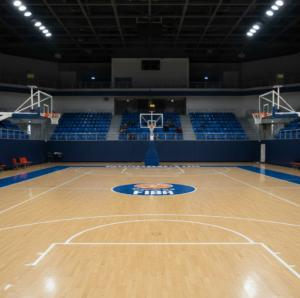
The International Basketball Federation (FIBA) governs most international basketball competitions, including school-level games, amateur leagues, and professional tournaments outside the NBA. FIBA standards are also the most commonly adopted worldwide for indoor sports facilities.
Official FIBA Court Size:
-
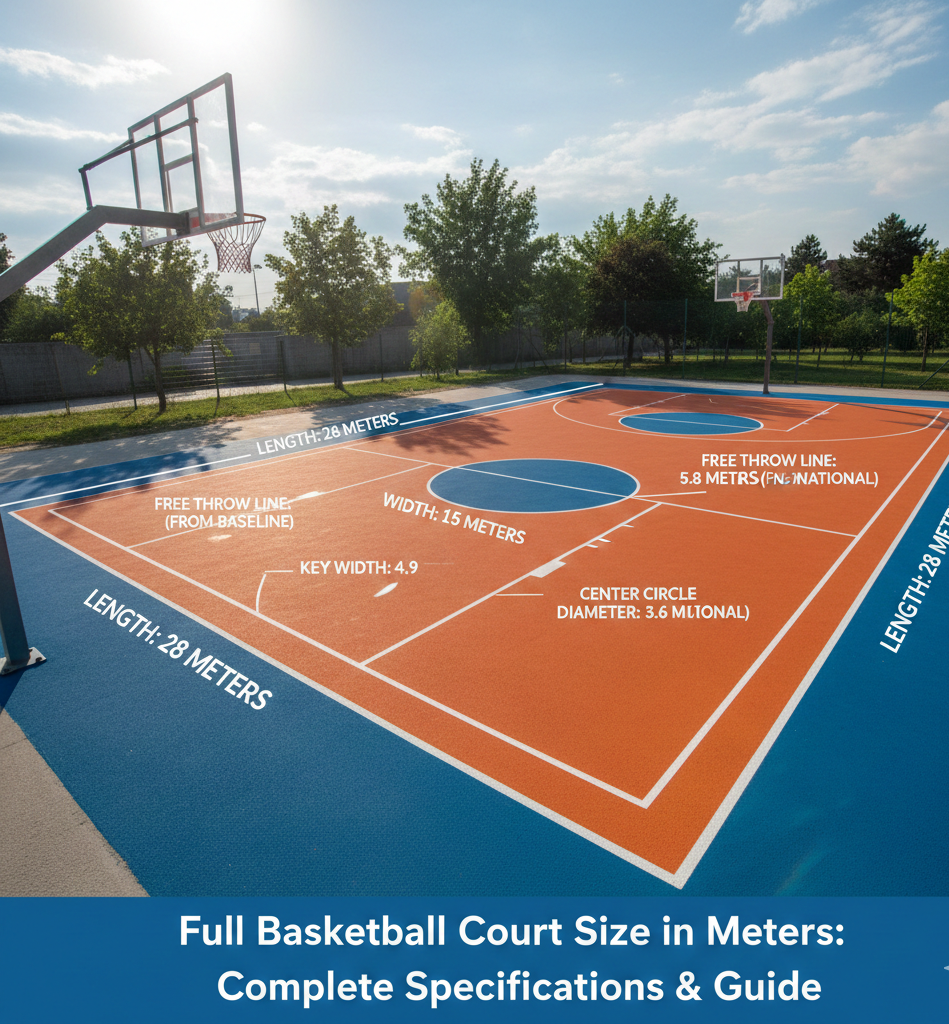
Length: 28 meters
-
Width: 15 meters
This creates a rectangular playing area that allows balanced offensive and defensive movement while maintaining fast-paced gameplay. These dimensions are measured from the inside edge of the boundary lines.
The 28m × 15m court size is widely used because it fits well within indoor sports halls and multi-purpose arenas while still meeting professional gameplay requirements.
Standard Full Basketball Court Dimensions (NBA)
The National Basketball Association (NBA) follows slightly larger court measurements. These dimensions are primarily used in professional leagues in the United States and NBA-regulated arenas.
Official NBA Court Size:
-
Length: 28.65 meters (94 feet)
-
Width: 15.24 meters (50 feet)
Although the difference compared to FIBA standards is relatively small, NBA courts offer slightly more space, especially along the sidelines and baselines. When designing courts intended for international use, FIBA dimensions are generally preferred due to their global acceptance.
Key Areas and Markings on a Full Basketball Court
A full basketball court is divided into multiple zones, each with precise measurements that influence gameplay rules and player positioning.
1. The Key (Restricted Area / Paint Area)
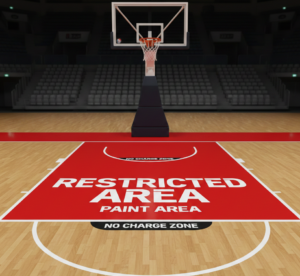
The key, commonly known as the paint, is one of the most critical zones on the basketball court. It controls player movement near the basket and helps regulate offensive dominance.
FIBA Key Dimensions:
-
Width: 4.9 meters
-
Length (baseline to free-throw line): 5.8 meters
-
Restricted semi-circle radius: 1.25 meters
The restricted area arc below the basket prevents defensive players from drawing charging fouls when standing directly under the hoop. Accurate marking of this area is essential for fair officiating.
2. Free-Throw Line and Free-Throw Circle
The free-throw area is used for penalty shots after fouls and is a focal point during set plays.
Measurements:
-
Distance from baseline to free-throw line: 5.8 meters
-
Free-throw circle radius: 1.8 meters
-
Line thickness: 5 to 10 centimeters
The upper half of the free-throw circle is drawn with a solid line, while the lower half is usually dashed. This layout allows proper player positioning during free throws.
3. Three-Point Line
The three-point line significantly impacts modern basketball strategies, encouraging long-range shooting and floor spacing.
Three-Point Distances:
-
FIBA: 6.75 meters from the center of the basket
-
NBA:
-
7.24 meters at the top
-
6.7 meters at the corners
-
Proper measurement ensures consistent scoring rules.
4. Center Circle and Mid-Court Line
The center of the court is where games begin and restart after halftime.
Center Court Specifications:
-
Center circle diameter: 3.6 meters
-
Center line: Divides the court into two equal halves of 14 meters each
The center circle must be clearly visible to ensure correct jump-ball positioning at the start of the game.
5. Basket, Rim, and Backboard Specifications
Basket and backboard dimensions are universally standardized, meaning they remain consistent across all professional and amateur levels.
Official Measurements:
-
Rim height from floor: 3.05 meters
-
Rim diameter: 45 centimeters
-
Backboard width: 1.8 meters
-
Backboard height: 1.05 meters
-
Distance from baseline to backboard: 1.2 meters
6. Sidelines, Baselines, and Boundary Markings
Court Boundaries:
-
Sidelines (length): 28 meters
-
Baselines (width): 15 meters
The lines must be uniform throughout the court.
Additional Clearance and Safety Zones
Clearance Requirements:
-
Minimum free zone: 2 meters on all sides
-
Recommended for competitive venues: 3 meters or more
This extra space accommodates referee movement, prevents collisions, and allows safe player momentum near boundaries.
Flooring and Surface Requirements
The performance and safety of a basketball court depend heavily on the quality of its surface. A properly designed court floor should provide:
-
Effective shock absorption to reduce joint stress
-
Slip resistance for quick direction changes
-
Durability to handle constant play
-
Consistent ball bounce across the entire surface
Common Basketball Court Flooring Options:
-
Maple hardwood flooring (professional indoor courts)
-
Synthetic polyurethane (PU) sports flooring
-
Vinyl sports flooring systems
-
Outdoor acrylic court surfaces
Each surface type should comply with international sports flooring standards to ensure player comfort and long-term performance.
Indoor vs Outdoor Basketball Court Considerations
-
Indoor courts require controlled lighting, ventilation, and moisture protection
-
Outdoor courts must be weather-resistant, UV-stable, and designed for drainage
Conclusion
a standard size of 28 meters by 15 meters (FIBA) or 28.65 meters by 15.24 meters (NBA), along with precisely marked zones such as the key, three-point line, and free-throw areas, these courts ensure consistency, fairness, and high-level performance.
Whether you are planning a school playground, training academy, community sports center, or professional arena, adhering to official basketball court dimensions in meters guarantees safety, durability, and global compatibility. Proper design not only enhances gameplay but also supports athlete development and long-term facility value.