Selecting the right basketball court flooring is a critical decision when constructing a new court or upgrading an existing one. The flooring system you choose directly impacts player safety, performance, and the long-term value of your facility. A well-engineered basketball surface supports rapid acceleration, sudden deceleration, sharp directional changes, and continuous jumping while minimizing joint stress and reducing injury risk. Whether you are setting up a professional indoor arena, a school gymnasium, a residential backyard court, a community sports centre, or a training academy, understanding your flooring options ensures you make a choice that aligns with performance expectations, maintenance capability, and budget.
This comprehensive guide explores the top basketball flooring types in 2025, their benefits, installation insights, performance standards, and expert recommendations to help you select the ideal court surface.
Why Choosing the Right Basketball Court Flooring Matters
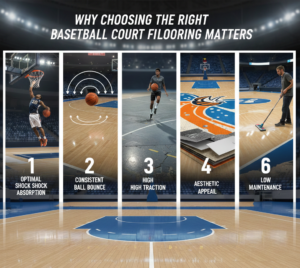
Basketball is a dynamic, high-impact sport requiring rapid movement, precision, and stability. The floor is more than just a surface—it is an integral part of the playing environment. A high-quality basketball court floor provides:
-
Optimal Shock Absorption: Reduces stress on joints, knees, and lower back.
-
Consistent Ball Bounce: Ensures accurate rebound and enhances game fairness.
-
High Traction: Prevents slips and enables quick lateral movement.
-
Durability: Withstands continuous foot traffic, ball impacts, and equipment wear.
-
Aesthetic Appeal: Enhances the visual appeal of indoor arenas or training facilities.
-
Low Maintenance: Minimizes operational costs and effort over the lifecycle.
Neglecting to select the right floor can result in reduced player performance, increased injury risk, frequent repairs, and a shorter lifespan for your court. Choosing a professional-grade flooring solution from the outset is crucial for both performance and safety.
Top Basketball Court Flooring Types in 2025
Different materials cater to different needs, whether professional competition, school-level sports, or residential recreation. Below are the most popular and high-performing basketball flooring options available today.
1. Maple Hardwood Flooring (Professional Indoor Courts)
Best For: NBA, FIBA, college-level indoor arenas, professional academies.
Maple hardwood has long been the gold standard for indoor basketball courts. Its dense, durable structure offers natural shock absorption and consistent ball rebound, making it ideal for competitive play. Modern maple courts often incorporate a sprung subfloor system to enhance comfort and reduce stress on players’ joints.
Key Benefits:
-
Exceptional durability and long lifespan (20–40 years with proper maintenance).
-
Natural shock absorption for safer play.
-
Premium ball bounce quality for consistent game performance.
-
Classic and professional sports aesthetics.
Considerations:
-
High initial investment and installation cost.
-
Requires climate-controlled environments to prevent warping.
-
Regular maintenance including polishing, cleaning, and occasional resurfacing is necessary.
Maple hardwood remains the top choice for facilities seeking the ultimate indoor performance and professional-level play.
2. Polyurethane (PU) Sports Flooring
Best For: Multi-purpose indoor courts, school gyms, community recreation centers.
PU flooring is a seamless, cushioned, and resilient surface suitable for multi-sport use. Its construction absorbs shock effectively, protects athletes, and delivers a smooth, uniform surface for basketball, volleyball, or other indoor sports.
Key Benefits:
-
Excellent shock absorption to reduce injury risk.
-
Seamless surface with no joints or gaps.
-
Durable under heavy sports usage.
-
Easy cleaning and low-maintenance.
-
Good long-term value due to durability and multipurpose design.
PU flooring is ideal for indoor facilities where versatility, safety, and performance must be balanced with cost.
3. Vinyl (PVC) Sports Flooring
Best For: Budget-conscious indoor courts, institutions, and residential gyms.
Vinyl flooring offers a practical and cost-effective option for indoor basketball surfaces. It provides a cushioned, high-grip surface that supports beginner to intermediate play, with multiple layers for enhanced shock absorption.
Advantages:
-
Affordable and low-maintenance solution.
-
Good traction and slip resistance.
-
Available in various thicknesses, textures, and colors.
-
Adequate performance for schools, colleges, and community courts.
While it may not replicate the feel of hardwood, vinyl offers a reliable and economical alternative for indoor courts.
4. Modular Polypropylene (PP) Tiles (Outdoor Courts)
Best For: Outdoor basketball courts, residential backyards, school playgrounds, and sports complexes.
Interlocking polypropylene tiles are designed specifically for outdoor use. They are UV-stabilized, weather-resistant, and allow for quick installation, making them ideal for environments exposed to sun, rain, or temperature fluctuations.
Key Benefits:
-
Excellent grip and traction even in wet conditions.
-
Impact-resistant surface suitable for frequent play.
-
Quick assembly and easy replacement of damaged tiles.
-
Low maintenance with high durability.
Outdoor PP tiles provide a practical solution for courts requiring portability, flexibility, and all-weather performance.
5. Rubber Court Flooring
Best For: Training areas, fitness-focused gyms, and hybrid-use sports spaces.
Rubber flooring is rugged, shock-absorbing, and non-slip, making it ideal for basketball practice zones or multi-purpose areas where safety and durability are priorities.
Pros:
-
Excellent shock absorption for joints and muscles.
-
Supports agility and strength training activities.
-
Non-slip and wear-resistant.
-
Durable and long-lasting under frequent use.
Rubber courts are particularly suited for training environments where performance and safety are equally important.
Key Features of Top Basketball Court Flooring
Regardless of the material chosen, high-quality basketball flooring exhibits several essential characteristics:
-
Shock Absorption – Reduces force transmitted to the body, preventing injuries to knees, ankles, and the lower back. Professional surfaces typically provide 20–35% shock absorption.
-
Ball Bounce Consistency – Ensures uniform rebound for accurate gameplay, generally 90% or more for high-quality surfaces.
-
Traction & Grip – Supports rapid lateral movement and sudden stops without causing slips.
-
Durability – Withstands foot traffic, ball impacts, scratches, and scuff marks. Indoor and outdoor courts differ in expected durability.
-
Compliance with Safety Standards – Certified systems follow FIBA, EN 14904, or DIN sports standards, ensuring quality and long-term reliability.
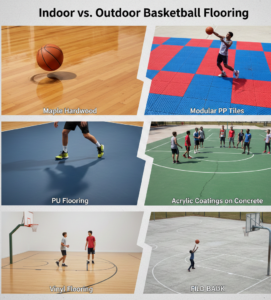
Indoor vs. Outdoor Basketball Flooring
Indoor Best Options:
-
Maple Hardwood: Professional-level bounce and shock absorption.
-
PU Flooring: Seamless, multipurpose indoor surfaces.
-
Vinyl Flooring: Budget-friendly indoor solution.
Outdoor Best Options:
-
Modular PP Tiles: UV-resistant, weatherproof, high traction.
-
Acrylic Coatings on Concrete: Cost-effective, durable, and suitable for community or residential courts.
Cost Considerations
Basketball flooring costs depend on material, court size, location, customization, and installation complexity. Approximate Indian pricing ranges:
-
Hardwood Maple: Premium/high-budget option.
-
PU Flooring: Upper mid-range.
-
Vinyl Flooring: Mid-range.
-
Modular PP Tiles: Budget to mid-range.
-
Acrylic Coatings: Budget-friendly option.
Additional costs may include line markings, logos, and base construction.
Maintenance Requirements
Hardwood Flooring: Daily sweeping, regular polishing, re-sanding every 5–10 years.
PU or Vinyl Flooring: Simple mopping, occasional top-up coatings.
Modular Tiles: Water wash and selective tile replacement.
Acrylic Floors: Annual repainting for heavy-use courts.
Selecting a flooring type compatible with your maintenance capacity reduces long-term costs and ensures a consistently safe playing surface.
How to Choose the Best Basketball Court Flooring
Ask yourself these questions:
-
Indoor or outdoor? Hardwood/PU for indoor, PP tiles or acrylic for outdoor.
-
Budget constraints? Vinyl or acrylic for economical options.
-
Player level? Professionals prefer hardwood; schools and colleges can use PU or vinyl.
-
Multi-sport requirements? PU is ideal for multi-purpose halls.
-
Maintenance capacity? Modular tiles and vinyl are easier to maintain.
Answering these questions will guide you to a flooring solution that balances performance, cost, and longevity.
Why Professional Installation Is Essential
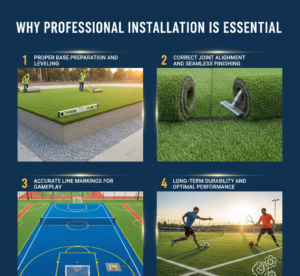
Even the highest-quality flooring can underperform if installed incorrectly. Expert installation ensures:
-
Proper base preparation and leveling.
-
Correct joint alignment and seamless finishing.
-
Accurate line markings for gameplay.
-
Long-term durability and optimal performance.
Professional installation guarantees that your basketball court not only looks professional but also performs to its full potential for years.
Final Verdict: Best Basketball Court Flooring for 2025
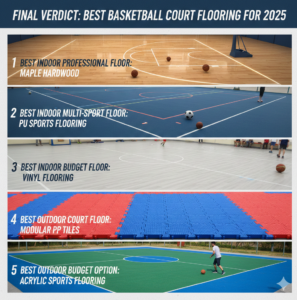
There is no one-size-fits-all solution; the “best” flooring depends on your environment, usage, and budget:
-
Best Indoor Professional Floor: Maple Hardwood
-
Best Indoor Multi-Sport Floor: PU Sports Flooring
-
Best Indoor Budget Floor: Vinyl Flooring
-
Best Outdoor Court Floor: Modular PP Tiles
-
Best Outdoor Budget Option: Acrylic Sports Flooring
By carefully evaluating your facility’s requirements, you can select a basketball flooring system that maximizes safety, enhances performance, and offers excellent value for years to come.
Frequently Asked Questions (FAQ)
Q1. What is the best flooring for professional indoor basketball?
Answer: Hardwood maple flooring remains the top choice for professional indoor courts because of its unmatched playability and performance, especially for competitive games.
Q2. Can synthetic flooring match hardwood performance?
Answer: High-quality synthetic floors have gotten very close, providing excellent traction and durability, though traditional hardwood still leads in bounce and feel for elite play.
Q3. What’s the best outdoor court surface?
Answer: Acrylic-coated courts are currently considered the best balance of performance, weather resistance, and maintenance for outdoor play.
Q4. How long does each surface last?
-
Hardwood: 15+ years with maintenance
-
Synthetic/Acrylic: ~8–12 years depending on use
-
Rubber/Modular: ~6–10 years
-
Concrete/asphalt base (with coating): varies by wear and climate
Q5. Which surface is safest for players?
Hardwood and quality synthetic floors offer the best shock absorption and traction, helping reduce injury risks; plain concrete/asphalt alone is the least forgiving.
Q6. How important is maintenance?
Very. Hardwood courts require regular refinishing and climate control. Synthetic and acrylic systems need less frequent care, making them more cost-effective over time.
🧠 Conclusion: What’s Best in 2025?
🏆 Indoor Courts:
→ Hardwood flooring (Maple) is still the benchmark for competitive and professional play, offering superior performance and longevity, despite higher cost and maintenance.
🌤 Outdoor Courts:
→ Acrylic synthetic flooring leads the field — blending weather resistance, low maintenance, and good playability even under harsh sun and rain conditions.
🏡 Recreational / Multi-Purpose:
→ Synthetic, rubber, or modular tiles are flexible, lower-cost options that support both indoor and light outdoor use with better joint comfort.