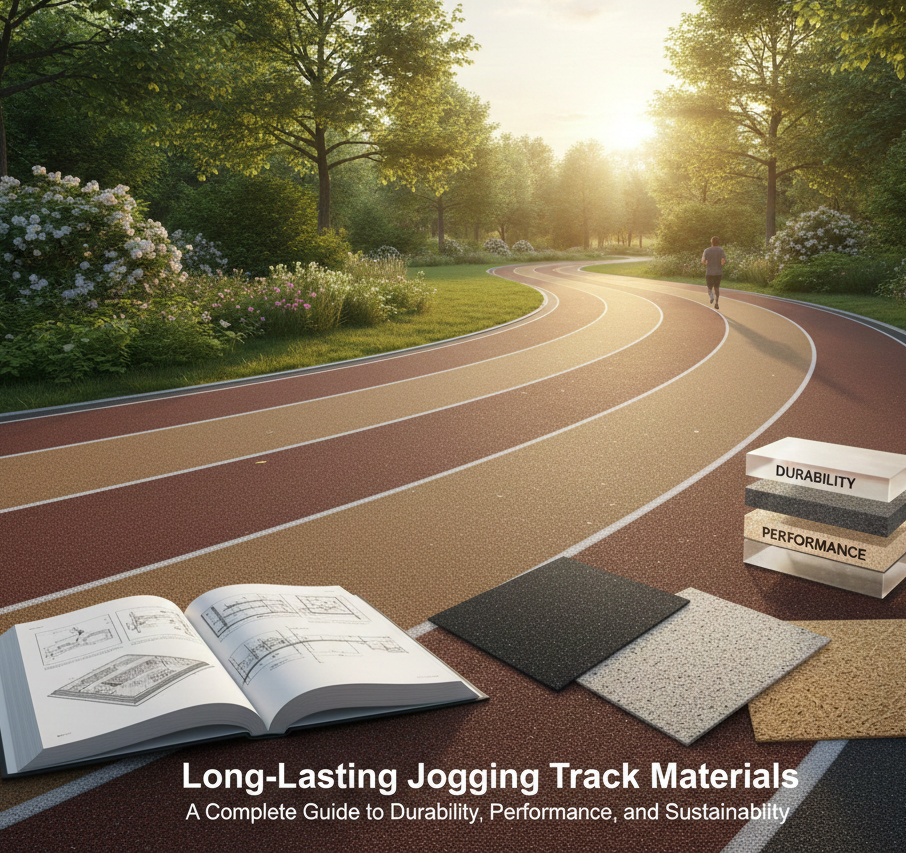
Jogging tracks are no longer limited to professional stadiums. Today, they are an essential part of public parks, residential townships, educational campuses, fitness centers, and recreational spaces. A well-designed jogging track promotes health, reduces injury risk, and enhances the overall aesthetics of an environment. However, the effectiveness and lifespan of a jogging track depend heavily on the materials used in its construction.
Choosing the right jogging track material is not just a matter of cost—it directly affects durability, safety, maintenance requirements, and user experience. This blog explores long-lasting jogging track materials, their properties, advantages, limitations, and best use cases, helping planners, architects, and facility managers make informed decisions.
Key Requirements for Long-Lasting Jogging Track Materials

Before examining specific materials, it is essential to understand the characteristics that define a durable jogging track:
-
High wear resistance to withstand continuous foot traffic
-
Shock absorption to reduce stress on joints and muscles
-
Slip resistance for safety in wet or dry conditions
-
Weather resistance, including UV exposure, rain, and temperature variations
-
Low maintenance needs over time
-
Eco-friendliness and sustainability
-
Consistent surface performance throughout its lifespan
A long-lasting jogging track must balance comfort, resilience, and structural integrity.
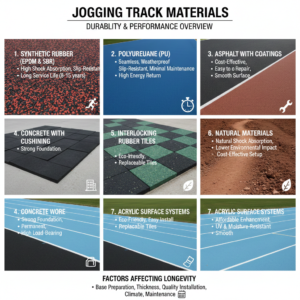
1. Synthetic Rubber (EPDM and SBR)
Overview
Synthetic rubber is one of the most widely used materials for jogging tracks worldwide. It typically consists of SBR (Styrene-Butadiene Rubber) as a base layer and EPDM (Ethylene Propylene Diene Monomer) as the top wear layer.
Durability and Performance
-
Excellent resistance to abrasion and foot traffic
-
Maintains elasticity over many years
-
Performs well in both hot and cold climates
Advantages
-
High shock absorption reduces injury risk
-
Slip-resistant surface
-
Customizable thickness and color
-
Long service life (8–15 years with proper installation)
Limitations
-
Higher initial cost compared to natural surfaces
-
Requires professional installation
Best Use Cases
-
Public parks
-
Athletic facilities
-
School and university campuses
-
Residential jogging tracks
Synthetic rubber remains a top choice for long-term jogging track performance.
2. Polyurethane (PU) Jogging Tracks
Overview
Polyurethane tracks are seamless, poured-in-place surfaces commonly used in professional sports facilities. They are engineered for high durability and consistent performance.
Durability and Performance
-
Extremely high tensile strength
-
Resistant to cracking and deformation
-
Maintains uniform surface quality over time
Advantages
-
Excellent shock absorption and energy return
-
Weatherproof and UV-resistant
-
Minimal maintenance required
-
Seamless surface reduces trip hazards
Limitations
-
Higher cost than most alternatives
-
Skilled labor required for installation
Best Use Cases
-
High-end jogging tracks
-
Stadiums and sports complexes
-
Urban fitness zones
Polyurethane tracks are ideal where longevity and performance consistency are critical.
3. Asphalt with Specialized Surface Coatings
Overview
Asphalt is a traditional base material often enhanced with acrylic or rubberized coatings to improve comfort and durability for jogging tracks.
Durability and Performance
-
Strong structural base
-
Long lifespan when properly sealed
-
Can handle heavy use
Advantages
-
Cost-effective for large areas
-
Smooth and uniform surface
-
Easy to repair
Limitations
-
Harder surface compared to rubber or PU
-
Requires periodic resurfacing
-
Lower shock absorption
Best Use Cases
-
Community jogging paths
-
Large parks with budget constraints
-
Mixed-use walking and jogging trails
When combined with proper coatings, asphalt can be a durable and practical solution.
4. Concrete with Cushioning Layers
Overview
Concrete is sometimes used as a structural base with cushioning overlays such as rubber mats or acrylic systems to enhance user comfort.
Durability and Performance
-
Extremely long-lasting structural foundation
-
Resistant to deformation and erosion
Advantages
-
Very low structural maintenance
-
Suitable for permanent installations
-
High load-bearing capacity
Limitations
-
Hard surface without cushioning
-
Requires additional layers to be jogger-friendly
-
Higher risk of joint impact if poorly designed
Best Use Cases
-
Urban jogging tracks
-
Rooftop tracks
-
Areas requiring high structural strength
Concrete works best when paired with resilient surface layers.
5. Interlocking Rubber Tiles
Overview
Interlocking rubber tiles are modular systems made from recycled rubber, offering flexibility and ease of installation.
Durability and Performance
-
Good resistance to wear and moisture
-
Tiles can be replaced individually
Advantages
-
Eco-friendly and recyclable
-
Easy installation and repair
-
Slip-resistant surface
Limitations
-
Visible joints may affect aesthetics
-
Can shift if base preparation is poor
Best Use Cases
-
Recreational jogging paths
-
Indoor tracks
-
Temporary or semi-permanent installations
Rubber tiles provide durability with sustainability benefits.
6. Natural Materials (Clay, Crushed Stone, and Gravel)
Overview
Natural jogging track materials are commonly used in parks and rural settings, offering a softer and more organic running experience.
Durability and Performance
-
Moderate durability
-
Requires regular upkeep
Advantages
-
Natural shock absorption
-
Lower environmental impact
-
Cost-effective initial setup
Limitations
-
Prone to erosion and weather damage
-
Requires frequent leveling and replenishment
-
Shorter lifespan compared to synthetic materials
Best Use Cases
-
Nature parks
-
Trail jogging paths
-
Low-traffic recreational areas
While not the longest-lasting option, natural materials are valued for comfort and aesthetics.
7. Acrylic Surface Systems
Overview
Acrylic surfaces are often applied over asphalt or concrete bases to enhance durability, traction, and weather resistance.
Durability and Performance
-
Good resistance to UV and moisture
-
Moderate elasticity
Advantages
-
Affordable surface enhancement
-
Smooth and visually appealing
-
Low maintenance
Limitations
-
Less cushioning than rubber or PU
-
Surface may harden over time
Best Use Cases
-
Multi-use jogging and walking tracks
-
School campuses
-
Community parks
Acrylic systems extend the lifespan of base materials effectively.
Factors Affecting Longevity of Jogging Track Materials
Even the best materials can fail prematurely without proper planning. Longevity depends on:
-
Base preparation and drainage design
-
Correct material thickness
-
Quality of installation
-
Climate conditions
-
Maintenance routines
Regular cleaning, timely repairs, and surface inspections significantly extend track life.
Sustainability and Future Trends
Modern jogging track construction increasingly emphasizes sustainability. Recycled rubber, low-VOC binders, permeable surfaces, and solar-reflective coatings are shaping the future of track materials. Long-lasting materials reduce waste, maintenance costs, and environmental impact over time.
Conclusion
Selecting long-lasting jogging track materials is a strategic investment in public health, safety, and infrastructure quality. Synthetic rubber and polyurethane systems lead in durability and performance, while asphalt, concrete, and acrylic solutions offer cost-effective alternatives. Natural materials remain valuable for specific environments, though they require higher maintenance.
The ideal jogging track material depends on usage intensity, climate, budget, and long-term goals. By prioritizing durability, shock absorption, and proper installation, jogging tracks can serve communities effectively for many years.
A well-constructed jogging track is more than a path—it is a foundation for healthier lifestyles and sustainable urban development.