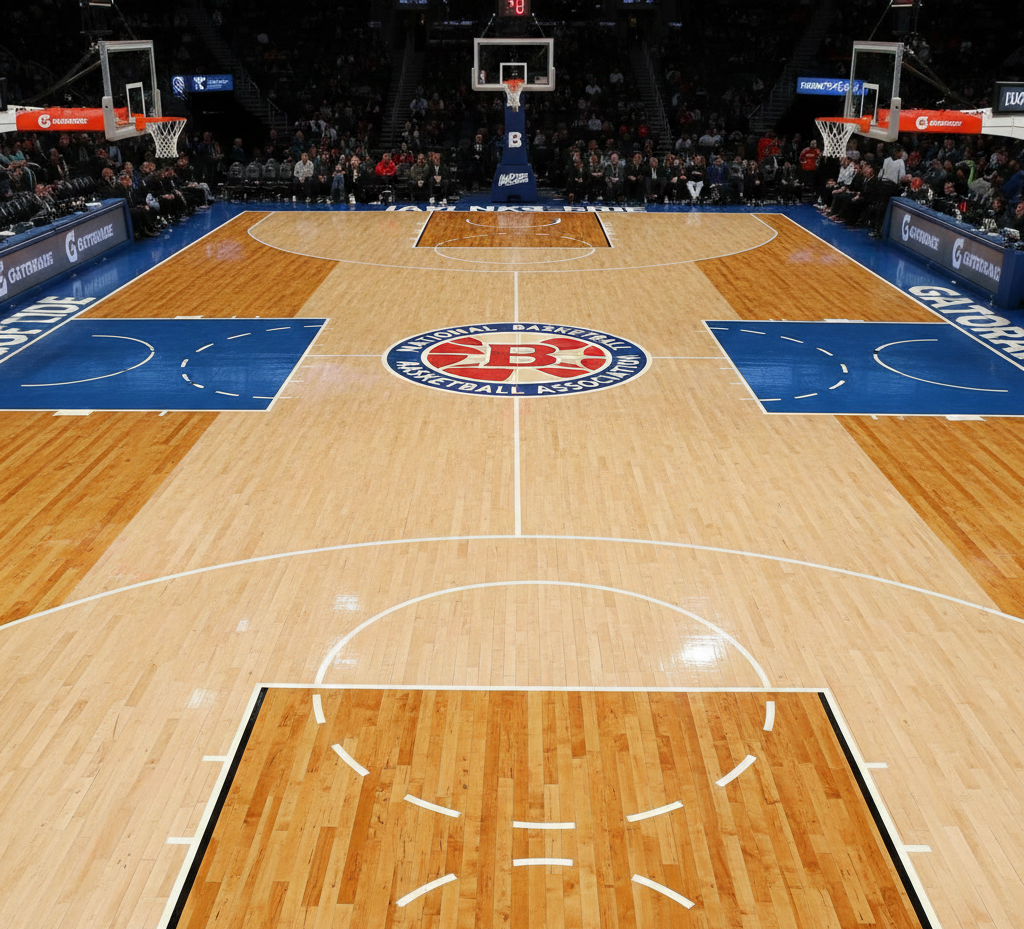
A basketball court floor is more than just a flat playing surface—it is a carefully engineered sports zone designed for performance, safety, gameplay accuracy, and visual appeal. Whether you walk into an indoor arena, a school gym, or an outdoor community court, the flooring has a distinct look, structure, and design that instantly reveals its purpose.
From the glossy hardwood of professional NBA courts to the textured acrylic or modular tile surfaces found outdoors, every basketball floor has its own visual identity. Understanding what a basketball court looks like helps players, facility owners, architects, and sports flooring installers make better decisions when building, renovating, or maintaining courts.
This complete blog explains what a basketball court floor looks like, the design elements, markings, surface features, textures, colors, and materials that give it its signature appearance.
The Overall Look of a Basketball Court Floor
A standard basketball court floor typically includes:
-
A rectangular playing area
-
A smooth and uniform surface
-
Clearly painted court markings
-
Symmetrical layout on both halves
-
A consistent color scheme
-
A durable finish or texture for grip
Whether indoor or outdoor, the court must look visually balanced, easy to understand, and game-ready.
1. The Shape and Size of the Court
A basketball court floor is always rectangular, with exact dimensions depending on the level of the sport:
Professional (NBA):
-
94 ft x 50 ft (28.65 m x 15.24 m)
International (FIBA):
-
28 m x 15 m
High School:
-
Slightly smaller variations
Regardless of the exact size, the layout remains symmetrical, and the markings follow global standards.
2. Surface Color and Finish
Indoor Court Appearance
Indoor basketball floors are usually:
-
Light brown or golden (maple hardwood)
-
Polished to a high gloss
-
Smooth and seamless
-
Reflective under sports lighting
Some modern indoor courts may use:
-
PU sports flooring with matte finishes
-
Vinyl or PVC floors with subtle textures
Outdoor Court Appearance
Outdoor courts use different colors, typically:
-
Blue
-
Green
-
Red
-
Yellow
-
Orange
-
Dual-tone combinations
3. Court Markings – The Most Identifiable Feature
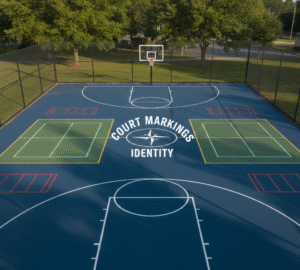
Court markings define the look of a basketball floor. These painted lines organize gameplay and ensure rule compliance.
Key Markings You Will See:
• Sidelines & Baselines
Outline the boundary of the court.
• Center Circle
Used for the opening jump ball.
Located exactly in the center of the court.
• Mid-Court Line (Half-Court Line)
Divides the court into two equal halves.
• Three-Point Line
Forms a large arc around the basket.
Varies slightly in distance depending on association (NBA, FIBA, colleges).
• Key / Paint Area / Free-Throw Lane
A rectangular section under each basket.
Often colored differently from the main floor for visibility.
• Free-Throw Circle
Where players take free throws.
• Restricted Area Arc
A semicircle near the basket indicating no-charge zone.
Color of Markings
Line colors typically include:
-
White
-
Black
-
Yellow
-
Blue
Professional courts may also use bold accent colors for team branding.
4. The Center Court Logo
Most indoor courts prominently display:
-
Team logos
-
School emblems
-
Sports complex branding
-
Sponsor graphics
The center logo is typically large, vibrant, and placed inside the center circle or spanning across it.
Outdoor courts may or may not have logos depending on budget and purpose.
5. Surface Texture and Feel
Indoor Court Texture
-
Extremely smooth
-
Slightly glossy due to polyurethane finish
-
Seamless and professional
-
Designed to allow controlled sliding and gripping
Outdoor Court Texture
-
Slightly rough
-
More matte than glossy
-
Weatherproof
-
Provides traction for shoes even when dusty or slightly wet
6. What the Material Looks Like
Different basketball floors have different appearances depending on the materials used.
-
Light brown
-
Natural wood patterns
-
High shine
-
Traditional and premium appearance
-
Smooth, colored surface
-
Matte or semi-gloss
-
Modern look
-
Slightly textured
-
Uniform color
-
Soft sheen
-
Bright, bold colors
-
Visible texture
-
Very durable look
-
Interlocking square tiles
-
Grid-like pattern visible
-
Multi-color options
-
Drainage holes sometimes visible
7. The Basketball Hoop Shadow Area
Because basketball involves continuous action near the hoop, this zone often visually stands out.
Indoor Courts
-
Slight discoloration over time (before refinishing)
-
Heavier wear patterns
-
More foot traffic marks
Outdoor Courts
-
Slightly faded paint
-
Extra scuff marks on the key area
Professional maintenance easily restores these areas.
8. Gloss Level – How Shiny Is a Basketball Floor?
Indoor Courts
, especially under strong arena lights. This shine comes from layers of:
-
Polyurethane coating
-
Sealants
-
Protective top coats
Outdoor Courts
-
Glossy surfaces may become slippery
-
Weatherproof finishes reduce shine
-
UV-resistant coatings emphasize durability, not gloss
9. Court Zones: What They Look Like at First Glance
Main Court
-
Large, clear, and bright
-
Symmetrical on both sides
-
Shows consistent color and texture
Key/Paint Area
-
Often colored differently
-
High-visibility rectangle
-
Contains free-throw circle markings
Three-Point Arc
-
Smooth curve around each basket
-
Clearly visible from anywhere on court
Out-of-Bounds Area
-
Widens around the perimeter
-
May feature advertiser logos in professional settings
10. Lighting & Reflection on Indoor Courts
-
Sports lights are strong
-
Coated surfaces shine
-
Maple wood reflects light naturally
This combination creates the iconic glossy basketball look seen in professional arenas.
What a Basketball Court Floor Does Not Look Like
To avoid mistakes in design or flooring selection, understand that a proper basketball floor does NOT look like:
-
Rough concrete
-
Uneven or cracked surfaces
-
Multi-colored distracting patterns
-
Overly glossy outdoor floors
-
Tile or marble flooring
-
Surfaces without standard markings
A correct basketball court must meet sports flooring standards for visibility and performance.
Conclusion: The Basketball Court Floor Has a Signature Look and Professional Identity
-
Symmetrical rectangular layout
-
Clear and accurate line markings
-
Unique zone areas and arcs
-
Polished indoor surfaces or textured outdoor finishes
-
Bright colors and professional appearance
-
Organized and highly functional design
These visual elements come together to create a surface that supports fast gameplay, reduces injury risk, and enhances the overall basketball experience.
Whether indoors or outdoors, every court reflects the sport’s identity—clean, structured, energetic, and performance-driven.
Frequently Asked Questions (FAQ)
What Does a Basketball Court Floor Look Like? – A Complete Guide to Design, Appearance & Features
1. What does a standard basketball court floor look like?
A standard basketball court floor is a flat, smooth surface with clearly marked boundary lines, a center circle, free-throw lanes (the “paint”), a three-point arc, and a half-court line. Indoor courts usually feature polished hardwood with a glossy finish, while outdoor courts are commonly made of concrete or asphalt with painted markings.
2. What material is used for indoor basketball court floors?
Professional and indoor courts are typically made from high-quality hardwood, most commonly maple. For example, the courts used in the National Basketball Association are constructed from tightly fitted maple wood panels for durability, bounce consistency, and shock absorption.
3. What are the main markings on a basketball court floor?
A basketball court floor includes:
-
Baselines and sidelines (outer boundaries)
-
Half-court line
-
Center circle
-
Free-throw line
-
Key or paint area
-
Three-point line
-
Restricted area arc
These markings help define player positions and scoring zones.
4. Why are some basketball courts colorful?
Many courts feature team colors, logos, or unique designs for branding and visual appeal. For instance, courts used in the NBA often display team logos at center court and custom color schemes inside the key area.
5. What is the “paint” area on a basketball court?
The “paint” refers to the rectangular area under the basket, also called the key or lane. It is usually painted a contrasting color to stand out from the rest of the floor and is crucial for free throws, rebounds, and close-range scoring.
6. How is an outdoor basketball court floor different?
Outdoor courts are typically made from concrete or asphalt with acrylic coatings for grip and weather resistance. Unlike polished indoor hardwood floors, outdoor surfaces are textured and matte to prevent slipping in various weather conditions.
7. What size is a professional basketball court?
An official NBA court measures 94 feet long by 50 feet wide. International courts governed by FIBA are slightly smaller, measuring 28 meters by 15 meters.
8. Why is the basketball court floor shiny?
Indoor hardwood courts are sealed and polished with protective finishes. This glossy surface enhances durability, improves ball bounce, and gives courts their iconic reflective appearance.
9. Do all basketball courts look the same?
No. While official dimensions and markings remain consistent at professional levels, school, college, and recreational courts may vary in color, logo placement, and minor design details.
10. How often is a basketball court floor maintained?
Professional courts are cleaned daily and refinished periodically. In leagues like the National Basketball Association, floors are carefully maintained to ensure player safety, consistent performance, and a premium appearance.