Jogging tracks have become essential features in modern parks, fitness zones, and urban green spaces. They promote community health, encourage outdoor activity, and offer a safe, dedicated area for running and walking.
When designing a park jogging track, width plays a crucial role. It determines user comfort, safety, and overall experience. Whether you’re planning a jogging path for a public park, residential complex, or fitness trail, understanding the standard jogging track width and related design aspects is vital.
This article explains the ideal jogging track width, design standards, materials, and planning tips to create a safe and enjoyable jogging environment.
Understanding Jogging Tracks in Parks
A jogging track is a smooth, well-laid pathway designed for running or brisk walking. It may circle around lawns, playgrounds, lakes, or open fitness areas.
Park jogging tracks are usually built from materials such as asphalt, concrete, rubber (EPDM), or interlocking pavers. These surfaces provide durability and comfort while ensuring low maintenance.
But before choosing materials or layout, the track width must be decided, as it affects:
-
User capacity (how many joggers can use it simultaneously)
-
Safety (collision prevention and side clearance)
-
Maintenance costs
-
Land use and landscaping design
Standard Jogging Track Width
The width of a jogging track depends on the number of lanes, expected user volume, and available space. While there’s no single “universal” width, several international and Indian design standards provide practical guidance.
Below are the commonly accepted width ranges:
| User Type / Location | Recommended Width | Details |
|---|---|---|
| Single-Lane Track (Low Traffic) | 1.2 – 1.5 meters | Suitable for narrow park paths or community gardens. Allows one jogger at a time. |
| Two-Way Jogging Track | 2.5 – 3.0 meters | Ideal for medium-use parks, allows two people to jog in opposite directions safely. |
| High-Usage Public Park Track | 3.5 – 5.0 meters | Designed for busy city parks or lakeside promenades; accommodates multiple joggers and walkers. |
| Combined Walking & Jogging Track | 4.0 – 6.0 meters | Divided zones for walkers and runners, often color-coded for clarity. |
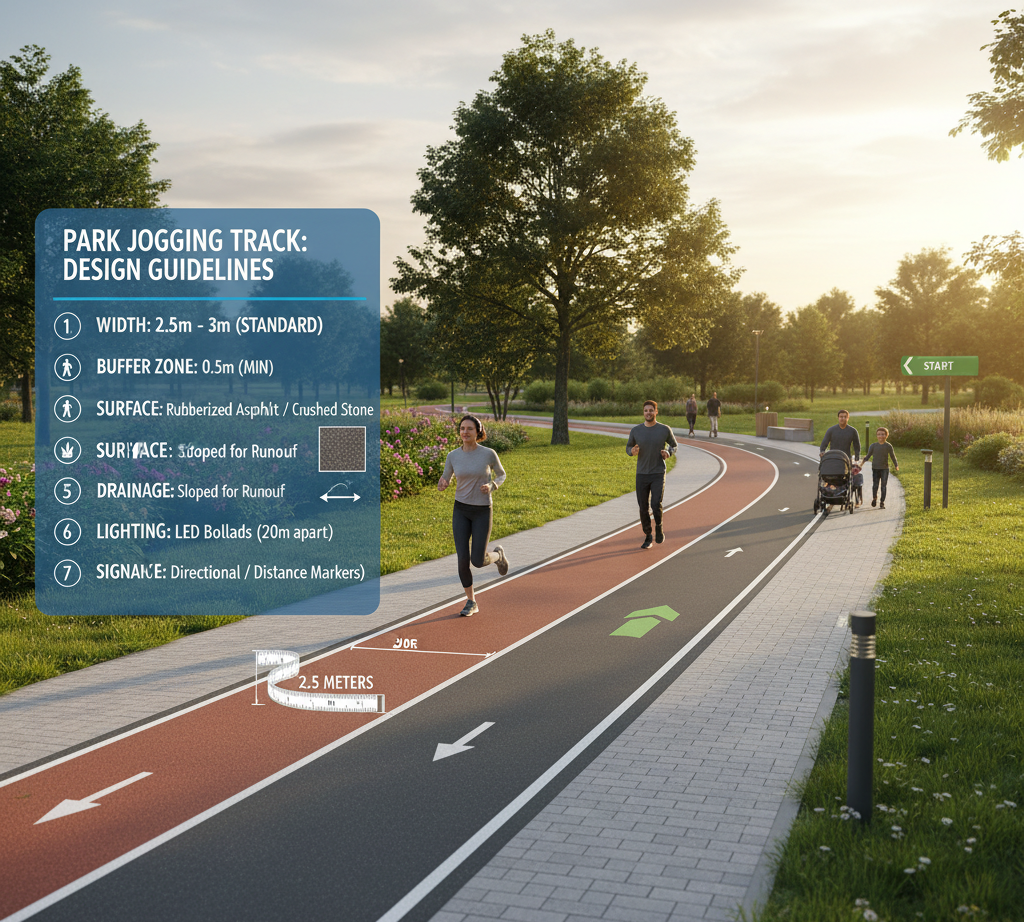
For most urban parks and residential developments, the standard jogging track width is around 2.5 to 3 meters. This allows comfortable movement for both joggers and casual walkers without congestion.
Lane Division in Jogging Tracks
Some parks include lane markings to organize movement.
-
Single-lane tracks (narrow) are used for one-direction jogging loops.
-
Two-lane tracks separate joggers and walkers.
-
Multi-lane tracks (3 or more) are used in large recreational parks or near sports complexes.
Each lane is usually about 1.2 meters wide, based on the average human stride and personal space needed for running.
Example:
-
2-lane track = 2.4 meters
-
3-lane track = 3.6 meters
Factors Influencing Track Width
When determining how wide a park jogging track should be, several site-specific and design factors come into play.
1. User Volume and Purpose
The number of daily visitors is a key factor. A small community park may only need a 2-meter-wide track, while a busy city park with hundreds of users per hour should have at least 4 meters of jogging space.
2. Park Layout and Available Area
In parks with limited open space, narrower tracks with one-way jogging loops are practical. Larger areas can accommodate wider, dual-purpose tracks that include walkers, joggers, and cyclists.
3. Safety Considerations
Sufficient width helps prevent collisions between users, especially when people run at different speeds. Extra space also allows for safe overtaking and shoulder clearance.
4. Accessibility and Inclusivity
Tracks should be accessible to users of all ages and abilities, including seniors and wheelchair users (where applicable). Wider tracks make it easier to share the space safely.
5. Maintenance and Cost
Wider tracks require more surface material and higher construction costs. However, they also reduce edge wear and are easier to maintain in the long term.
Ideal Widths for Different Environments
Let’s look at typical examples of track widths based on park type:
-
Neighborhood or Garden Park: 2 to 2.5 meters
-
Public City Park: 3 to 4 meters
-
Lakefront or Promenade: 4 to 6 meters
-
School or Institutional Campus: 2.5 to 3.5 meters
-
Recreational Stadium Park: 5 meters and above
If the jogging track is part of a multi-activity trail (e.g., joggers, cyclists, and walkers together), the width can extend up to 6–8 meters, divided into lanes or separated by colored surfacing.
Material Considerations
While the width ensures functionality, the surface material ensures comfort and safety. Common jogging track materials include:
-
Asphalt / Bituminous Mix
-
Smooth, flexible, and suitable for heavy foot traffic.
-
Ideal for 3–5m wide tracks in public parks.
-
-
Concrete
-
Highly durable and low maintenance.
-
Harder on joints; recommended for 2–3m wide walking paths.
-
-
Rubberized EPDM Surface
-
Soft, cushioned surface perfect for runners.
-
Used for high-end or premium park tracks, 3–4m wide.
-
-
Interlocking Paver Blocks
-
Decorative and easy to install or repair.
-
Suitable for community or society parks, 2–3m width.
-
-
Natural Gravel or Soil Track
-
Eco-friendly and cost-effective.
-
Typically 2.5–3m wide for small or nature-themed parks.
-
Design and Layout Tips
To maximize functionality and visual appeal, park designers follow these best practices for jogging track width and layout:
-
Include shoulders or green buffers (0.5m on each side) to separate the track from lawns or flowerbeds.
-
Add gentle curves to avoid monotony and improve aesthetics.
-
Provide distance markers every 100 meters to help users track progress.
-
Ensure proper drainage — tracks should have a 1–2% side slope to prevent water accumulation.
-
Install lighting poles every 15–20 meters for evening jogging.
-
Use different colors or textures to mark jogging and walking lanes (e.g., red for jogging, gray for walking).
Safety and Accessibility Standards
A jogging track must be safe, comfortable, and usable by everyone. The recommended standards include:
-
Edge clearance: At least 0.5 meters from walls, fences, or vegetation.
-
Surface smoothness: Free from bumps, cracks, or uneven joints.
-
Non-slip surface: Especially for outdoor tracks exposed to rain.
-
Accessibility: Ramps and gradual slopes for inclusive design.
These small details make a big difference in user satisfaction and park usability.
Example: Ideal Jogging Track Design
Let’s consider a public urban park:
-
Track Shape: Circular or oval
-
Length: 500 meters per loop
-
Width: 3.5 meters (dual-use: joggers + walkers)
-
Surface: Rubberized EPDM or asphalt
-
Side Buffer: 0.5 meters each side (total 4.5 meters space)
-
Lighting: LED poles every 20 meters
-
Drainage: 2% side slope with perforated edge drains
This design supports 150–200 users per hour, offering comfort, durability, and safety.
Final Thoughts
When designing a jogging track in a park, width matters as much as surface quality. A well-proportioned track not only ensures smooth movement and safety but also enhances the park’s overall appeal.
For most public and residential parks, a track width of 2.5 to 3.5 meters works perfectly. Wider tracks — up to 5 meters — are ideal for busy parks and multi-use fitness trails.
By combining thoughtful width planning, quality materials, and good landscaping, a jogging track becomes more than a pathway — it becomes a destination for health, community, and recreation.