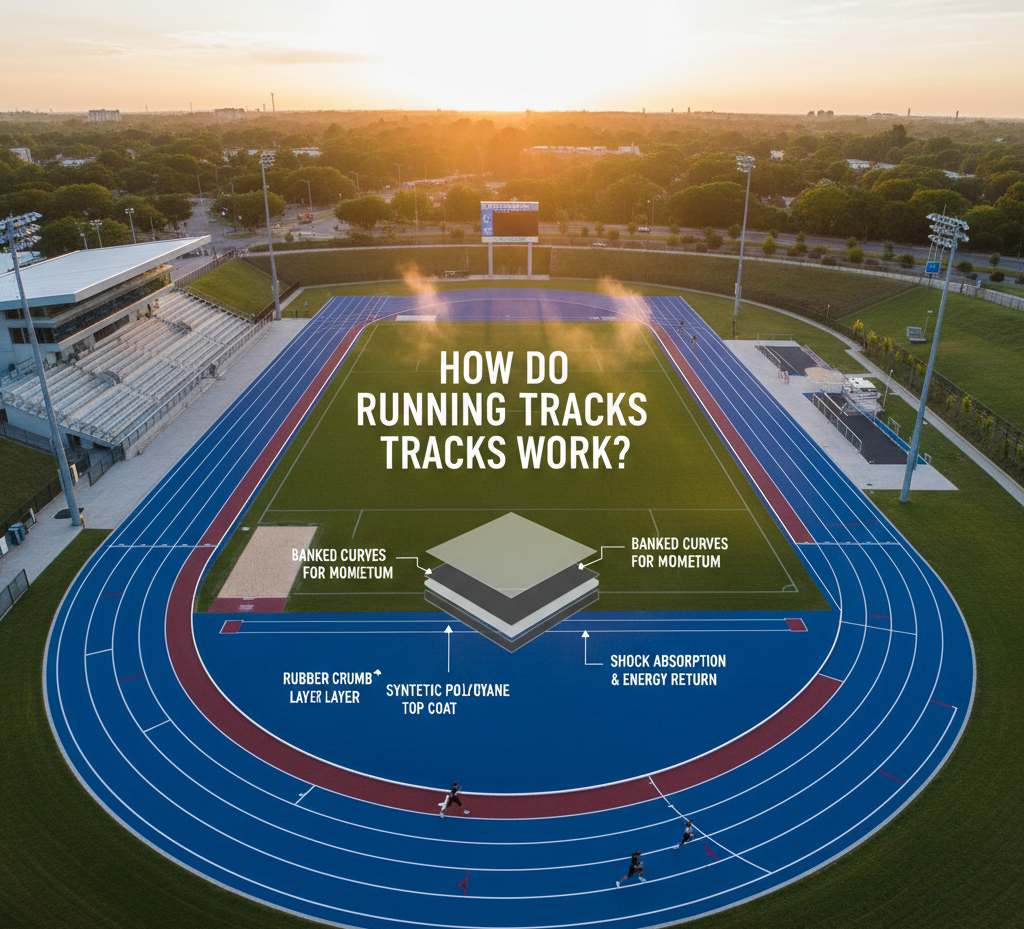
Running tracks are iconic symbols of fitness, competition, and athletic excellence. Whether it’s the Olympic stadium or your local jogging park, running tracks are designed with precision, science, and purpose. But have you ever wondered how running tracks actually work? Why are they oval? Why is one lap exactly 400 meters? And how do they help improve your running performance?
This guide explains everything — from the design and structure of running tracks to how they’re used for training, timing, and competition.
What Is a Running Track?
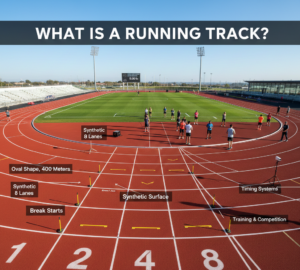
A running track is a specially designed oval-shaped path used for running, jogging, and athletic events. The standard outdoor track you see in schools or stadiums measures 400 meters in total distance around the inner lane. Tracks are built to provide consistent conditions for athletes to train and compete safely.
But running tracks aren’t just about circles and lines. Every curve, lane, and marking has a purpose — ensuring fairness, accuracy, and performance consistency.
The Standard Track Layout
The modern athletics track is based on international standards set by World Athletics (formerly IAAF). Here’s what defines how a standard track works:
-
Shape: Oval, with two parallel straights and two equal semicircular curves.
-
Length: 400 meters measured along the innermost lane’s line.
-
Width: Each lane is 1.22 meters wide.
-
Number of Lanes: Usually 6, 8, or 9 lanes depending on the stadium’s size.
The lanes are numbered from the inside out, meaning Lane 1 (the innermost lane) is the shortest route, while the outer lanes cover more distance around the curve.
Why Is a Track 400 Meters Long?
You might wonder — why exactly 400 meters?
Before standardization, tracks varied in size — some were 500 meters, others 440 yards (a quarter-mile). But in 1980, international athletics bodies adopted the 400-meter track as the universal standard.
This specific length allows easy measurement for popular races such as:
-
100 meters (straight section)
-
200 meters (half lap)
-
400 meters (one full lap)
-
800 meters (two laps)
-
1500 meters (just under four laps)
It also fits neatly within a football or soccer field, making stadium construction more practical.
How Lanes and Distances Work
Since the outer lanes cover more distance, they start further ahead than the inner ones. This is why you see staggered starting lines in races like the 200m or 400m sprints.
Here’s how that works:
-
Lane 1 (innermost) = 400 meters
-
Lane 2 = 407.67 meters
-
Lane 3 = 415.33 meters
-
Lane 4 = 423.00 meters
To ensure fairness, the start lines are staggered so that every runner covers the same total distance.
The Materials That Make Tracks Work
Running tracks are not made of ordinary materials like concrete or asphalt. They are designed to protect the runner’s body while providing grip and bounce.
There are three main types of running track surfaces:
-
Cinder Tracks (Old Type): Made from crushed brick or stone. They’re soft but uneven and affected by rain.
-
Synthetic Tracks: Made from polyurethane or latex mixed with rubber granules. They’re durable, weather-resistant, and ideal for modern competitions.
-
Hybrid or Modular Tracks: Designed with layered systems that combine shock absorption and high traction — the standard for international events.
A good track surface provides:
-
Shock absorption: Reduces joint stress.
-
Traction: Prevents slipping during sprints or turns.
-
Energy return: Helps runners push off efficiently with each step.
Track Markings and Their Meanings
If you’ve ever looked closely at a running track, you’ve seen lines, arrows, and numbers. Each marking has a purpose to help athletes and officials measure distances accurately.
Here’s a breakdown of key markings:
-
Start lines: Indicate where each race begins.
-
Finish line: Common to all lanes.
-
Exchange zones: For relay races, where batons are passed.
-
Hurdle marks: Show where hurdles must be placed.
-
Break line: For races where athletes can move to the inner lane after a certain distance (like in 800m races).
These markings ensure every event follows the same rules, no matter where in the world it’s held.
How Timing Works on a Running Track
Timing is an essential part of how running tracks function.
In professional events, electronic timing systems are used with sensors placed at the start and finish lines. These are triggered by a starting gun connected to the timer. Accuracy can be up to one-thousandth of a second (0.001s).
In local or practice sessions, runners often use:
-
Stopwatches for manual timing.
-
RFID chips or smartwatches that track laps and pace automatically.
-
Photo-finish cameras to determine winners in close races.
Why Running Tracks Are Curved
The oval shape isn’t random — it’s designed for efficiency.
If a track were a straight 400-meter stretch, it would take up massive space. The curved design fits the same distance compactly while allowing athletes to maintain speed.
However, curves also present a challenge: centrifugal force. When you run on a curve, your body tends to lean inward to balance the pull toward the outside. That’s why athletes in inside lanes have slightly tighter turns — and why staggered starts are crucial for fairness.
Indoor vs. Outdoor Tracks
Not all tracks are the same. There are two main categories:
-
Outdoor Tracks – Standard 400 meters long, used for most competitions and training sessions.
-
Indoor Tracks – Usually 200 meters long, built with tighter curves and often banked (sloped) to help maintain speed on turns.
Indoor tracks are common in colder regions where year-round outdoor training isn’t possible.
How Running Tracks Help in Training
Running tracks are not only for professional athletes. They are perfect for people at all fitness levels because they offer:
-
Measured distance: You always know how far you’ve run.
-
Safe environment: No vehicles, obstacles, or distractions.
-
Consistent surface: Less risk of injury than running on roads or trails.
-
Goal-based workouts: You can easily plan intervals, sprints, and recovery laps.
For example:
-
Sprinters use the track for 100m and 200m intervals.
-
Distance runners use it for endurance sessions and pacing practice.
-
Recreational joggers enjoy a predictable, low-impact running environment.
Maintenance: How Tracks Stay in Shape
To keep a running track functional and safe, regular maintenance is essential. This includes:
-
Cleaning the surface to remove debris.
-
Repairing cracks or worn sections.
-
Repainting faded lines.
-
Ensuring proper drainage to avoid water damage.
High-quality tracks can last 8–12 years depending on usage and climate conditions.
The Science Behind Track Design
Track builders use geometry and physics to ensure uniformity. The two straights and two semicircles are designed so the radius of each curve allows smooth running transitions.
The inner radius of a standard track is 36.5 meters, and the total width (including lanes) adds up to about 9.76 meters for 8 lanes. These dimensions ensure that every curve and straight portion flows naturally into each other, minimizing energy loss during turns.
Why Running Tracks Are Important
Running tracks represent more than just a surface — they are the foundation of modern athletics. They:
-
Promote accurate timing and fair competition.
-
Encourage regular fitness habits.
-
Offer an inclusive space for all ages and abilities.
-
Support physical education and community health programs.
From Olympic champions to morning joggers, everyone benefits from the simplicity and precision of a running track.
Final Thoughts
So, how do running tracks work? They function through a carefully engineered combination of design, material, geometry, and measurement accuracy. Every curve, lane, and line is planned to ensure safety, fairness, and performance enhancement.
The next time you step onto a track, remember — it’s not just a loop of rubber. It’s a finely tuned system built to help you measure progress, break limits, and experience the pure joy of running.