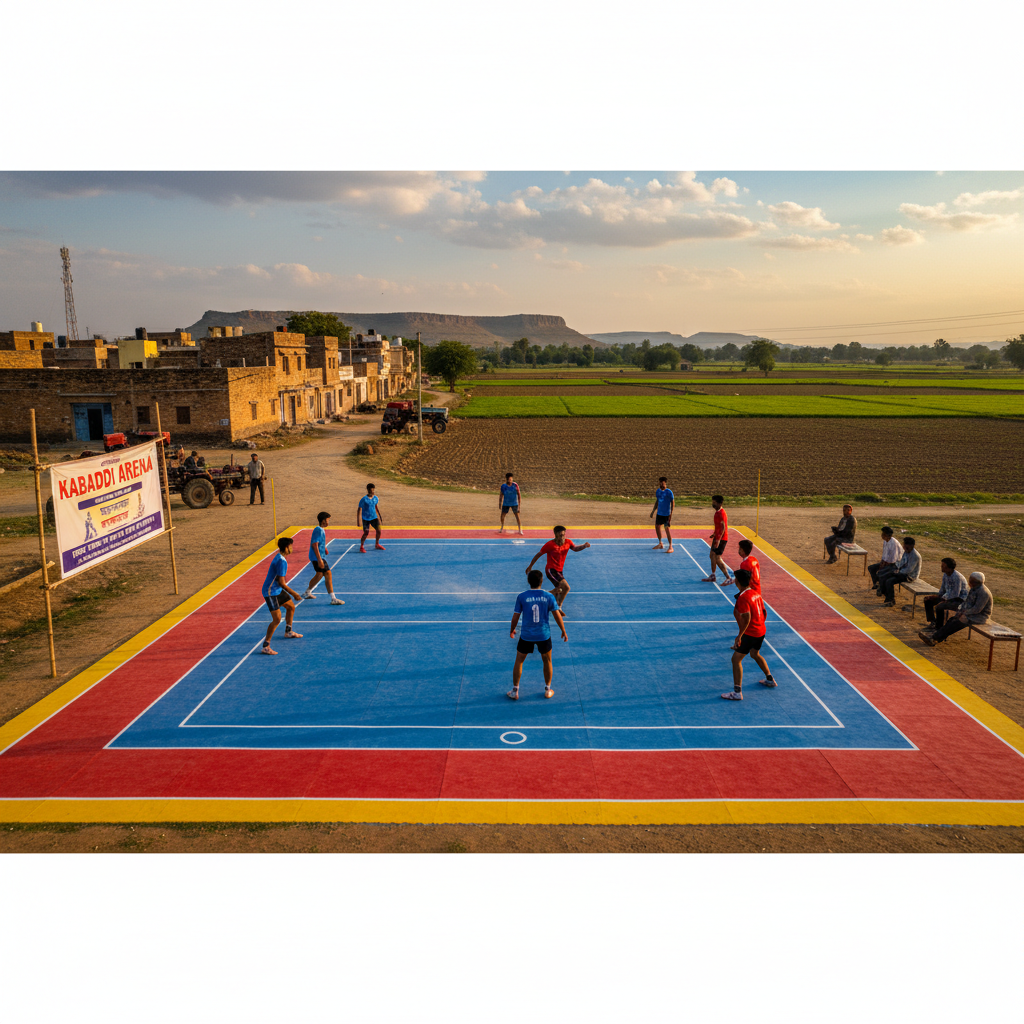
Building Strong Foundations for a Champion State
Introduction
Haryana has long been recognized as the powerhouse of Indian sports—especially in kabaddi, where the state has produced some of the country’s most celebrated players. From rural akharas to national and international arenas, kabaddi runs through the veins of Haryana’s sporting culture.
The Role of Flooring in Kabaddi Performance
Kabaddi is a physically demanding sport involving quick sprints, dives, tackles, and sudden direction changes. These movements exert intense pressure on players’ knees, ankles, and joints. Perfect grip and traction for swift movement
-
Shock absorption to prevent injuries
-
Smooth, even texture to avoid tripping hazards
-
Weather resistance for outdoor use
-
Easy maintenance for long-term cost efficiency
A well-designed kabaddi court floor can dramatically improve player safety, enhance training quality, and make the court suitable for professional tournaments.
Climate and Conditions in Haryana
Haryana experiences a semi-arid climate with extremely hot summers, mild winters, and occasional monsoon rains.
-
Heat-resistant and UV-stable
-
Non-slip even in slightly dusty conditions
-
Moisture-proof for outdoor installations
-
Durable under frequent use and temperature variations
Standard Kabaddi Court Dimensions
The standard court dimensions prescribed by the Amateur Kabaddi Federation of India (AKFI) are:
-
Men’s and junior boys’ court: 13 meters × 10 meters
-
Women’s and junior girls’ court: 12 meters × 8 meters
These dimensions ensure uniformity across all tournaments and adequate space for movement beyond the play boundaries.
Flooring Options for Kabaddi Courts in Haryana
1. Traditional Clay or Mud Courts
The heart of rural Haryana beats in the akharas, where kabaddi is traditionally played on mud courts.
Advantages:
-
Inexpensive and easily available materials
-
Good traction for bare-foot play
-
Natural shock absorption
Disadvantages:
-
Requires daily watering and leveling
-
Difficult to maintain for professional matches
2. EVA Interlocking Mat Flooring (Synthetic Surface)
EVA (Ethylene Vinyl Acetate) mats are the most popular choice for kabaddi flooring in Haryana today.
Advantages:
-
Excellent shock absorption and anti-slip surface
-
Durable in hot and humid climates
-
Quick and easy installation
Specifications:
-
Thickness: 25–40 mm
-
Density: 120–140 kg/m³
-
Color options: Blue, Green, Red (for professional look)
3. PU (Polyurethane) or Rubberized Flooring
PU or rubber flooring is often used for indoor kabaddi arenas and multi-sport complexes.
Advantages:
-
Smooth, consistent surface with excellent traction
-
High resilience and long life
-
Resistant to scratches, temperature, and moisture
-
Suitable for professional tournaments
Disadvantages:
-
Higher installation and maintenance costs
-
Requires expert installation and curing time
This flooring is ideal for indoor facilities in cities like Gurugram, Faridabad, or Panipat, where sports academies prefer multi-purpose courts.
4. Hybrid Flooring Systems
Hybrid systems combine a concrete base with a rubber or synthetic top layer.
Step-by-Step Kabaddi Court Construction Process in Haryana
Step 1: Site Preparation
-
Level the ground and compact the soil
2: Base Construction
-
Lay a reinforced concrete base (100–150 mm thick)
-
Maintain a 1% slope for water runoff
3: Waterproof Layer
-
Apply a polymer-based moisture barrier to protect the surface from dampness
4: Shock Absorbent Layer
-
Install a 10 mm rubber or foam underlay to cushion player impact
5: Top Flooring Installation
-
Lay interlocking EVA mats or apply PU coating, depending on the chosen material
-
Cover the entire play area and surrounding safety zones
6: Marking Lines
-
Mark all standard kabaddi lines (midline, baulk line, bonus line, lobby area)
-
Use white or yellow line paint with a 5 cm width for visibility
7: Finishing Touches and Inspection
-
Smooth all edges and check for surface uniformity
8: Maintenance Plan
-
Daily cleaning and dust removal
-
Regular inspection for cracks, gaps, or damaged mats
-
Repaint line markings annually
Recommended Technical Specifications
| Component | Specification |
|---|---|
| Court Size (Men) | 13 m × 10 m |
| Court Size (Women) | 12 m × 8 m |
| Base Material | RCC Concrete (150 mm thick) |
| Slope | 1% for drainage |
| Moisture Barrier | Polymer-based waterproof layer |
| Top Surface | EVA mats / PU coating |
| Mat Thickness | 30–40 mm |
| Line Width | 5 cm, contrasting color |
| Safety Margin | 2 m around the court |
Cost of Kabaddi Court Flooring in Haryana
| Type of Flooring | Approx. Cost (₹) |
|---|---|
| Clay Court | ₹50,000 – ₹70,000 |
| EVA Mat Flooring | ₹2.5 – ₹4.5 lakh |
| PU/Rubber Flooring | ₹5 – ₹7 lakh |
| Hybrid System | ₹4 – ₹6 lakh |
Note: Prices vary depending on site condition, thickness, and installation scope.
Benefits of Modern Kabaddi Flooring
-
Enhanced Safety: Reduces joint and ligament injuries.
-
All-Weather Play: Withstands Haryana’s heat, dust, and rain.
-
Professional Look: Suitable for district, state, and national tournaments.
-
Low Maintenance: Easy to clean and maintain for years.
-
Quick Installation: EVA mats can be installed or replaced in a few hours.
-
Longevity: Lifespan of up to 8–10 years with proper care.
Why Haryana Needs Quality Kabaddi Flooring
Several sports academies and stadiums across the state—like those in Sonipat, Rohtak, and Jhajjar—are adopting synthetic kabaddi flooring to align with national and international standards.
Conclusion
By upgrading from traditional mud courts to modern kabaddi court flooring, the state can continue producing champions who compete confidently on global stages.
With the right flooring—be it EVA mats, PU surfaces, or hybrid systems—Haryana can ensure safer, more consistent, and world-class kabaddi facilities across its towns and villages. A solid court foundation today will shape the kabaddi legends of tomorrow.