Introduction
Kabaddi, one of India’s most exciting and fast-paced traditional sports, has witnessed a remarkable resurgence in recent years. Across the hilly towns and valleys of Uttarakhand, the sport continues to inspire young athletes in schools, colleges, and communities. From Pauri to Dehradun, and from Nainital to Almora, kabaddi is not just a game—it is a reflection of teamwork, stamina, and discipline.
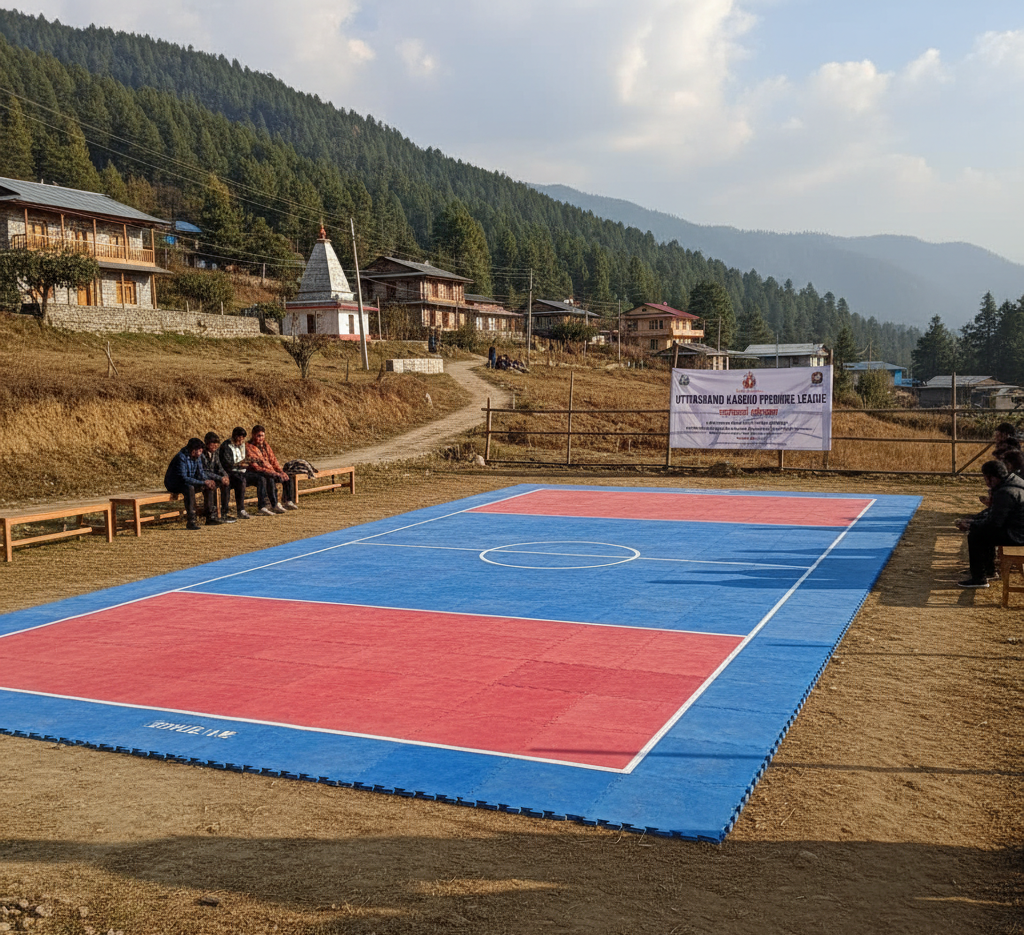
With the growing popularity of the sport, there is an increasing need for professional kabaddi court flooring in Uttarakhand. The right flooring ensures player safety, consistent performance, and long-term durability—particularly important in a state known for its unique climatic and geographic challenges.
Understanding the Terrain and Climate of Uttarakhand
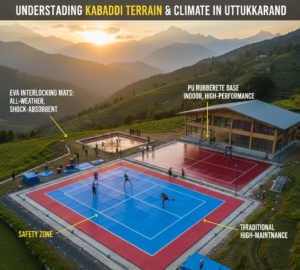
Uttarakhand’s landscape is largely mountainous, with regions that experience heavy rainfall, cold winters, and significant temperature variation between seasons. These factors directly influence construction and flooring choices for sports facilities.
For kabaddi courts in Uttarakhand, flooring materials must be:
-
Resistant to moisture and temperature changes
-
Non-slippery to ensure safe movement
-
Shock absorbent, to reduce injuries during tackles or dives
-
Durable and low-maintenance, to minimize costs in remote areas
Whether the court is located indoors (in a school or sports complex) or outdoors (in a community playground or college campus), these environmental considerations determine the type of flooring that will perform best.
Standard Kabaddi Court Dimensions
Before beginning construction, it’s important to follow the official measurements set by the Amateur Kabaddi Federation of India (AKFI):
-
Men’s and junior boys’ court: 13 meters (length) × 10 meters (width)
-
Women’s and junior girls’ court: 12 meters × 8 meters
-
Safety clearance: At least 1–2 meters on each side
The flooring should extend beyond the play area to include this safety zone, ensuring players have enough room during tackles and boundary plays.
Flooring Options Suitable for Uttarakhand
Depending on location, usage, and budget, several flooring types can be considered:
1. Clay or Mud Flooring (Traditional Option)
-
Commonly used in rural areas and local tournaments
-
Offers natural grip and soft impact surface
-
Very economical, but high maintenance—requires daily watering, rolling, and leveling
-
Not ideal for rainy or cold conditions
While traditional clay courts have cultural value, they are best suited for small village-level games rather than competitive or institutional use.
2. EVA Interlocking Mats (Synthetic Rubber Flooring)
-
Made of high-density EVA (Ethylene Vinyl Acetate) material
-
Interlocking design ensures quick installation and easy replacement
-
Excellent shock absorption, grip, and durability
-
Water-resistant and weather-proof—perfect for Uttarakhand’s rainy or cold regions
-
Low maintenance and long lifespan
These mats are now the preferred choice for schools, colleges, and professional kabaddi facilities in the hill regions due to their flexibility and resilience.
3. Polyurethane (PU) or Rubberized Flooring
-
Ideal for indoor kabaddi courts or high-performance training centers
-
Smooth, uniform surface with excellent cushioning and anti-slip properties
-
Can be customized for temperature resistance
-
Higher installation cost but exceptional durability
4. Hybrid Flooring Systems
-
Combines a concrete base with a synthetic or PU top layer
-
Balances cost and performance
-
Provides a professional finish suitable for both outdoor and indoor courts
For Uttarakhand, a hybrid or EVA mat flooring system is most practical. It provides weather resistance, long-term reliability, and easy maintenance even in hilly terrain.
Construction Process for a Kabaddi Court in Uttarakhand
Step 1: Site Preparation and Leveling
The site should be cleared of stones, roots, or debris. Since hilly terrain can have uneven ground, proper earth leveling and slope correction are crucial. Drainage channels should be incorporated to prevent waterlogging during monsoons.
Step 2: Base Construction
A reinforced concrete base of 100–150 mm thickness is typically used. The surface must be smooth and slightly sloped (~1%) to allow rainwater runoff for outdoor courts.
Step 3: Moisture Barrier
A waterproof polymer coating or primer is applied to prevent dampness from reaching the flooring layer—especially vital in areas prone to high humidity or rainfall.
Step 4: Shock Absorbent Under-Layer
A 10 mm foam or rubber underlay improves comfort, reduces joint stress, and adds flexibility to the court.
Step 5: Top Flooring Installation
-
EVA Mats: Interlocked tightly to form a uniform surface covering the play area and safety margins.
-
PU Flooring: Applied in multiple layers over the sub-base and allowed to cure before marking.
Step 6: Court Marking
Lines such as the midline, baulk line, and bonus line are marked in white or yellow paint (5 cm thick) following official kabaddi regulations.
Step 7: Edge Finishing and Safety Zone
The edges are smoothed and finished properly to prevent tripping hazards. A clear buffer area of 2 meters around the court is recommended.
Step 8: Inspection and Testing
Before official use, the surface is tested for evenness, shock absorption, grip, and dimensional accuracy.
Step 9: Maintenance
Routine maintenance involves sweeping or mopping, checking for loose mats, and repainting faded lines annually.
Benefits of Modern Kabaddi Flooring in Uttarakhand
-
All-Weather Playability:
Synthetic flooring resists rain, snow, and sunlight—allowing year-round use. -
Enhanced Safety:
Shock-absorbent surfaces protect athletes from joint injuries during dives and tackles. -
Professional Appeal:
A modern, smooth surface enhances the overall aesthetics of sports complexes and institutions. -
Low Maintenance:
Unlike clay courts, synthetic mats require minimal care, saving time and effort. -
Long Lifespan:
High-quality EVA mats or PU floors last 8–10 years with proper upkeep. -
Easy Installation:
Interlocking mats can be installed or replaced quickly, even in remote hill areas.
Recommended Specification for Uttarakhand
| Component | Specification |
|---|---|
| Court Size | 13 m × 10 m (men), 12 m × 8 m (women) |
| Sub-base | 150 mm reinforced concrete with 1% slope |
| Moisture Barrier | Waterproof polymer sealer |
| Shock Absorption Layer | 10 mm rubber or foam underlay |
| Top Surface | EVA interlocking mats, 30–40 mm thick, 120 kg/m³ density |
| Line Markings | White/yellow, 5 cm wide |
| Safety Clearance | 2 m around playfield |
| Maintenance | Sweep daily, inspect monthly, repaint annually |
Cost Overview
The cost of kabaddi court flooring in Uttarakhand depends on material type, location, and project scale:
-
Clay or mud court: ₹40,000 – ₹60,000
-
EVA interlocking mats: ₹2.5 – ₹4.5 lakh
-
PU/rubber flooring: ₹5 – ₹7 lakh
-
Hybrid flooring: ₹4 – ₹6 lakh
Costs may vary slightly due to transportation and installation logistics in hilly regions.
Conclusion
Constructing a kabaddi court in Uttarakhand requires thoughtful planning, durable materials, and climate-sensitive engineering. Whether for schools in Dehradun, colleges in Haldwani, or sports academies in Pithoragarh, investing in quality kabaddi flooring ensures player safety, long-term performance, and year-round usability.