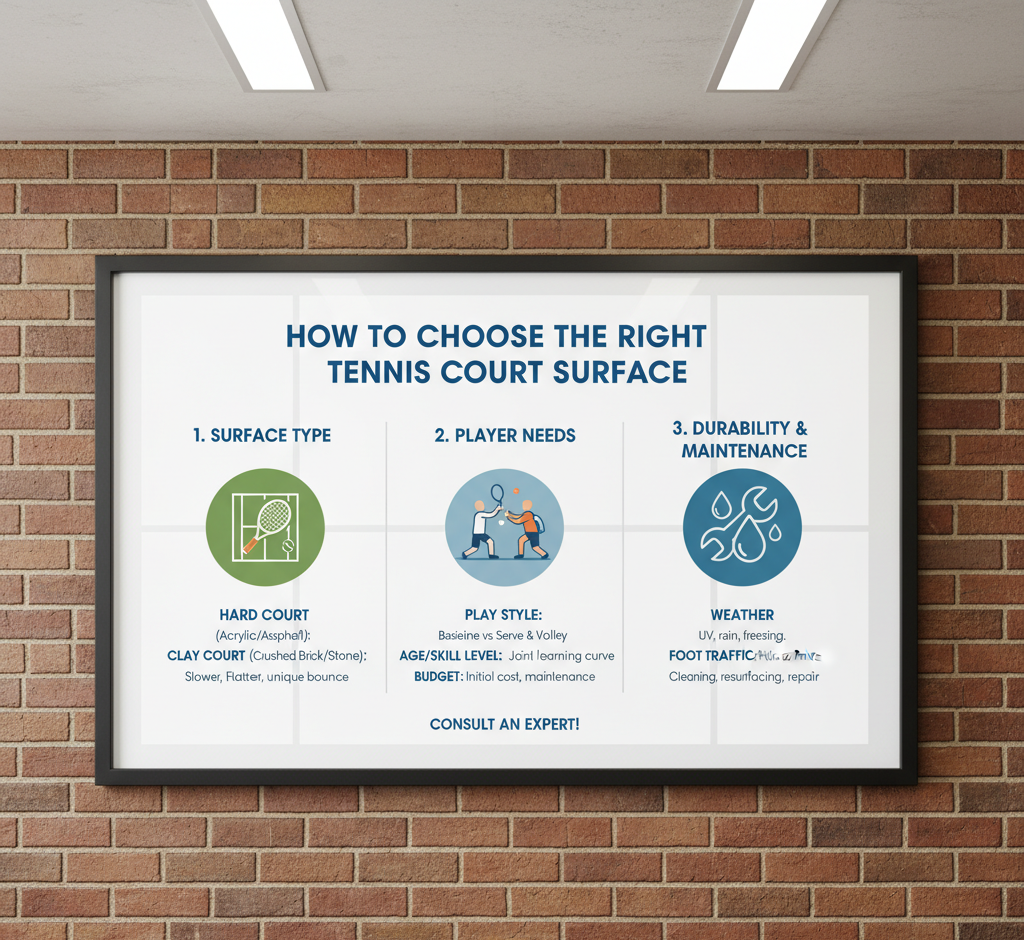
Building a tennis court is more than just laying out boundaries and nets — it’s about selecting the right flooring system that ensures comfort, durability, and performance. The type of floor you choose for your tennis court affects everything from ball bounce and player movement to maintenance costs and lifespan.
Whether you’re planning a court for a sports academy, school, club, or residential community, understanding your flooring options is essential to making an informed decision. This guide explains how to choose the floor for a tennis court, covering surface types, key factors, and modern construction insights to help you find the perfect match.
1. Why the Right Tennis Court Flooring Matters
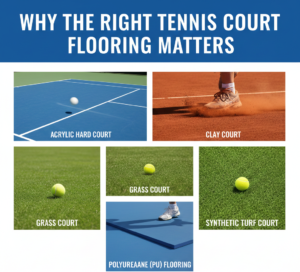
The tennis court floor isn’t just the surface — it’s the foundation of playability and safety. The right material impacts:
-
Speed of the game: Faster or slower ball movement
-
Bounce quality: Consistency and height of rebounds
-
Player comfort: Shock absorption and traction
-
Durability: Resistance to weather and wear
-
Maintenance: Long-term upkeep and repair cost
A poor choice can lead to uneven performance, high maintenance, and even injuries. That’s why selecting the appropriate flooring type based on your location, budget, and usage is crucial.
2. Common Types of Tennis Court Flooring
There are several types of tennis court surfaces, each offering unique features and suited for different needs. Let’s explore the most popular options.
A. Acrylic Hard Courts
Overview:
Acrylic is the most commonly used flooring for both professional and recreational tennis courts. It’s the official surface for tournaments like the US Open and Australian Open, favored for its consistency, appearance, and durability.
Features:
-
Built over a concrete or asphalt base
-
Coated with multiple layers of acrylic resin
-
Optional cushion layer for shock absorption
Advantages:
-
Long-lasting and weather-resistant
-
Provides uniform ball bounce
-
Low maintenance
-
Available in customizable colors
-
Suitable for both indoor and outdoor courts
Best For:
Schools, sports complexes, clubs, and private courts.
B. Clay Courts
Overview:
Clay courts are famous for their slow ball speed and high bounce, encouraging longer rallies and strategic gameplay. This traditional surface is seen at the French Open (Roland Garros).
Features:
-
Made from crushed brick, shale, or stone
-
Typically built on compacted layers with a drainage system
Advantages:
-
Soft on joints
-
Reduces player fatigue
-
Ideal for developing skill and endurance
-
Visually appealing natural look
Disadvantages:
-
High maintenance (watering, rolling, brushing)
-
Can become slippery in rain
-
Slower gameplay may not suit all players
Best For:
Tennis academies and professional training facilities.
C. Grass Courts
Overview:
Grass courts are the original tennis surface, known for their speed and classic charm. They deliver a fast-paced game with a low bounce and require a high level of maintenance.
Features:
-
Built on a soil base covered with natural grass
-
Requires constant watering, mowing, and reseeding
Advantages:
-
Fast gameplay
-
Natural cushioning for players’ joints
-
Aesthetic and premium appearance
Disadvantages:
-
High cost and maintenance
-
Weather-dependent
-
Not suitable for high-traffic areas
Best For:
Luxury sports resorts, private estates, and traditional clubs.
D. Synthetic Turf Courts
Overview:
Synthetic turf (artificial grass) has become a popular modern alternative to natural grass. It offers the same visual appeal with better durability and all-weather usability.
Features:
-
Made from UV-stabilized synthetic fibers
-
Usually filled with silica sand or rubber granules
Advantages:
-
Low maintenance
-
Weatherproof and durable
-
Comfortable for long matches
-
Consistent bounce and grip
Disadvantages:
-
Slightly different ball response than natural grass
-
Needs periodic brushing and leveling
Best For:
Residential complexes, schools, and multi-sport facilities.
E. Polyurethane (PU) Flooring
Overview:
PU flooring is one of the most advanced and comfortable tennis flooring systems. It’s a seamless, cushioned surface suitable for both indoor and semi-outdoor courts.
Features:
-
Made from elastic polyurethane resin over a concrete base
-
Provides uniform texture and grip
Advantages:
-
Excellent shock absorption
-
Non-slip and smooth finish
-
Easy to clean and maintain
-
Long lifespan
Disadvantages:
-
Higher initial installation cost
-
Requires professional setup
Best For:
Indoor stadiums, professional facilities, and multi-purpose sports halls.
F. Modular Tile Systems
Overview:
Modular tiles are an innovative flooring trend for tennis courts, providing flexibility and portability. These interlocking polypropylene tiles can be installed over existing bases quickly and easily.
Features:
-
Prefabricated, interlocking tiles
-
Often cushioned for extra comfort
Advantages:
-
Quick installation and removal
-
Durable and weather-resistant
-
Portable and easy to maintain
Disadvantages:
-
May feel slightly different from traditional courts
-
Requires precise leveling during installation
Best For:
Temporary setups, schools, or event-based sports courts.
3. Factors to Consider When Choosing Tennis Court Flooring
To select the best flooring for your tennis court, consider the following factors:
| Factor | Description | Recommended Surface |
|---|---|---|
| Location (Indoor/Outdoor) | Outdoor courts need UV and weather resistance | Acrylic or Synthetic Turf |
| Budget | Determines material and construction quality | Acrylic (Economical) or PU (Premium) |
| Climate | Hot or humid regions require heat-resistant, non-slip surfaces | Acrylic or Synthetic Grass |
| Player Skill Level | Professionals may prefer specific ball behavior | Clay or Acrylic |
| Maintenance Capacity | Regular upkeep vs. low-maintenance preference | Acrylic or PU |
| Usage Frequency | Heavy use requires stronger materials | Acrylic or Modular Tiles |
4. Expert Tips for Selecting the Perfect Surface
Here are some expert recommendations to help you make a confident choice:
-
Prioritize Player Safety: Choose flooring with proper cushioning and slip resistance.
-
Think Long-Term: A slightly higher upfront investment can save you years of repairs.
-
Consider Dual Use: Modular or PU courts can support multiple sports like badminton or volleyball.
-
Hire a Professional Contractor: Proper base preparation and leveling are crucial for surface performance.
-
Go Green: Opt for eco-friendly materials with low VOC content and water-saving construction designs.
5. Maintenance and Longevity
Regular maintenance keeps your court safe, attractive, and long-lasting.
-
Clean Debris: Sweep or wash regularly to prevent dust and dirt buildup.
-
Recoat Surfaces: Acrylic and PU floors may need recoating every few years.
-
Drainage Check: Ensure proper slope and water flow.
-
Brush Synthetic Turf: Maintain even infill and bounce quality.
-
Inspect Lines: Repaint markings for visibility and safety.
With proper care, modern tennis court flooring can last 10–15 years or more.
6. Final Thoughts
Choosing the right floor for your tennis court is a decision that defines both the performance and lifespan of your facility. From traditional clay and grass courts to modern acrylic, PU, and modular surfaces, each option offers distinct advantages.