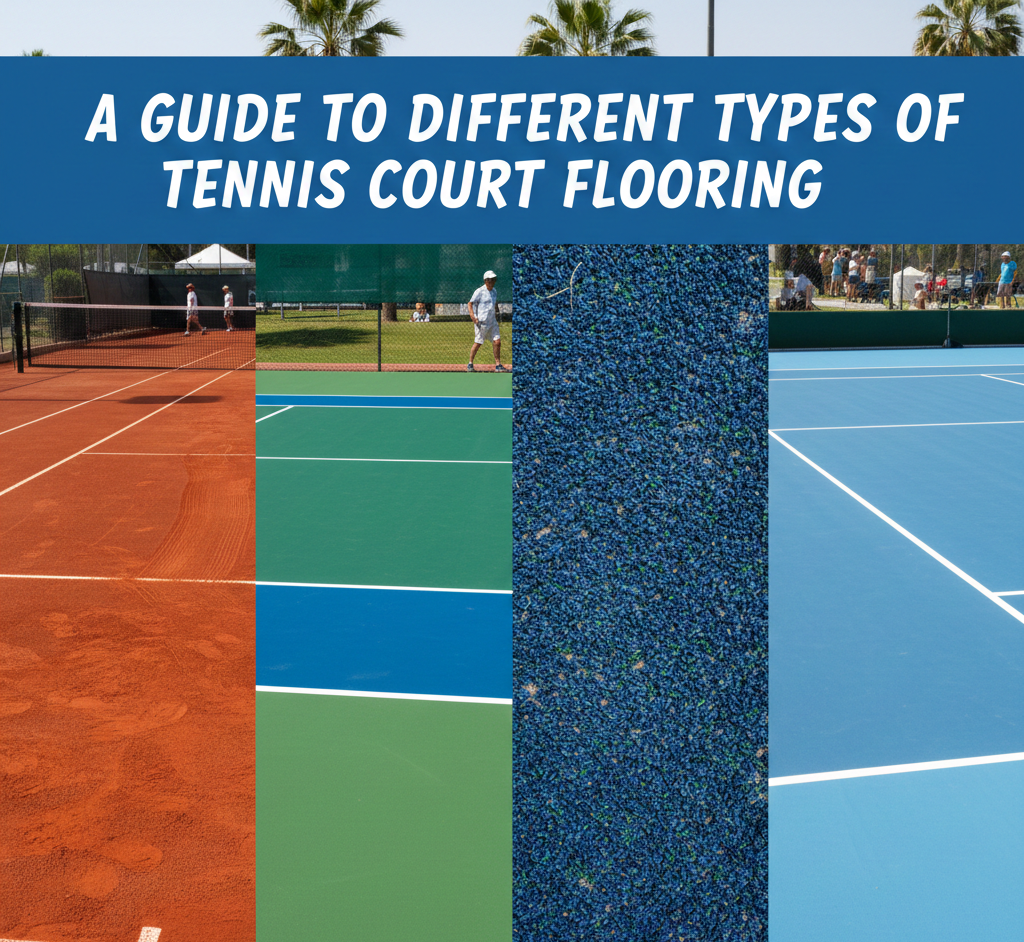
Tennis is one of the most dynamic and tactical sports in the world, where court surface plays a decisive role in how the game is played. The type of tennis court flooring directly affects ball bounce, game speed, player movement, comfort, and injury prevention.
From classic clay and grass courts to modern acrylic, synthetic, and modular systems, each tennis surface offers unique playing characteristics. Whether you are developing a professional sports facility, school court, residential installation, or club, understanding tennis court flooring options is essential to making the right choice.
This guide explores the most common tennis court flooring types, their features, advantages, limitations, and ideal applications.
1. Hard Court Tennis Flooring
Overview
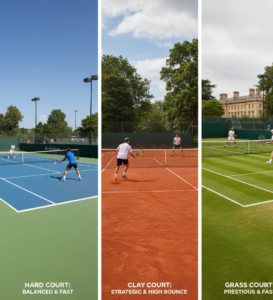
Hard courts are among the most widely used tennis surfaces globally and are featured in major tournaments such as the US Open and Australian Open. These courts are constructed using asphalt or concrete bases finished with multiple layers of acrylic coating.
The surface provides a uniform and predictable bounce, resulting in medium-to-fast play that suits a wide range of playing styles.
Key Characteristics
-
Consistent ball bounce
-
Balanced speed for offense and defense
-
Suitable for indoor and outdoor use
Advantages
-
Long-lasting and low maintenance
-
Performs well in diverse climates
-
Customizable colors and surface textures
Limitations
-
Harder on joints without cushioning layers
-
Can retain heat under strong sunlight
Best Applications
Professional tournaments, tennis academies, schools, sports complexes, and public courts.
2. Clay Court Tennis Flooring
Overview
Clay courts are known for slower game speed and higher ball bounce, encouraging longer rallies and strategic play. The most iconic clay-court tournament is the French Open.
These courts are constructed using crushed brick, stone, or shale, layered over a well-drained base. The soft surface promotes endurance and technical skill development.
Key Characteristics
-
Slow playing speed
-
High and consistent bounce
-
Encourages tactical, baseline play
Advantages
-
Soft on joints and muscles
-
Lower risk of impact injuries
-
Surface can be easily repaired and leveled
Limitations
-
Requires frequent maintenance (watering, rolling, brushing)
-
Not ideal for heavy rainfall or humid climates
-
Slower pace may not suit all players
Best Applications
Outdoor academies, training centers, and clubs focused on endurance and skill development.
3. Grass Court Tennis Flooring
Overview
Grass courts represent the heritage and elegance of tennis and are famously used at Wimbledon. This surface delivers the fastest pace of play with a low, skidding bounce.
Grass courts are built on a natural soil base with carefully maintained live grass, demanding expert upkeep to preserve play quality.
Key Characteristics
-
Fast surface speed
-
Low and sometimes unpredictable bounce
-
Soft, natural playing feel
Advantages
-
Excellent shock absorption
-
Comfortable underfoot
-
Prestigious and visually striking
Limitations
-
Extremely high maintenance requirements
-
Acrylic Synthetic Tennis Flooring Highly weather-dependent
-
Expensive to install and maintain
Best Applications
Luxury clubs, private estates, and premium tournament venues.
4. Acrylic Synthetic Tennis Flooring
Overview
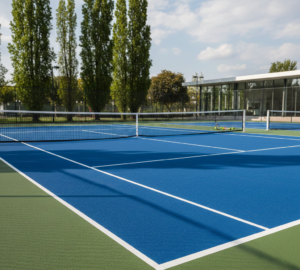
Acrylic tennis courts are an advanced version of traditional hard courts, using multi-layer acrylic systems over asphalt or concrete bases. These surfaces offer customizable playing speeds, improved grip, and enhanced weather resistance.
By adjusting coating thickness and texture, acrylic courts can be designed as slow, medium, or fast-paced.
Key Characteristics
-
Uniform ball bounce
-
Excellent traction and durability
-
UV and weather resistant
Advantages
-
Long service life with minimal maintenance
-
Visually appealing color options
-
Cushion layers can be added for joint protection
Limitations
-
Requires professional installation
-
Higher cost than plain concrete courts
Best Applications
Professional tennis facilities, schools, clubs, and community sports complexes.
5. Artificial Grass Tennis Flooring
Overview
Artificial grass courts are a modern alternative to natural turf, offering the look of grass without intensive maintenance. These surfaces use synthetic fibers with sand or rubber infill, delivering comfortable play and consistent bounce.
Key Characteristics
-
Medium-speed surface
-
Comfortable cushioning
-
All-weather usability
Advantages
-
Minimal maintenance requirements
-
Durable and weather-resistant
-
Player-friendly and visually appealing
Limitations
-
Bounce differs slightly from natural grass
-
Requires periodic brushing to maintain infill distribution
Best Applications
Residential courts, schools, recreational clubs, and multi-sport areas.
6. Polyurethane (PU) Tennis Flooring
Overview
Polyurethane (PU) tennis courts are typically used in indoor or semi-covered facilities. These courts feature a seamless, elastic surface installed over rubber or asphalt bases, offering exceptional shock absorption and comfort.
Key Characteristics
-
Seamless, cushioned surface
-
High traction and durability
-
Joint-friendly performance
Advantages
-
Excellent impact absorption
-
Long lifespan with minimal upkeep
-
Suitable for multi-purpose indoor sports
Limitations
-
Higher initial installation cost
-
Requires skilled professional application
Best Applications
Indoor tennis courts, professional clubs, gymnasiums, and multi-sport halls.
7. Modular Tile Tennis Flooring
Overview
Modular interlocking tile systems are flexible, portable tennis flooring solutions. Made from polypropylene tiles, they allow rapid installation and removal, making them ideal for temporary or multi-use setups.
Key Characteristics
-
Quick installation
-
Good traction and drainage
-
Available in multiple colors and textures
Advantages
-
Portable and reusable
-
Weather-resistant
-
Suitable for multi-sport environments
Limitations
-
Less cushioning than PU systems
-
Requires a firm, level sub-base
Best Applications
Temporary courts, events, exhibitions, schools, and indoor training facilities.
How to Choose the Right Tennis Court Flooring
Selecting the right tennis surface depends on several critical factors:
-
Purpose: Competitive play, training, or recreation
-
Location: Indoor or outdoor installation
-
Climate: Heat, rainfall, humidity, and UV exposure
-
Budget: Initial cost versus long-term maintenance
-
Player Needs: Speed preference, comfort, and safety
Quick Recommendations
-
Choose acrylic or PU for professional and institutional use
-
Opt for artificial grass for low maintenance and aesthetics
-
Select clay courts for endurance-focused training
Conclusion
Each tennis court flooring type offers distinct playing characteristics, maintenance demands, and performance advantages. Whether you value the tradition of grass, the strategic depth of clay, or the modern durability of acrylic and PU surfaces, the right choice depends on your facility’s goals, environment, and budget.
A well-selected tennis court surface enhances player performance, safety, and long-term usability, making it a vital investment for any tennis facility.
FAQ – Different Types of Tennis Court Flooring: Complete Guide
1. What are the standard types of tennis court flooring?
The most common tennis court flooring types include:
- Hard Courts – Asphalt or concrete with acrylic coating, fast-paced and low maintenance
- Clay Courts – Soft surface made of crushed brick or shale, slower ball bounce, preferred for professional tournaments
- Grass Courts – Natural grass surface, fast-paced play, requires high maintenance
- Synthetic/Modular Courts – Made with interlocking tiles or synthetic materials, suitable for indoor and outdoor recreational use
2. What are the advantages of a hard tennis court?
- Durable and long-lasting
- Low maintenance compared to grass or clay
- Provides consistent ball bounce
- Suitable for both indoor and outdoor facilities
3. What are the benefits of clay tennis courts?
- Slower ball speed, ideal for strategic gameplay
- Softer surface, reducing impact on joints
- Excellent for professional tournaments and training
4. Why choose grass tennis courts?
- Fastest type of court with low ball bounce
- Preferred for traditional and professional tournaments
- Provides natural aesthetic and smooth playing surface
5. What is synthetic or modular tennis court flooring?
- Made with interlocking tiles, polyurethane, or acrylic synthetic materials
- Can be installed indoors or outdoors
- Low maintenance and weather-resistant
- Provides consistent ball bounce and player comfort
6. How long does it take to construct a tennis court?
- Hard or synthetic courts: 2–4 weeks
- Clay courts: 3–5 weeks
- Grass courts: 6–8 weeks (including turf establishment and maintenance)
7. How much does tennis court construction cost?
- Hard courts: ₹15–30 lakh
- Synthetic/modular courts: ₹20–40 lakh
- Clay courts: ₹25–50 lakh
- Grass courts: ₹35–60 lakh (maintenance intensive)