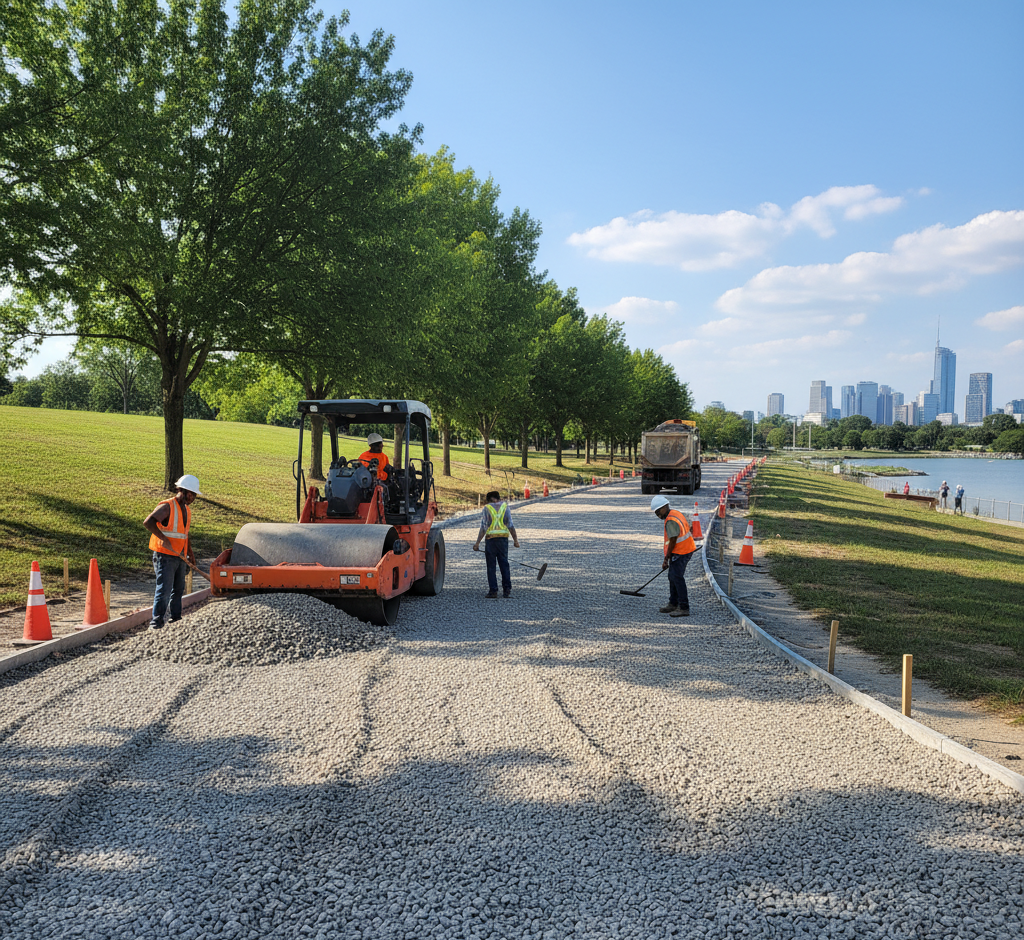
When it comes to jogging track construction, most people focus on the visible surface—PU, EPDM, or acrylic. While the top layer determines comfort, grip, and appearance, the true strength of a jogging track lies beneath it. Jogging track base preparation is the most critical phase of construction, directly influencing durability, drainage, safety, and lifecycle cost.
A poorly prepared base can lead to cracks, uneven settlement, water stagnation, and premature surface failure—even when premium surfacing materials are used. On the other hand, a scientifically engineered base ensures smooth performance, minimal maintenance, and a lifespan that can extend beyond 15 years.
Whether you are developing a 400-meter athletic track, a residential jogging path, a park trail, or a school fitness loop, understanding proper base preparation is essential.
Why Jogging Track Base Preparation Is So Important
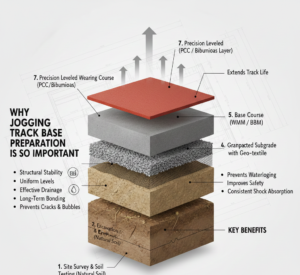
The base acts as the structural backbone of the jogging track system. It supports the load of runners, maintenance equipment, and environmental stress while maintaining uniformity and drainage.
A professionally prepared base provides:
-
Structural stability and load-bearing strength
-
Uniform surface levels to prevent tripping hazards
-
Effective water drainage during rain
-
Protection from soil movement and erosion
-
Long-term bonding support for surface materials
Without correct base preparation, surface layers may develop cracks, bubbles, depressions, or delamination within a short period.
Key Benefits of Proper Base Preparation
-
Extends the life of the jogging track surface
-
Reduces repair and resurfacing costs
-
Improves athlete safety and comfort
-
Prevents waterlogging and moisture damage
-
Ensures consistent shock absorption and surface response
-
Maintains professional-grade finish over time
Stages of Jogging Track Base Preparation
A high-quality jogging track base is built through a systematic, engineering-driven process. Each stage plays a crucial role in overall performance.
1. Site Survey and Soil Testing
Base preparation begins with a detailed site investigation.
This includes:
-
Topographical survey to assess natural slope and drainage flow
-
Soil testing to determine bearing capacity, moisture content, and compaction strength
-
Water table analysis, especially important in monsoon-prone regions
If the soil is weak, expansive, or clayey, it must be stabilized using lime, cement, or granular material before construction continues. Ignoring soil conditions is one of the most common causes of track failure.
2. Earthwork and Excavation
Once soil conditions are understood, excavation begins.
Key steps include:
-
Removal of vegetation, loose soil, and organic matter
-
Excavation to the required depth, typically 300mm to 600mm, depending on track design
-
Achieving uniform formation level across the site
-
Mechanical compaction using rollers
Proper excavation ensures that the base does not settle unevenly over time.
3. Subgrade Preparation
The subgrade is the compacted natural soil layer that supports all upper layers.
Important requirements:
-
Compaction to achieve CBR of 8–10% minimum
-
Uniform leveling across the entire track
-
Introduction of geo-textile fabric if required, to prevent soil migration
-
Maintaining a slope of 1–2% for surface drainage
A strong subgrade prevents long-term settlement and moisture-related failures.
4. Granular Sub-Base Layer
The sub-base layer distributes loads and improves drainage.
Specifications:
-
Material: Crushed stone or gravel (40mm–65mm)
-
Thickness: 100mm–150mm
-
Compaction using vibrating rollers in multiple passes
This layer acts as a buffer between soil and structural layers, improving stability and load transfer.
5. Base Course (WMM / WBM)
The base course is the most critical structural layer in jogging track base preparation.
Common materials:
-
Wet Mix Macadam (WMM)
-
Water Bound Macadam (WBM)
Specifications:
-
Thickness: 100mm–150mm
-
Compaction to 95–98% Proctor density
-
Smooth, uniform finish
A well-compacted base course ensures strength, prevents deformation, and supports long-term performance of PU or EPDM surfaces.
6. Wearing Course (PCC or Bituminous Layer)
The wearing course forms the final hard foundation for the jogging surface.
Options include:
-
PCC (Plain Cement Concrete) – preferred for PU and EPDM tracks
-
Bituminous Asphalt Layer – used for acrylic or flexible systems
This layer must be:
-
Crack-free
-
Properly cured
-
Smooth and accurately sloped
Any defects at this stage will reflect directly on the finished surface.
7. Precision Leveling and Finishing
Before surface installation, precision leveling is performed using:
-
Laser level instruments
-
Straight-edge testing
-
Water ponding tests
This ensures:
-
No low points or undulations
-
Proper water flow
-
Uniform thickness of the surface layer
Accurate leveling directly impacts runner comfort and surface durability.
Drainage Design in Jogging Track Base Preparation
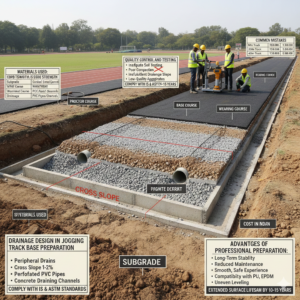
Effective drainage is non-negotiable in jogging track construction.
Drainage solutions include:
-
Peripheral drains around the track
-
Cross slope of 1–2%
-
Perforated PVC pipes below sub-base layers
-
Concrete drainage channels
Good drainage prevents water stagnation, mold growth, and surface degradation.
Materials Used in Jogging Track Base Preparation
| Layer | Material | Purpose |
|---|---|---|
| Subgrade | Natural soil (stabilized if needed) | Base support |
| Sub-Base | Crushed stone / gravel | Drainage & load distribution |
| Base Course | WMM / WBM | Structural strength |
| Wearing Course | PCC / Asphalt | Surface foundation |
| Drainage | PVC pipes / channels | Water management |
All materials should comply with IS and ASTM standards.
Quality Control and Testing
Professional jogging track base preparation involves strict quality checks:
-
Compaction tests (Proctor Density)
-
CBR testing for soil strength
-
Plate load tests
-
Slope and level verification
-
Drainage flow testing
These tests ensure the base is ready to support high-performance surfacing.
Cost of Jogging Track Base Preparation in India
Costs vary based on soil condition, track size, and material selection.
| Track Type | Approx. Cost (INR) |
|---|---|
| Mini Track (100–150m) | ₹80,000 – ₹1,50,000 |
| 200m Track | ₹2,00,000 – ₹3,50,000 |
| 400m Track | ₹3,50,000 – ₹6,00,000 |
These costs typically include excavation, compaction, base layers, and drainage.
Common Mistakes in Jogging Track Base Preparation
❌ Inadequate soil testing
❌ Poor compaction
❌ Insufficient drainage slope
❌ Use of low-quality aggregates
❌ Uneven leveling before surfacing
Avoiding these mistakes requires experienced contractors and strict quality control.
Advantages of Professional Jogging Track Base Preparation
-
Long-term structural stability
-
Reduced maintenance and repair costs
-
Smooth, safe jogging experience
-
Compatibility with PU, EPDM, and acrylic surfaces
-
Higher return on investment
-
Extended surface lifespan by 10–15 years
Conclusion
Jogging track base preparation is the single most important factor that determines the performance, safety, and lifespan of a jogging track. No surface system—no matter how advanced—can compensate for a weak or poorly prepared base.
By following proper engineering standards, using quality materials, ensuring precise compaction, and implementing effective drainage, you create a foundation that supports years of safe, enjoyable, and professional-grade jogging.