A jogging track is not complete without precise line marking. These markings are more than just lines — they define lanes, guide users, and ensure safety and performance accuracy. Whether for a 400-meter professional athletic track, a school jogging track, or a community fitness trail, line marking brings structure, order, and aesthetic appeal to the entire facility.
Proper jogging track line marking requires technical accuracy, high-quality paints, and compliance with World Athletics and national sports standards to ensure the surface meets both functional and visual expectations.
🏃 What Is Jogging Track Line Marking?
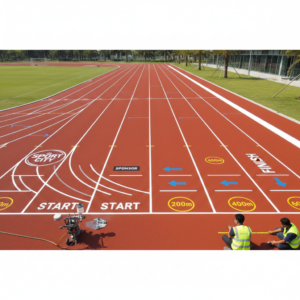
Line marking refers to the process of painting visible and durable lines, numbers, and symbols on a jogging or running track surface. These lines divide lanes, indicate distances, and mark start and finish points for better user orientation.
In short, line marking transforms a plain surface into a professional-grade running zone by ensuring:
-
Correct lane spacing and width
-
Uniform measurements
-
Clear directional guidance
-
Enhanced visibility and safety
🧭 Purpose of Line Marking on Jogging Tracks
The markings are essential for:
-
Guidance: Helps users stay in their lanes.
-
Measurement Accuracy: Ensures every lap or distance is consistent.
-
Safety: Prevents collisions during group activities.
-
Professional Appearance: Adds a polished, athletic look to the facility.
-
Compliance: Meets global sports and construction standards.
📏 Standard Jogging Track Line Marking Dimensions
While 400 meters is the global standard for an athletic or jogging track, smaller community tracks (100m, 200m, 300m) follow the same proportionate measurements.
Below are the standard line marking dimensions and parameters for jogging tracks:
| Specification | Measurement / Standard |
|---|---|
| Total Track Length | 400 meters (standard) |
| Lane Width | 1.22 meters (World Athletics Standard) |
| Number of Lanes | 4 to 8 (based on area) |
| Line Width | 5 cm (0.05 m) |
| Measurement Line Position | 30 cm inside the inner boundary of each lane |
| Start Line Curvature | Adjusted per lane to ensure equal lap distance |
| Finish Line | Common for all lanes, perpendicular to straights |
| Direction Arrow | 0.3 m long, 0.15 m wide, every 50 m (optional) |
Each marking is placed precisely to guarantee lap accuracy and uniform lane distance.
⚙️ Types of Markings Used on Jogging Tracks
Professional jogging tracks include a variety of markings for functionality and user experience.
1. Lane Lines
-
Continuous white lines separating each lane.
-
Width: 5 cm.
-
Ensures equal lane spacing and safe jogging distance.
2. Start & Finish Lines
-
Solid straight lines marking start and endpoint of laps.
-
Usually painted in white or yellow for visibility.
3. Directional Arrows
-
Arrows guide runners on one-way jogging flow.
-
Prevents confusion and collisions in shared facilities.
4. Distance Indicators
-
100m, 200m, 400m markers for lap counting.
-
Optional colored circles or symbols along the edge.
5. Logo / Branding
-
Optionally, facility name or sponsor logos can be added near start zones for branding.
🎨 Paints and Materials Used in Line Marking
Durability and visibility depend heavily on the type of paint and application method used. High-quality, UV-resistant paints ensure long-lasting markings that withstand wear, weather, and foot traffic.
| Type of Paint | Features | Best For |
|---|---|---|
| PU (Polyurethane) Paint | Excellent adhesion, UV and water-resistant | Synthetic / PU Tracks |
| Acrylic Line Paint | Fast-drying, bright colors | Outdoor concrete or asphalt jogging tracks |
| Thermoplastic Paint | Thick layer, long-lasting, skid-resistant | High-traffic fitness trails |
| Epoxy Paint | Strong bonding, chemical-resistant | Indoor or covered jogging tracks |
All paints should comply with ASTM D4060 (abrasion resistance) and ISO 2812 (chemical durability) standards.
🧱 Jogging Track Line Marking Process
Line marking is a technical process requiring professional equipment, skilled applicators, and accurate layout measurements. Below is the standard step-by-step procedure:
Step 1: Surface Preparation
-
Clean track thoroughly to remove dust, oil, and debris.
-
Ensure surface is dry and level.
Step 2: Layout Planning
-
Measure and mark the centerline using string and chalk.
-
Use laser-guided or auto-line machines for precision.
: Masking
-
Apply masking tape for straight, clean edges.
-
Align with lane markings and curved sections accurately.
: Paint Application
-
Apply PU or acrylic-based line paint using a line-marking machine.
-
Paint 1–2 coats depending on color intensity.
: Drying & Finishing
-
Allow paint to dry for 12–24 hours.
-
Remove masking tape carefully for crisp edges.
-
Apply protective coating (optional) for extended durability.
: Inspection
-
Verify line width, position, and alignment with measuring tape or laser.
-
Ensure all markings comply with World Athletics and site standards.
🌈 Color Standards for Jogging Track Markings
Although white is the global standard for lane markings, other colors are used for differentiation or design customization.
| Color | Use |
|---|---|
| White | Lane markings, start/finish lines |
| Yellow | Distance indicators or caution zones |
| Blue | Directional markings or multi-purpose lanes |
| Red / Green | Special-purpose zones or branding |
| Black | Contrast for light-colored surfaces |
Proper color contrast ensures visibility under both sunlight and artificial lighting.
⚒️ Tools and Equipment Used
Professional line marking requires specialized tools for precision and uniformity:
-
Laser-guided line marking machines
-
Measuring tapes and compasses
-
Airless paint sprayers
-
Chalk lines and masking tapes
-
Drying blowers (for quick cure)
-
Protective masks and gloves for applicators
🧩 Maintenance of Track Line Markings
To maintain visibility and aesthetics, markings should be inspected and refreshed regularly.
Maintenance Guidelines:
-
Clean the track weekly to remove dirt buildup.
-
Avoid abrasive cleaning brushes.
-
Repaint lines every 2–3 years, or sooner if faded.
-
Inspect after monsoons for paint wear or peeling.
-
Use compatible solvents for cleaning (never acid or harsh chemicals).
Proper maintenance keeps the track safe, professional-looking, and durable over time.
💰 Cost of Jogging Track Line Marking in India
The cost depends on track size, paint type, and number of lanes.
| Track Type | No. of Lanes | Material Used | Approx. Cost (INR) |
|---|---|---|---|
| 100m Mini Track | 2–3 | Acrylic Paint | ₹25,000 – ₹45,000 |
| 200m School Track | 4 | PU Paint | ₹50,000 – ₹90,000 |
| 400m Standard Track | 6–8 | PU / Thermoplastic | ₹1,00,000 – ₹2,50,000 |
| Custom Fitness Trail | Variable | Acrylic / Epoxy | ₹40 – ₹100 per sq.m |
Prices include marking layout, paint, labor, and finishing.
🏆 Benefits of Professional Line Marking
-
Precision & Accuracy: Ensures every lane and distance is accurate.
-
Aesthetic Finish: Enhances the visual quality of the facility.
-
Durability: Long-lasting paint resists fading and cracking.
-
Safety: Clear markings prevent confusion and accidents.
-
Compliance: Meets international standards for professional use.
-
Branding Flexibility: Can include logos, colors, or sponsors.
🏁 Conclusion
A professionally marked jogging track combines precision, performance, and presentation. From lane divisions to directional arrows, each marking adds clarity, safety, and style to the facility.
By using high-quality paints, following accurate standards, and hiring expert applicators, you can ensure that your jogging track line markings remain crisp, durable, and visually striking for years.
Frequently Asked Questions (FAQ) – Jogging Track Line Marking
1. What is jogging track line marking?
Jogging track line marking refers to painting or embedding lines on a jogging track to guide runners, separate lanes, indicate distances, and enhance safety and aesthetics.
2. Why is line marking important on jogging tracks?
-
Lane separation for walkers, joggers, and runners
-
Distance measurement markers for training or events
-
Improved safety by preventing collisions
-
Aesthetic and professional look for parks, schools, or sports facilities
3. What materials are used for line marking?
-
Paint-based markings with UV-resistant and anti-slip properties
-
Thermoplastic or epoxy coatings for durability
-
Embedded or inlaid lines in synthetic or rubber tracks for long-lasting visibility
4. How many lanes should a jogging track have?
-
Residential or park tracks: 1–2 lanes (1.2–1.5 m each)
-
Professional tracks: 2–4 lanes (1.5–2 m each)
Lanes help manage traffic flow and user safety.
5. Are distance markers used on jogging tracks?
Yes, tracks often include markers every 100 m, 200 m, or 500 m to:
-
Help runners track progress
-
Assist in training programs
-
Measure distance for fitness assessments or events
6. Can jogging track lines be customized?
Yes, line colors, width, and styles can be customized for:
-
Lane separation
-
Distance markers
-
Aesthetic appeal or branding for parks, residential complexes, or schools
7. How is line marking done on synthetic jogging tracks?
-
Surface is cleaned and leveled
-
UV-resistant paint or epoxy is applied with stencils
-
Optional inlaid markings for extra durability
-
Finished lines are anti-slip and weather-resistant
8. How long does jogging track line marking last?
-
Painted lines: 1–2 years, depending on traffic and weather
-
Epoxy or thermoplastic lines: 3–5 years
-
Inlaid lines: 5–10 years, highly durable for professional tracks
9. Can jogging track lines be maintained?
Yes, lines can be maintained by:
-
Regular cleaning to remove dirt and debris
-
Touch-up painting or coating when fading occurs
-
Replacing inlaid or embedded lines if damaged
10. Do jogging tracks require markings for events or competitions?
Yes, tracks can include special markings for races, marathons, or fitness challenges to guide participants and measure distances accurately.
11. Are line markings safe for all weather conditions?
High-quality UV-resistant, anti-slip paints and coatings make lines safe in rain, sun, or humid conditions, reducing the risk of slipping.
12. Who is responsible for jogging track line marking?
Professional sports flooring contractors or track construction companies handle line marking to ensure accuracy, durability, and compliance with standards.
13. How much does jogging track line marking cost in India?
-
Standard painted lines: ₹50–₹150 per meter
-
Epoxy or thermoplastic lines: ₹150–₹400 per meter
-
Inlaid lines: ₹400–₹800 per meter
Cost depends on material, track type, and total length of markings.
14. Can jogging track line marking be added to existing tracks?
Yes, line markings can be applied to existing synthetic, rubber, or asphalt tracks, provided the surface is clean, level, and free of cracks.