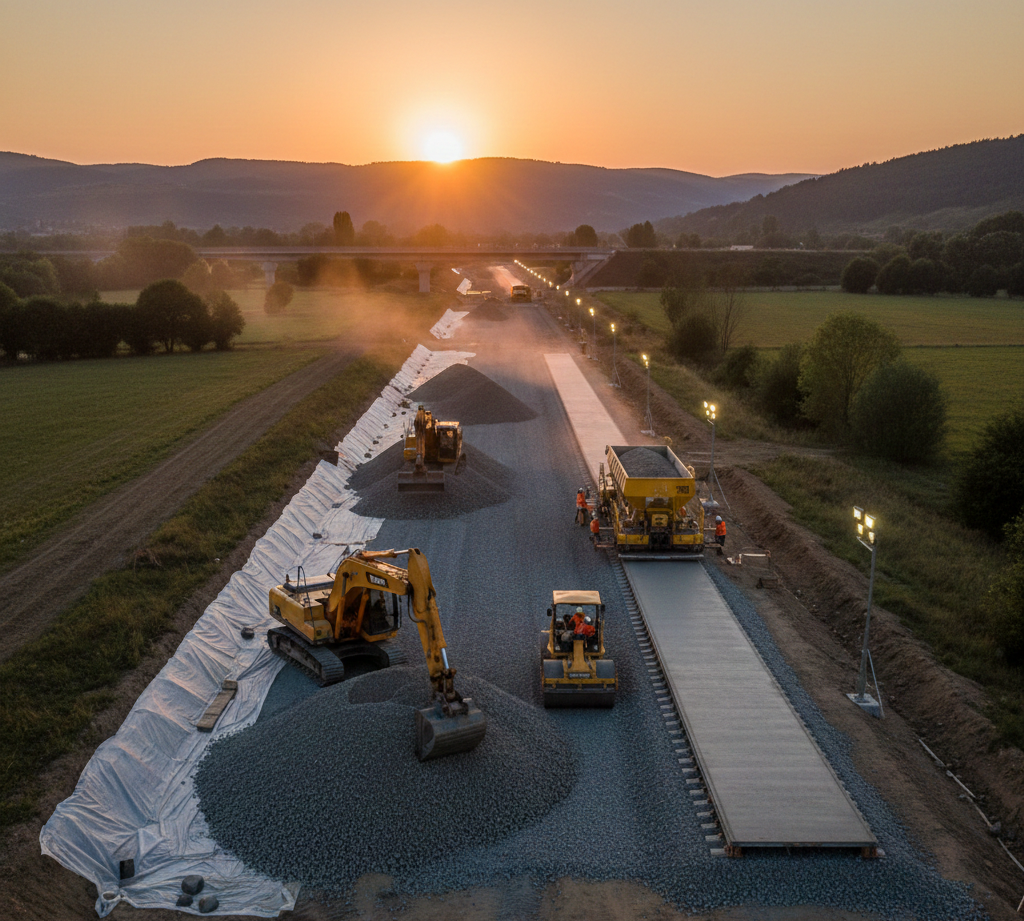
Every high-performance running track starts with a strong, well-engineered base. Track base construction is the critical first step in building safe, durable, and long-lasting athletic facilities.
1. Importance of Track Base Construction
The track base serves as the foundation for all subsequent layers in the running track system. Its importance can be summarized as follows:
-
Structural Stability
-
Supports the weight of the track layers and the impact of running athletes.
-
Prevents surface deformation and cracking over time.
-
-
Drainage Facilitation
-
Allows water to flow through or away from the track surface efficiently.
-
Prevents water accumulation that could compromise safety and surface longevity.
-
-
Surface Uniformity
-
Provides a flat, consistent platform for synthetic layers like polyurethane, Tartan, or EPDM.
-
Ensures smooth transitions on straightaways and curves.
-
-
Shock Absorption
-
Works with elastic layers to reduce strain on athletes’ joints.
-
Enhances energy return and running performance.
-
-
Durability and Lifespan
-
A properly engineered base increases the lifespan of the track by 10–15 years or more.
-
2. Components of a Running Track Base
The base of a running track typically consists of multiple layers, each designed to fulfill a specific function:
-
Subgrade Layer
-
The natural soil is compacted to achieve uniform density and strength.
-
Weak soils are often stabilized with additives or replaced with engineered fill.
-
-
Aggregate Base Layer
-
Composed of crushed stone, gravel, or sand.
-
Provides structural support and facilitates water drainage.
-
Compacted in layers to achieve maximum stability.
-
-
Asphalt or Concrete Layer
-
Serves as the primary foundation for synthetic tracks.
-
Ensures a rigid, level surface that resists deformation.
-
Thickness typically ranges from 50–100 mm, depending on the project specifications.
-
-
Primer Layer (Optional)
-
A thin coat of polyurethane or bitumen may be applied to enhance adhesion between the base and the synthetic track surface.
-
-
Slope and Grading
-
Base is graded to maintain a 0.5–1% cross slope for drainage.
-
Curves and bends are carefully adjusted to maintain lane consistency and proper water flow.
-
3. Steps in Track Base Construction
Constructing a running track base involves several methodical steps:
Step 1: Site Preparation
-
Clear vegetation, debris, and topsoil.
-
Conduct soil testing to determine compaction requirements and load-bearing capacity.
-
Excavate to the desired depth, accounting for aggregate, asphalt, and track surface layers.
Step 2: Subgrade Stabilization
-
Compact the natural soil using rollers or plate compactors.
-
Stabilize soft or weak soils with lime, cement, or geotextile membranes as needed.
-
Spread crushed stone, gravel, or sand in layers of 75–150 mm.
-
Compact each layer thoroughly to ensure structural integrity and even settlement.
-
Apply asphalt or pour concrete over the compacted aggregate.
-
Ensure precise leveling using laser or screed technolog
-
Apply the required cross slope for drainage and uniformity.
-
Smooth transitions on curves and straightaways to meet professional track standards.
-
Clean the base of dust, loose particles, and debris.
4. Materials Used in Track Base Construction
-
Subgrade Soil
-
Should have proper compaction and load-bearing capacity.
-
Weak soils require stabilization or replacement.
-
-
Crushed Stone/Gravel
-
Provides strength and water drainage.
-
Common sizes range from 20–40 mm.
-
-
Sand
-
Sometimes mixed with gravel to improve leveling and compaction.
-
-
Asphalt or Concrete
-
Rigid base layer providing durability and stability for synthetic surfaces.
-
Asphalt is preferred for flexibility; concrete is used where maximum rigidity is needed.
-
-
Primer/Adhesive
-
Optional polyurethane or bitumen coating for superior bonding with synthetic track layers.
-
5. Factors Affecting Track Base Construction
-
Soil Type and Bearing Capacity – Determines the need for stabilization or thicker base layers.
-
Climate Conditions – Tracks in rainy regions may require more robust drainage and thicker bases.
-
Track Usage – High-frequency usage or professional stadiums require stronger, thicker bases.
6. Common Challenges and Solutions
-
Uneven Settlement
-
Solution: Use well-compacted layers and high-quality aggregate.
-
-
Poor Drainage
-
Solution: Maintain proper cross slope and integrate subsurface drainage pipes.
-
-
Weak Soil Support
-
Solution: Stabilize soil with lime, cement, or geotextile layers.
-
-
Cracking in Asphalt or Concrete Base
-
Solution: Ensure adequate curing, correct mix, and proper thickness.
-
7. Advantages of a Professionally Constructed Track Base
-
Longevity – Reduces risk of deformation or cracks over years of use.
-
Safety – Provides uniform surface for synthetic layers, minimizing injury risk.
-
Performance – Enhances energy return, traction, and running speed.
-
Low Maintenance – Well-constructed bases prevent frequent repairs.
-
Compliance – Meets international and national athletic standards.
8. Applications
Track base construction is essential for:
-
Olympic and Professional Stadiums
-
University and School Athletic Tracks
-
Community Sports Grounds
-
Indoor Synthetic Tracks
-
Multi-Sport Training Facilities
9. Maintenance Tips for Track Base
-
Inspect for cracks or uneven settlement regularly.
-
Ensure proper drainage to avoid water pooling.
-
Avoid placing heavy vehicles or equipment on unfinished or weak base sections.
-
Repair minor defects promptly to prevent surface layer damage.
10. Conclusion
Track base construction is the most crucial step in building a high-quality running track. A carefully designed and well-executed base ensures structural stability, proper drainage, surface uniformity, and long-term durability.
From subgrade preparation and aggregate layering to asphalt or concrete base installation, every step is critical. By investing in a professional track base, facility owners can maximize athlete safety, performance, and the lifespan of their track, making it a cornerstone of world-class athletic infrastructure.
(FAQ – Track Base Construction)
1. What is track base construction?
Track base construction refers to the process of building the foundational layers of a running track, ensuring stability, drainage, and long-term durability before installing the final track surface. A proper base is essential for athlete safety, performance, and minimizing maintenance costs.
2. What are the layers involved in a track base?
Typically, a professional track base consists of:
-
Subgrade preparation – Leveling and compacting the natural ground.
-
Sub-base layer – Usually crushed stone or gravel for strength and drainage.
-
Base layer – Asphalt or concrete providing a stable foundation.
-
Surface layer – Synthetic track material (PU, EPDM, or polyurethane) installed over the base.
3. What types of surfaces can be laid over the track base?
Common surfaces include:
-
Polyurethane (PU) tracks – Durable, high-performance for athletics.
-
EPDM rubber tracks – Good cushioning and slip-resistance.
-
Synthetic tracks – Multi-layered for competitive sports.
-
Tartan tracks – Standard for professional stadiums.
4. How do I choose the right track base construction for my facility?
Consider:
-
Usage – Competitive athletics, school sports, or recreational jogging.
-
Climate & drainage – Proper base construction prevents waterlogging and damage.
-
Budget – Asphalt base is cost-effective; concrete base is more durable but expensive.
-
Maintenance – Some bases require periodic resurfacing or patching.
5. How long does it take to construct a track base?
-
Small school tracks: 2–4 weeks
-
Standard 400m stadium tracks: 6–10 weeks
-
Time depends on site preparation, material curing, weather, and size of the track.
6. Can the track base be constructed outdoors?
Yes. Outdoor tracks require proper grading, drainage, and weather-resistant materials. Indoor tracks also follow similar base construction methods but with additional considerations for moisture and foundation load.
7. What is the cost of track base construction?
-
Crushed stone/gravel sub-base: ₹150–₹300 per sq. ft
-
Asphalt base: ₹300–₹450 per sq. ft
-
Concrete base: ₹400–₹600 per sq. ft
-
Costs vary depending on materials, region, and project scale.
8. How durable is a professionally constructed track base?
With proper materials and construction:
-
Asphalt base: 10–15 years
-
Concrete base: 15–20 years
Regular maintenance of surface layers prolongs the life of the base.
9. Can existing tracks be upgraded?
Yes. Existing tracks can often be resurfaced with a new synthetic layer after assessing the base for stability, drainage, and cracks.
10. Do track base construction companies provide complete installation services?
Yes. A professional company typically offers:
-
Site inspection and feasibility study
-
Base material selection
-
Layered construction (subgrade, sub-base, base)
-
Installation of synthetic or polyurethane surface
-
Line marking and finishing touches