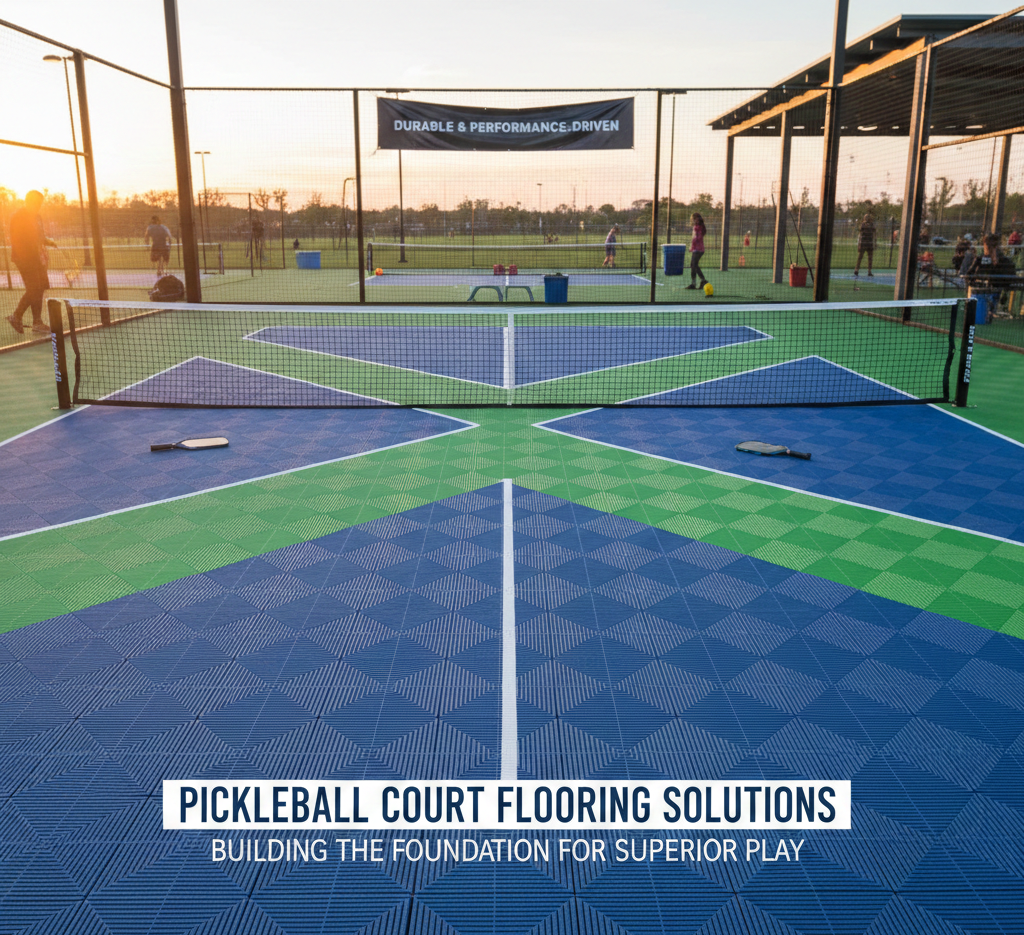
Pickleball has rapidly evolved from a recreational pastime into one of the fastest-growing sports worldwide. As the game gains popularity across residential communities, sports clubs, schools, and professional facilities, the importance of high-quality pickleball court flooring has never been greater. The playing surface is not just a base—it directly influences ball response, player movement, safety, durability, and overall game experience.
Selecting the right pickleball court flooring solution requires careful consideration of performance requirements, environmental conditions, player comfort, and long-term maintenance. Whether you are planning a backyard court, a dedicated club facility, or a large-scale sports complex, choosing the appropriate flooring system ensures optimal playability and lasting value.
Why Pickleball Court Flooring Matters
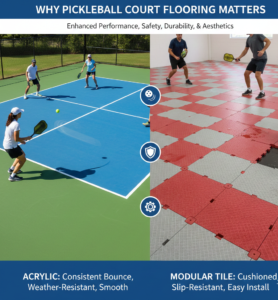
Unlike generic hard surfaces, pickleball courts demand precision-engineered flooring. The surface must deliver consistent ball bounce, provide adequate traction to support quick lateral movements, and minimize stress on players’ joints. Inadequate flooring can lead to uneven ball behavior, increased risk of injuries, faster surface deterioration, and higher maintenance costs.
A well-designed pickleball court flooring system enhances:
-
Game performance and fairness
-
Player safety and comfort
-
Surface durability and longevity
-
Visual appeal and court aesthetics
-
Compliance with professional standards
Popular Pickleball Court Flooring Solutions
Modern pickleball courts utilize specialized flooring systems designed to suit different environments, budgets, and usage patterns. Below are the most widely used flooring solutions for pickleball courts.
Acrylic Pickleball Court Flooring
Acrylic flooring is one of the most commonly used solutions for outdoor pickleball courts. This system consists of multiple layers of acrylic coatings applied over a concrete or asphalt base.
Key Benefits:
-
Provides a smooth and uniform playing surface
-
Ensures predictable and consistent ball bounce
-
Resistant to UV rays, rain, and temperature changes
-
Available in a wide range of colors for custom court designs
-
Requires minimal ongoing maintenance
Ideal Applications:
Acrylic flooring is best suited for outdoor courts in residential communities, parks, schools, and clubs where durability and weather resistance are essential.
Modular Tile Pickleball Flooring
Modular tile systems are composed of interlocking polymer or polypropylene tiles that snap together over a prepared base. These systems are increasingly popular due to their versatility and ease of installation.
Key Benefits:
-
Fast installation without permanent adhesives
-
Built-in drainage channels for quick water runoff
-
Excellent slip resistance for player safety
-
Cushioned tile options reduce joint impact
-
Suitable for both indoor and outdoor use
-
Easy to replace individual damaged tiles
Ideal Applications:
Modular tiles are perfect for indoor courts, temporary installations, rooftops, multi-purpose facilities, and locations requiring quick setup or relocation.
Post-Tension Concrete Pickleball Courts
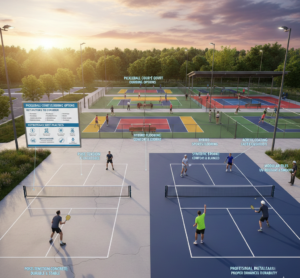
Post-tension concrete flooring represents a premium solution for permanent pickleball court installations. This system uses high-strength concrete reinforced with tensioned steel cables to minimize cracking and surface movement.
Key Benefits:
-
Exceptional durability and structural strength
-
Reduced surface cracking over time
-
Uniform and stable playing surface
-
Designed for long-term, high-traffic use
-
Ideal foundation for acrylic or hybrid systems
Ideal Applications:
Post-tension concrete is commonly used for professional-level courts, tournament venues, and outdoor facilities requiring maximum longevity and performance.
Synthetic Sports Flooring for Pickleball
Synthetic sports flooring systems are engineered with cushioned layers made from polyurethane, rubber blends, or similar materials. These surfaces are designed to enhance comfort and safety.
Key Benefits:
-
Superior shock absorption for joint protection
-
Enhanced traction and slip resistance
-
Comfortable surface for extended play
-
Suitable for indoor and semi-covered outdoor courts
-
Reduces fatigue and impact injuries
Ideal Applications:
Synthetic flooring is well-suited for indoor pickleball courts, gyms, training centers, and recreational facilities where player comfort is a top priority.
Hybrid Pickleball Court Flooring Solutions
Hybrid flooring systems combine multiple materials to deliver the best balance of durability, performance, and comfort. These systems often include a concrete base paired with acrylic coatings or modular tiles.
Key Benefits:
-
Combines structural strength with surface cushioning
-
Customizable for pickleball and other sports
-
Enhanced aesthetics and surface performance
-
Flexible design options based on facility needs
-
Long-lasting and cost-effective
Ideal Applications:
Hybrid solutions are ideal for multi-sport complexes, clubs, schools, and facilities hosting pickleball alongside tennis, basketball, or badminton.
Key Factors to Consider When Choosing Pickleball Court Flooring
Choosing the right flooring solution involves more than aesthetics. Several technical and functional factors must be evaluated to ensure the court performs as expected.
1. Surface Traction
Proper traction allows players to move confidently without slipping, especially during fast-paced rallies and directional changes.
2. Ball Bounce Consistency
A quality surface ensures predictable ball behavior, which is essential for fair and competitive play.
3. Durability and Weather Resistance
Outdoor courts must withstand sun exposure, rain, temperature fluctuations, and heavy foot traffic without degrading.
4. Maintenance Requirements
Low-maintenance flooring reduces long-term costs and downtime. Easy cleaning and simple resurfacing are valuable advantages.
5. Player Comfort and Safety
Shock-absorbing surfaces help protect players’ knees, ankles, and lower back, making the game safer for players of all ages.
Maintenance Best Practices for Pickleball Court Flooring
Proper maintenance significantly extends the lifespan and performance of pickleball court surfaces.
Recommended Maintenance Tips:
-
Regularly sweep or clean the court to remove dirt and debris
-
Inspect the surface for cracks, loose tiles, or uneven areas
-
Repair damage promptly to prevent further deterioration
-
Recoat acrylic surfaces every 3 to 5 years
-
Ensure effective drainage to avoid water pooling
-
Avoid dragging heavy equipment across the court surface
Pickleball Flooring Options at a Glance
| Flooring Type | Key Advantages | Best Applications |
|---|---|---|
| Acrylic Coating | Smooth finish, UV-resistant, low maintenance | Outdoor courts |
| Modular Tiles | Easy installation, cushioned, versatile | Indoor & multi-purpose |
| Post-Tension Concrete | Highly durable, stable, long-lasting | Professional outdoor courts |
| Synthetic Sports Flooring | Shock absorption, safe traction | Indoor courts & gyms |
| Hybrid Flooring | Combines comfort and durability | Multi-sport facilities |
The Importance of Professional Installation
Professional installation plays a critical role in the success of any pickleball court flooring system. Proper surface preparation, accurate leveling, and correct material application ensure long-term performance and safety.
Benefits of Expert Installation:
-
Precise court dimensions and line markings
-
Proper slope and drainage design
-
Compliance with pickleball standards
-
Enhanced durability and surface lifespan
-
Improved safety and visual finish
Conclusion
Pickleball court flooring is the foundation of an exceptional playing experience. The right flooring solution enhances gameplay, protects players, and ensures long-term durability. From acrylic coatings and modular tiles to post-tension concrete and hybrid systems, today’s pickleball flooring solutions offer flexibility to meet diverse project needs.
By carefully evaluating usage requirements, environment, player comfort, and maintenance expectations, you can select a flooring system that delivers superior performance and lasting value. Investing in high-quality pickleball court flooring is an investment in safety, enjoyment, and the future of the sport.
Pickleball Court Flooring Solutions — FAQs
1. What are the main types of pickleball court flooring solutions?
Common flooring solutions for pickleball courts include:
• Synthetic Acrylic (Coated) Surfaces – Acrylic coatings applied over a well-prepared concrete or asphalt base remain the most widely used option worldwide for both outdoor and many indoor courts. They deliver excellent traction, ball bounce consistency, weather resistance and customization options.
• Cushioned Acrylic Systems – Similar to standard acrylic but with added rubberized layers under the topcoat to increase shock absorption, making them friendlier on joints.
• Modular Interlocking Tiles – Snap-together plastic or polymer panels placed over a solid base. They’re quick to install, portable, and have built-in drainage channels.
• PVC/Vinyl or Polyurethane Sports Flooring – Roll-out sheet or tile systems commonly used for indoor or multipurpose facilities; they offer consistent bounce and easy maintenance.
• Bare Asphalt/Concrete (with finishing) – These are structural bases that can be finished with coatings or paint; uncoated surfaces are generally not ideal for play without additional surface treatment.
2. What is the best overall flooring solution for outdoor pickleball?
Synthetic acrylic on a concrete or asphalt base is widely regarded as the best outdoor solution. It offers excellent traction, consistent bounce, UV and weather resistance, and low maintenance, supporting recreational to tournament-grade play.
3. What benefits do cushioned acrylic surfaces offer?
Cushioned acrylic systems include shock-absorbing layers that:
-
Reduce impact on knees and joints
-
Improve play comfort over long sessions
-
Maintain good traction and bounce quality
These are popular for clubs, schools and high-use courts.
4. When should I choose modular interlocking tiles?
Consider modular tiles if you want:
✔ Faster installation and possible temporary setups
✔ Built-in drainage (useful after rain)
✔ Easy replacement of damaged sections
✔ Portability or relocation flexibility
They’re great for multi-purpose venues, pop-up courts or rooftops but may feel slightly different underfoot than traditional acrylic.
5. Are PVC/Vinyl or Polyurethane surfaces good options?
Yes — especially for indoor courts or multi-sport facilities:
-
PU/PUR vinyl systems offer good shock absorption and drive repeat use in gyms.
-
They’re smooth, easy to clean, and can be installed seam-free.
-
Some vinyl options exceed industry standards for rebound and consistency.
However, for outdoor use they need adequate UV protection to avoid degradation.
6. Can you just play on raw concrete or asphalt?
Bare concrete or asphalt can provide a basic playing surface, but on their own:
-
They tend to be hard on joints
-
They can become slippery when wet
-
They lack surface texture needed for optimal traction
Finishing them with acrylic or other sport coatings dramatically improves performance and safety.
7. How does the surface affect ball bounce and play quality?
-
Acrylic coatings: Medium-fast, consistent bounce and predictable play.
-
Cushioned surfaces: Slightly softer bounce with better comfort.
-
Modular tiles: Reliable bounce but seams can slightly influence ball behavior.
-
Vinyl/PVC/PU: Smooth consistent bounce indoors; may feel different than outdoor hard courts.
8. What about weather resistance and outdoor durability?
For outdoor installations, choose materials that are:
✔ UV-resistant (to prevent fading)
✔ Moisture-resistant
✔ Designed for temperature fluctuations
Acrylic coatings and quality modular tiles meet these needs well.
9. What maintenance is required for these flooring solutions?
-
Acrylic surfaces: Regular sweeping and occasional hose-down; recoating every few years keeps texture and color vibrant.
-
Modular tiles: Easy to clean; individual tiles can be replaced if damaged.
-
Vinyl/PU sheet systems: Usually low maintenance — periodic sweeping and damp mopping.
10. How long do different flooring types last?
Lifespan varies by solution:
-
Acrylic systems: ~8–12 years with good maintenance.
-
Modular tiles: ~5–10+ years depending on use and quality.
-
Vinyl/PU indoor flooring: Long lifespan indoors with proper use.
-
Bare uncoated concrete/asphalt: Generally shorter and less ideal without coatings.