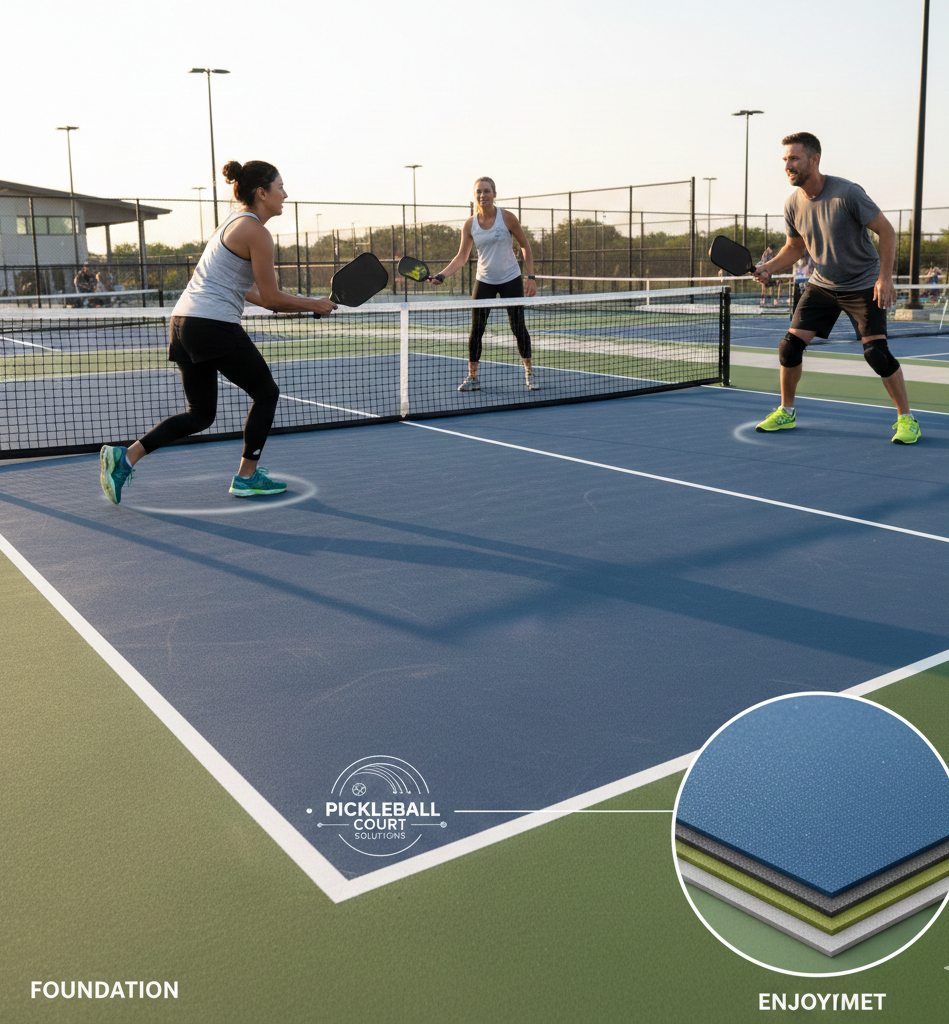
Pickleball has quickly grown into one of the most popular sports across all age groups, combining the best elements of tennis, badminton, and table tennis. While the rules and equipment are important, the true foundation of an enjoyable pickleball experience lies beneath the players’ feet—the court surface. A high-quality pickleball court surface directly influences how the game feels, how safely players move, and how long the court lasts.
From residential backyards and schools to professional clubs and resorts, selecting the right pickleball court surface is essential for performance, durability, and long-term value. The right surface ensures consistent ball bounce, reliable traction, player comfort, and resistance to weather and wear.
Why the Pickleball Court Surface Is So Important
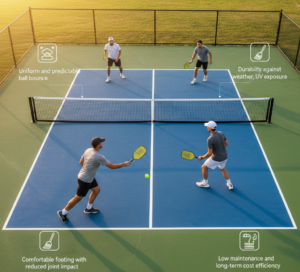
The surface of a pickleball court affects every aspect of gameplay. A poorly constructed or unsuitable surface can result in unpredictable ball response, slippery conditions, increased fatigue, and higher injury risk. On the other hand, a professionally designed surface enhances movement, confidence, and overall enjoyment of the game.
A quality pickleball court surface provides:
-
Uniform and predictable ball bounce
-
Slip-resistant texture for safe movement
-
Comfortable footing with reduced joint impact
-
Durability against weather, UV exposure, and heavy use
-
Low maintenance and long-term cost efficiency
Choosing the correct surface material transforms any space into a reliable, professional-grade pickleball court suitable for casual play or competitive matches.
Key Characteristics of an Ideal Pickleball Court Surface
A well-designed pickleball court surface must balance performance and safety. The most effective surfaces share several essential qualities:
-
Traction: Prevents slipping during quick direction changes
-
Consistency: Ensures reliable ball bounce across the entire court
-
Shock Absorption: Reduces stress on knees, ankles, and joints
-
Weather Resistance: Withstands sun, rain, and temperature changes
-
Durability: Maintains performance under repeated play
-
Ease of Maintenance: Simple cleaning and periodic recoating
These characteristics guide the selection of surface materials for different environments and player needs.
Types of Pickleball Court Surfaces
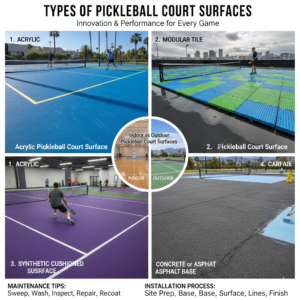
There are several surface options available, each offering unique advantages depending on location, usage, and budget.
1. Acrylic Pickleball Court Surface
Acrylic sports surfaces are the most widely used option for outdoor pickleball courts. These surfaces are applied in multiple layers over a concrete or asphalt base, creating a smooth yet textured finish ideal for competitive play.
Key Advantages:
-
Excellent traction and slip resistance
-
Consistent ball bounce and smooth gameplay
-
UV-resistant colors that remain vibrant
-
Weatherproof and durable for outdoor use
-
Low maintenance with long resurfacing cycles
Best Applications:
Outdoor courts in residential communities, parks, schools, and sports clubs.
2. Modular Tile Pickleball Court Surface
Modular tile surfaces consist of interlocking polymer tiles designed for flexibility and convenience. These surfaces can be installed over existing bases and are suitable for both indoor and outdoor courts.
Key Advantages:
-
Quick installation with minimal site preparation
-
Shock-absorbing properties for player comfort
-
Excellent drainage for wet conditions
-
Easy replacement of individual tiles
-
Portable and ideal for multi-purpose spaces
Best Applications:
Indoor facilities, rooftop courts, temporary courts, and multi-sport areas.
3. Synthetic Cushioned Pickleball Court Surface
Cushioned synthetic surfaces are engineered to enhance comfort and reduce physical strain. These systems include elastic or rubberized layers beneath the top coating, providing a softer feel underfoot.
Key Advantages:
-
Superior shock absorption
-
Reduced joint and muscle fatigue
-
Enhanced comfort for extended play
-
Smooth yet grippy playing texture
Best Applications:
Indoor courts, clubs, gyms, and facilities catering to senior players or frequent training sessions.
4. Concrete or Asphalt Base Surface
Concrete and asphalt surfaces form the structural foundation for most pickleball courts. While they can be used as basic playing surfaces, they are typically enhanced with acrylic or synthetic coatings for better performance.
Key Advantages:
-
Strong, stable, and long-lasting base
-
Cost-effective for large-scale installations
-
Compatible with various surface coatings
-
Ideal for permanent court construction
Best Applications:
Outdoor courts requiring durability and long-term structural stability.
Indoor vs Outdoor Pickleball Court Surfaces
The choice of surface also depends on whether the court is indoors or outdoors.
Indoor Pickleball Court Surfaces
Indoor courts often use synthetic, vinyl, or wooden sports flooring. These surfaces provide smooth play, controlled ball bounce, and a refined appearance while protecting players from weather conditions.
Key Benefits:
-
Controlled environment
-
Enhanced comfort and aesthetics
-
Ideal for training and competitive play
Outdoor Pickleball Court Surfaces
Outdoor courts require surfaces that can withstand sunlight, rain, and temperature variations. Acrylic coatings and modular tiles are the most common choices due to their weather resistance and durability.
Key Benefits:
-
UV and moisture resistance
-
Strong traction in varying conditions
-
Long-lasting performance outdoors
Pickleball Court Surface Installation Process
Professional installation is essential to achieve optimal surface performance and longevity. A typical installation process includes:
1. Site Inspection and Preparation
Assessment of soil condition, drainage, slope, and available space.
2. Base Construction
Creation of a level and stable concrete or asphalt foundation.
3. Surface Application
Installation of acrylic coatings, synthetic layers, or modular tiles.
4. Line Marking
Precision marking of pickleball court lines for singles and doubles play.
5. Final Finishing
Installation of nets, fencing, lighting, and final quality checks.
Each step is performed with attention to accuracy, safety, and performance standards.
Maintenance of Pickleball Court Surfaces
Regular maintenance ensures your pickleball court surface remains safe and visually appealing for years.
Maintenance Tips:
-
Sweep regularly to remove dust and debris
-
Wash the surface periodically with mild detergent
-
Inspect for cracks, loose tiles, or faded areas
-
Address minor repairs promptly
-
Recoat acrylic surfaces every few years
Proper maintenance significantly extends surface life and preserves play quality.
Why Professional Installation Matters
A professional pickleball court surface installer ensures correct layering, drainage, and finishing—factors that directly affect performance and durability. Expert installers use industry-approved materials and proven techniques to deliver smooth, regulation-compliant courts tailored to your specific needs and environment.
Professional installation results in:
-
Accurate court dimensions
-
Consistent surface texture
-
Enhanced safety and comfort
-
Reduced long-term maintenance costs
Applications for Quality Pickleball Court Surfaces
Well-designed pickleball court surfaces are suitable for:
-
Residential backyard courts
-
Sports clubs and academies
-
Schools and colleges
-
Community and recreational centers
-
Resorts and hospitality properties
-
Professional and tournament venues
Each application benefits from surface solutions tailored to usage intensity and player demographics.
Conclusion
The pickleball court surface is the heart of the game experience. A well-chosen and professionally installed surface enhances performance, ensures safety, and delivers long-term durability. Whether you opt for acrylic coatings, modular tiles, cushioned systems, or a combination of materials, selecting the right surface solution is essential for enjoyable and consistent play.