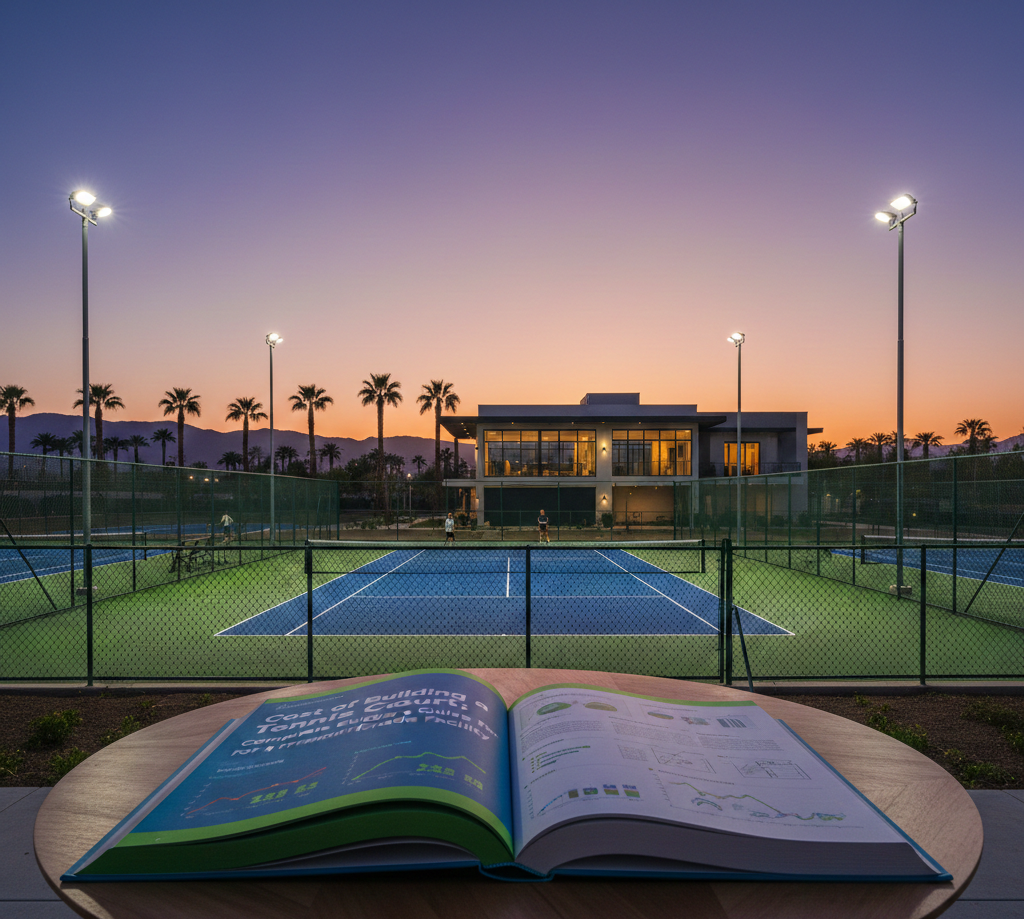
Constructing a tennis court is a long-term investment that enhances fitness, recreation, and property value. Whether you are planning a private residential court, a school or college facility, a sports club, or a professional training venue, understanding the cost of building a tennis court is essential for effective budgeting and decision-making.
The overall expense of tennis court construction can vary significantly depending on factors such as surface type, site preparation, accessories, labor quality, and geographic location. A well-planned project not only ensures smooth gameplay and player safety but also reduces maintenance costs over the years.
This comprehensive guide explains the key cost components, surface options, estimated budgets, and the value of professional construction to help you make an informed investment.
Understanding Tennis Court Construction Costs
The cost of building a tennis court is not a fixed figure. It is influenced by multiple variables that together define the quality, durability, and performance of the final court. Choosing the right combination of materials and construction methods ensures a balance between upfront cost and long-term value.
Key Factors Influencing the Cost of a Tennis Court
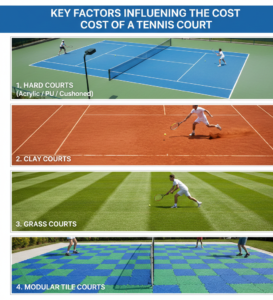
1. Tennis Court Surface Type
The playing surface is the most influential factor in overall cost. Each surface offers a unique playing experience, maintenance requirement, and lifespan.
Hard Courts (Acrylic / PU / Cushioned Systems)
Hard courts are the most commonly constructed tennis courts worldwide.
-
Medium to fast ball speed
-
Highly durable and weather-resistant
-
Suitable for recreational, training, and professional play
-
Low to moderate maintenance requirements
Cushioned acrylic systems add elastic layers beneath the surface, reducing joint impact and improving player comfort.
Clay Courts
Clay courts are popular for their traditional playing style.
-
Slower ball speed and higher bounce
-
Ideal for endurance-based play and training
-
Requires specialized materials such as crushed brick or shale
-
Higher ongoing maintenance, including watering and rolling
Grass Courts
Grass courts offer a premium and visually striking option.
-
Fast ball speed with low bounce
-
Requires natural or hybrid turf systems
-
High maintenance including mowing, irrigation, and reseeding
-
Commonly used in professional or luxury environments
Modular Tile Courts
Modular sports tiles are increasingly popular for flexible installations.
-
Quick installation and easy replacement
-
Low maintenance and excellent drainage
-
Suitable for indoor, outdoor, or temporary courts
-
Customizable colors and shock-absorption properties
2. Site Preparation and Groundwork
Site preparation is a critical cost component and directly impacts court durability.
Key elements include:
-
Land clearing and excavation
-
Soil testing and stabilization
-
Base construction using stone layers or asphalt
-
Precise leveling and compaction
-
Drainage systems to prevent water accumulation
Poor site preparation can lead to cracks, uneven bounce, and frequent repairs, increasing long-term costs.
3. Court Size and Layout
A standard tennis court follows international dimensions:
-
Length: 78 feet (23.77 meters)
-
Width: 36 feet for doubles, 27 feet for singles
In addition to the playing area, extra space is required for:
-
Run-off zones for player safety
-
Fencing and access pathways
-
Seating or spectator areas
Larger layouts and multiple courts naturally increase construction costs.
4. Accessories and Equipment
Essential and optional accessories add to the total project budget:
-
Tennis net and professional-grade net posts
-
Perimeter fencing systems
-
Lighting or floodlights for night play
-
Wind screens for better play conditions
-
Benches, umpire chairs, and scoreboards
While these may seem secondary, they significantly enhance usability and professional appeal.
5. Labor Quality and Construction Expertise
The quality of labor plays a major role in both initial cost and long-term savings.
-
Skilled professionals ensure accurate leveling and slope
-
Proper surface installation prevents premature wear
-
Expert workmanship reduces maintenance and repair expenses
Choosing experienced contractors may cost more initially but ensures superior durability and performance.
6. Geographic Location and Logistics
Construction costs can vary depending on:
-
Local labor rates
-
Availability and transportation of materials
-
Climate conditions influencing surface choice
-
Regional regulations and approvals
Urban locations or remote sites may involve higher logistics and labor costs.
Estimated Cost of Building a Tennis Court
While exact costs depend on project-specific requirements, the following ranges provide a general guideline:
| Court Type | Approximate Cost (USD) | Approximate Cost (INR) | Notes |
|---|---|---|---|
| Hard Acrylic / PU Court | $25,000 – $50,000 | ₹20 – ₹40 lakhs | Durable, medium-fast surface |
| Cushioned Acrylic Court | $30,000 – $55,000 | ₹25 – ₹45 lakhs | Added shock absorption |
| Clay Court | $30,000 – $60,000 | ₹25 – ₹50 lakhs | Higher maintenance |
| Grass Court | $35,000 – $70,000 | ₹30 – ₹60 lakhs | Premium, high upkeep |
| Modular Tile Court | $20,000 – $45,000 | ₹16 – ₹35 lakhs | Fast installation, low maintenance |
Additional Cost Components
-
Fencing: $5,000 – $12,000
-
Lighting / Floodlights: $8,000 – $20,000
-
Net, Posts & Accessories: $1,500 – $5,000
Note: These figures are indicative. Actual costs vary based on site conditions, design complexity, and material selection.
Long-Term Value of Professional Tennis Court Construction
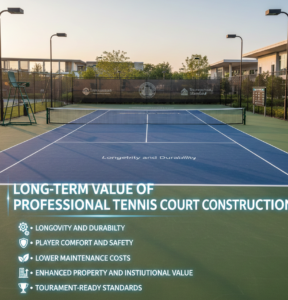
While cost is important, value matters more. Investing in professional construction delivers multiple long-term benefits:
Longevity and Durability
High-quality materials and proper base construction ensure the court lasts for decades with minimal structural issues.
Player Comfort and Safety
Correct slope, drainage, and surface elasticity reduce stress on joints and minimize injury risks.
Lower Maintenance Costs
Professional installation prevents common issues such as cracking, surface peeling, and waterlogging.
Enhanced Property and Institutional Value
A tennis court increases the appeal and market value of residential estates, clubs, schools, resorts, and hotels.
Tournament-Ready Standards
Professionally built courts comply with ITF guidelines, making them suitable for competitive and professional matches.
Why Choose sports-facility.in for Tennis Court Construction?
At sports-facility.in, we specialize in delivering end-to-end tennis court solutions tailored to your budget and project goals.
Our services include:
-
Site inspection and feasibility analysis
-
Detailed design planning and transparent cost estimation
-
Construction of hard, clay, grass, PU, cushioned, and modular courts
-
Base preparation, drainage, fencing, and lighting systems
-
Professional installation of nets, posts, and accessories
-
Maintenance guidance for long-term performance
Our focus is on quality, durability, and value—ensuring your tennis court performs at a professional level while remaining cost-effective.
Planning Your Tennis Court Investment
Building a tennis court is more than a construction project—it is an investment in fitness, recreation, and long-term asset value. Understanding the cost structure allows you to choose the right surface, features, and construction approach without compromising on quality.
With expert planning, transparent budgeting, and professional execution, a tennis court can deliver decades of enjoyment, performance, and prestige.