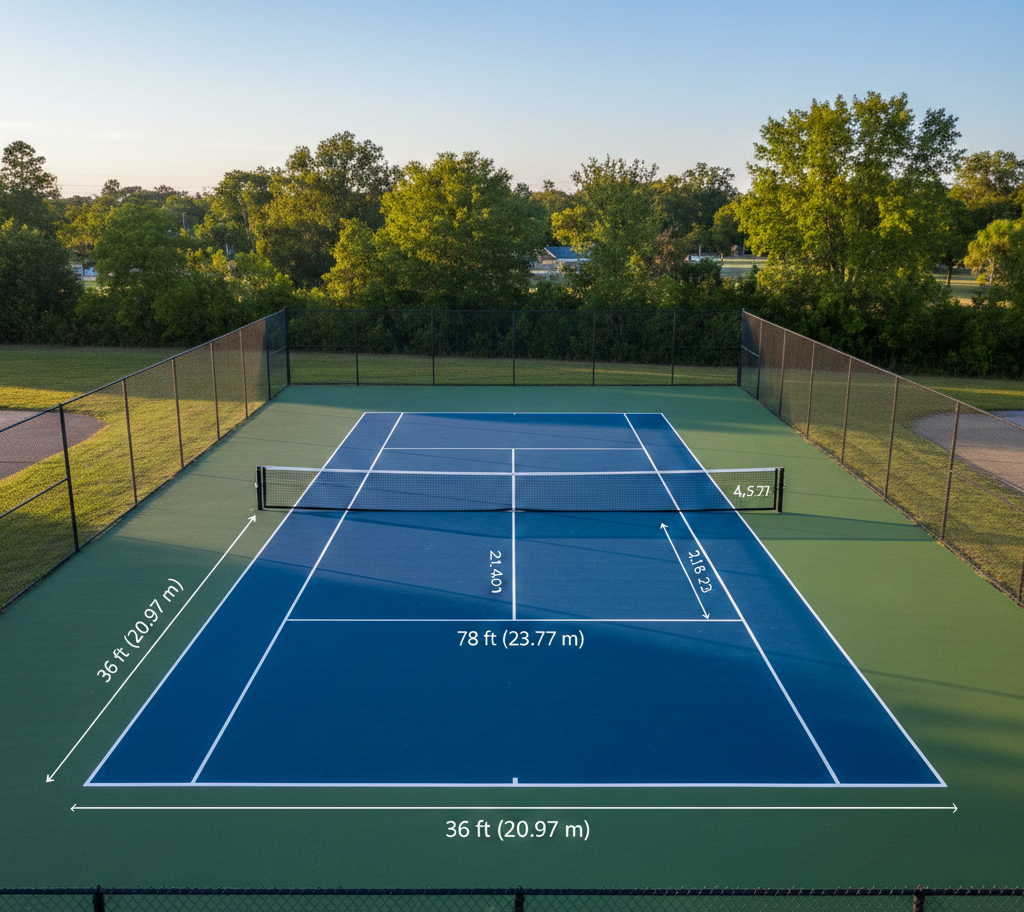
At [sports-facility.in], we provide detailed guidance and professional services related to standard tennis court dimensions, ensuring courts meet international standards for recreational, club, or professional play. The size, layout, and design of a tennis court are critical for fair play, safety, and optimal performance, whether for training academies, sports clubs, schools, or private estates.
What is the Standard Tennis Court Size?
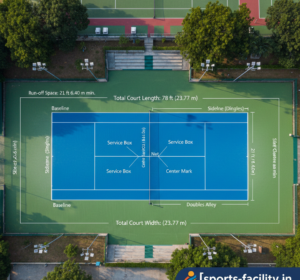
A standard tennis court is designed according to the specifications set by the International Tennis Federation (ITF). The court dimensions include the playing area, sidelines, baselines, service lines, and net placement.
Key Dimensions:
-
Total Court Length: 78 feet (23.77 meters)
-
Total Court Width:
-
Singles: 27 feet (8.23 meters)
-
Doubles: 36 feet (10.97 meters)
-
-
Baseline to Net Distance: 39 feet (11.89 meters) on each side
-
Service Line Distance from Net: 21 feet (6.40 meters)
-
Net Height: 3 feet (0.914 meters) at the center, 3.5 feet (1.07 meters) at the posts
-
Alley (Doubles Lane) Width: 4.5 feet (1.37 meters) on each side
These measurements ensure uniform gameplay, proper court ratios, and compliance with competitive regulations.
Court Layout and Markings
The layout of a standard tennis court includes:
-
Baselines: Define the back boundary of the court for rallies and serves.
-
Sidelines: Indicate the side boundaries for singles and doubles matches.
-
Service Boxes: Two rectangles on each side of the net used for serving, separated by the center service line.
-
Center Mark: A small line at the midpoint of each baseline, guiding proper serve placement.
-
Net: Divides the court into two halves and is tensioned to ITF specifications.
Proper court layout ensures consistent play, player safety, and accurate scoring.
Types of Tennis Court Surfaces
While dimensions remain standard, tennis courts can have different surfaces affecting ball speed, bounce, and player movement:
-
Hard Court – Asphalt or concrete base with acrylic coatings; medium to fast ball speed.
-
Clay Court – Crushed brick or shale surface; slower ball speed, ideal for tactical play.
-
Grass Court – Natural or hybrid grass; fast-paced surface with lower bounce.
-
PU / Cushioned Acrylic Court – Shock-absorbing layers with acrylic finish; player-friendly and professional.
-
Modular Tile Courts – Interlocking polymer tiles; quick installation, durable, and low maintenance.
Each surface type is built on the standard court dimensions, ensuring compliance with ITF regulations and professional play standards.
Why Standard Court Dimensions Matter
Using standard tennis court sizes is essential for:
-
Professional Play: Ensures consistency for tournaments, academies, and training programs.
-
Player Development: Provides the correct environment for developing techniques, strategies, and endurance.
-
Safety & Fairness: Proper dimensions reduce injury risks and maintain equitable gameplay.
-
Facility Planning: Helps architects, builders, and clubs optimize space and infrastructure.
Applications of Standard Tennis Court Sizes
Standard tennis court dimensions are applied across a wide range of facilities:
-
Professional Tennis Academies and Clubs
-
Schools, Colleges, and Universities
-
Private Residences and Villas
-
Resorts and Recreational Facilities
-
Government and Corporate Sports Complexes
Correct court size ensures long-term usability, compliance, and professional-standard playability.
Why Choose [sports-facility.in]?
As a leading tennis court construction company, [sports-facility.in] ensures that every court we build:
✅ Adheres to ITF-approved standard dimensions
✅ Provides professional-quality layout and markings
✅ Supports all types of tennis surfaces — hard, clay, grass, PU, or modular tiles
✅ Enhances player safety and performance
✅ Is built with durable materials and expert craftsmanship
We deliver tennis courts that are not only accurate in size but also visually appealing, safe, and long-lasting.
Build a Professional Tennis Court with Standard Dimensions
Whether you are planning a private estate court, sports club facility, or professional academy, following the standard tennis court size guidelines is essential for performance, fairness, and longevity.
📞 Contact us today for consultation, court design, or a detailed quotation.
Let [sports-facility.in] build a high-quality tennis court that meets all professional standards and player expectations.
Standard Tennis Court Size – FAQs
1. What are the standard dimensions of a tennis court?
-
Overall court dimensions: 23.77 meters (78 ft) long × 10.97 meters (36 ft) wide for doubles
-
Singles width: 8.23 meters (27 ft)
-
Service line distance: 6.40 meters (21 ft) from the net
-
Net height: 0.914 meters (3 ft) at the center, 1.07 meters (3.5 ft) at the posts
These dimensions are recommended by the International Tennis Federation (ITF).
2. What is the playing surface for tennis courts?
Common surfaces include:
-
Hard courts (concrete/asphalt with acrylic coating): Durable, medium-speed play
-
Clay courts: Slow surface, softer on joints, allows sliding
-
Grass courts: Fast surface, high maintenance, traditional Wimbledon-style play
-
Synthetic or acrylic courts: Low maintenance, consistent bounce
3. Why is the net height important?
-
Ensures proper gameplay and ball clearance
-
Provides fair competitive conditions
-
Standard net height: 0.914 m (3 ft) at the center; 1.07 m (3.5 ft) at posts
4. What is the recommended court orientation?
-
Tennis courts are generally oriented north-south to minimize sun glare for players
-
Orientation may vary slightly for stadiums or recreational facilities
5. What are the dimensions of the service boxes?
-
Each service box: 6.40 m (21 ft) deep × 4.115 m (13.5 ft) wide
-
Center service line: Divides the two service boxes
-
Correct dimensions ensure fair serving and gameplay
6. How much space is required around a tennis court?
-
Run-off space: Minimum 6.40 m (21 ft) behind baselines
-
Side clearance: Minimum 3.66 m (12 ft) for doubles play
-
Additional space may be required for spectator seating or stadium courts
7. What are the court markings?
-
Baselines: Longest lines at each end of the court
-
Sidelines: Inner lines for singles, outer for doubles
-
Service line: Marks the end of the service box
-
Center service line: Divides the service boxes
-
Center mark: Short line at baseline to help position serve
Markings must be white or yellow, clearly visible, and 5 cm (2 in) wide.
8. What maintenance is required for tennis courts?
-
Hard courts: Regular cleaning, resurfacing every 5–10 years
-
Clay courts: Daily rolling, watering, and line maintenance
-
Grass courts: Regular mowing, watering, and leveling
-
Check net tension and posts periodically
9. Can tennis courts be multi-purpose?
Yes, some courts are designed for:
-
Mini-tennis, pickleball, or badminton
-
Multi-sport recreational use (with removable nets and markings)
-
Training and practice sessions
10. Are there lighting requirements for tennis courts?
-
Required for evening or indoor courts
-
Minimum recommended lighting: 300–500 lux for recreational play, 1000 lux for professional tournaments
-
Even distribution without glare is essential
11. Why is professional design and installation recommended?
-
Ensures ITF-compliant dimensions and surface
-
Correct drainage and slope for outdoor courts
-
Accurate markings and net installation
-
Long-term durability and optimal playing conditions