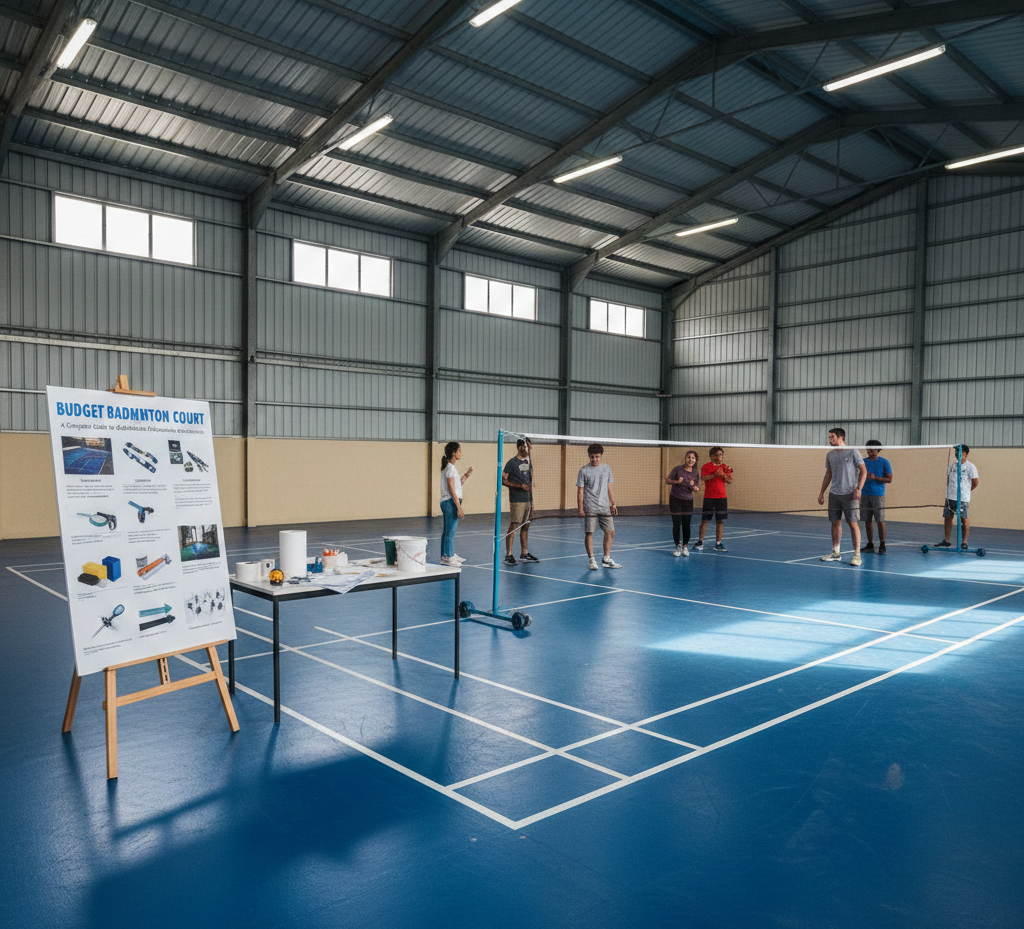
Badminton is one of the most widely played sports in India, enjoyed by people of all age groups—from school students and society residents to professional athletes. With growing awareness around fitness and indoor sports, the demand for badminton courts has increased significantly. However, one common concern often delays projects: cost.
Many people assume that building a badminton court requires a large investment. In reality, a budget badminton court can be constructed without sacrificing safety, durability, or play quality. With proper planning, smart material selection, and efficient execution, it is possible to build a long-lasting and professional badminton court within a controlled budget.
This guide explains everything you need to know about planning, designing, and constructing a badminton court affordably while maintaining high performance standards.
What Is a Budget Badminton Court?
A budget badminton court is designed to meet standard playing requirements while keeping construction and maintenance costs reasonable. Instead of premium materials like wooden flooring used in international arenas, budget courts use cost-effective alternatives that still offer excellent grip, comfort, and durability.
The objective is to achieve the right balance between:
-
Cost efficiency
-
Player safety and comfort
-
Surface durability
-
Easy maintenance
-
Professional gameplay experience
Budget badminton courts are ideal for:
-
Schools and colleges
-
Residential societies
-
Community sports centers
-
Clubs and training facilities
With the right design approach, even limited spaces and modest budgets can support a high-quality badminton facility.
Planning a Badminton Court on a Budget
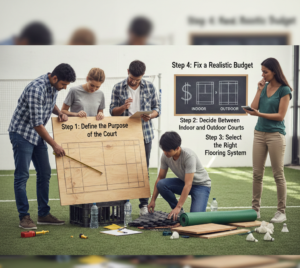
Successful budget construction depends on planning, not shortcuts. Before starting construction, it is essential to define your requirements clearly.
Step 1: Define the Purpose of the Court
The usage of the court directly impacts material selection and cost:
-
Recreational use (housing societies, communities)
-
Training use (schools, academies)
-
Club-level practice
Recreational and training courts can use more economical flooring options without affecting play quality.
Step 2: Decide Between Indoor and Outdoor Courts
-
Indoor badminton courts require roofing, ventilation, and lighting but offer all-weather usability.
-
Outdoor badminton courts are more affordable to build and are ideal for schools or community spaces, provided weather-resistant flooring is used.
Choosing the right setup can significantly reduce overall cost.
Step 3: Select the Right Flooring System
Flooring contributes the largest share of the construction budget. Selecting a cost-efficient yet durable flooring system is the key to affordable construction.
Step 4: Fix a Realistic Budget
In India, a well-constructed budget badminton court typically costs between:
₹3 lakh to ₹6 lakh, depending on:
-
Flooring type
-
Base preparation
-
Indoor or outdoor setup
-
Lighting and accessories
Having a fixed budget range helps avoid overspending during execution.
Cost-Effective Flooring Options for Budget Badminton Courts
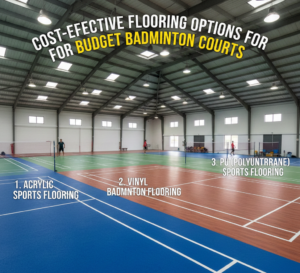
1. Acrylic Sports Flooring
Price Range: ₹150 – ₹300 per sq. ft.
Best For: Outdoor courts
Acrylic flooring is one of the most economical and widely used solutions for budget badminton courts. It consists of multiple layers applied over a concrete base, creating a smooth and non-slip playing surface.
Key Benefits:
-
Weather and UV resistant
-
Slip-resistant surface for safety
-
Low maintenance and easy cleaning
-
Available in multiple colors
Durability: 5–8 years with periodic resurfacing
Acrylic flooring is ideal for schools, residential complexes, and community courts.
2. Vinyl Badminton Flooring
Price Range: ₹250 – ₹450 per sq. ft.
Best For: Indoor courts
Vinyl flooring offers excellent comfort and shock absorption at a reasonable cost. It is installed in roll form over a smooth concrete base and is available in different thickness levels.
Key Benefits:
-
Cushioned surface reduces joint strain
-
Anti-slip and player-friendly
-
Easy installation and replacement
-
Suitable for multipurpose halls
Durability: 7–10 years depending on usage
Vinyl flooring is a popular choice for indoor school courts and training facilities.
3. PU (Polyurethane) Sports Flooring
Price Range: ₹350 – ₹600 per sq. ft.
Best For: Indoor and semi-covered courts
PU flooring provides a seamless, joint-free surface with excellent elasticity and durability. It offers professional performance at a lower cost than wooden courts.
Key Benefits:
-
High shock absorption
-
Smooth and consistent surface
-
Water-resistant and easy to maintain
-
Suitable for heavy usage
Durability: 8–12 years
PU flooring is ideal for academies and clubs seeking long-term performance within budget.
Factors That Influence Badminton Court Construction Cost
Understanding cost drivers helps control expenses effectively:
Flooring Material
Wooden courts are expensive, while acrylic, vinyl, and PU offer better value for budget projects.
Base Preparation
A well-leveled concrete base is essential. Proper base work prevents future repairs and surface damage.
Indoor vs Outdoor Setup
Indoor courts require roofing, lighting, and ventilation, increasing costs. Outdoor courts are simpler and more economical.
Labor and Installation
Professional installation ensures durability and reduces long-term maintenance expenses.
Accessories
Nets, posts, line markings, and lighting systems add to the overall budget.
Location
Material transport and regional labor costs may affect final pricing.
Sample Budget Estimation for a Standard Badminton Court
(Standard court size: 13.4m x 6.1m)
| Component | Estimated Cost (₹) |
|---|---|
| Base preparation & leveling | 40,000 – 60,000 |
| Flooring (Acrylic/Vinyl) | 2,50,000 – 3,50,000 |
| Net posts & equipment | 25,000 – 40,000 |
| Line marking & painting | 15,000 – 25,000 |
| Lighting (indoor) | 50,000 – 80,000 |
| Labor & miscellaneous | 40,000 – 70,000 |
| Total Estimated Cost | ₹3,20,000 – ₹6,00,000 |
Costs may vary based on location and material specifications.
Practical Tips to Build a Badminton Court on a Budget
-
Choose acrylic or vinyl flooring instead of wooden courts
-
Source materials locally to reduce transport costs
-
Opt for a multipurpose court layout if required
-
Use energy-efficient LED lighting
-
Stick to standard BWF dimensions
-
Avoid unnecessary decorative elements
Smart decisions during planning can significantly lower overall costs.
Maintenance Tips to Extend Court Life
Proper maintenance ensures long-term savings:
-
Clean the surface weekly
-
Inspect outdoor courts after heavy rain
-
Resurface acrylic courts every 4–5 years
-
Avoid dragging heavy objects
-
Ensure proper drainage around outdoor courts
Regular care helps prevent major repair expenses.
Benefits of a Budget Badminton Court
-
Affordable sports infrastructure solution
-
Faster construction timelines (15–20 days)
-
Professional-level playability
-
Low maintenance compared to wooden courts
-
Suitable for all age groups
-
Customizable colors and layouts
Conclusion
A budget badminton court proves that quality sports infrastructure does not have to be expensive. With careful planning, cost-effective flooring options, and professional execution, it is possible to build a safe, durable, and high-performance badminton court within a reasonable budget.
Whether you select acrylic flooring for outdoor resilience, vinyl for indoor comfort, or PU for all-around durability, the key lies in balancing cost and quality. By making informed decisions at every stage, your badminton court can deliver years of excellent gameplay while staying well within budget.
Frequently Asked Questions (FAQ)
1. What is the average cost of building a budget badminton court?
A budget badminton court can typically be built within ₹3 lakhs to ₹8 lakhs, depending on flooring type, location, and whether it is indoor or outdoor.
2. What is the cheapest flooring option for a badminton court?
Concrete flooring with proper surface treatment is the most affordable option. For better playability at a reasonable cost, PVC vinyl badminton flooring is a popular choice.
3. Can I build a badminton court in a small space?
Yes. A standard badminton court size is 44 ft × 20 ft (doubles), but recreational or practice courts can be adjusted slightly if space is limited.
4. Is an indoor or outdoor badminton court more budget-friendly?
Outdoor courts are generally cheaper due to lower construction and roofing costs. However, indoor courts offer year-round play and better durability.
5. What are the minimum requirements for a low-cost badminton court?
At minimum, you need a level base, proper court markings, net posts, a quality net, and adequate lighting. Optional features like cushioning layers or premium flooring increase cost.
6. How long does it take to construct an affordable badminton court?
A budget badminton court can usually be completed within 10 to 20 days, depending on site conditions and flooring type.
7. Can I convert an existing space into a badminton court to save money?
Yes. Converting an existing hall, shed, or terrace can significantly reduce construction costs by avoiding major civil work.
8. Does a low-budget badminton court require high maintenance?
No. Basic cleaning, periodic line repainting, and checking net tension are usually sufficient to maintain a budget court.
9. Are budget badminton courts suitable for professional play?
Budget courts are ideal for schools, academies, housing societies, and recreational use. Professional tournaments may require higher-grade flooring and lighting.
10. Is building a budget badminton court a good investment?
Yes. With minimal setup cost, badminton courts can generate income through hourly bookings, coaching sessions, and memberships.