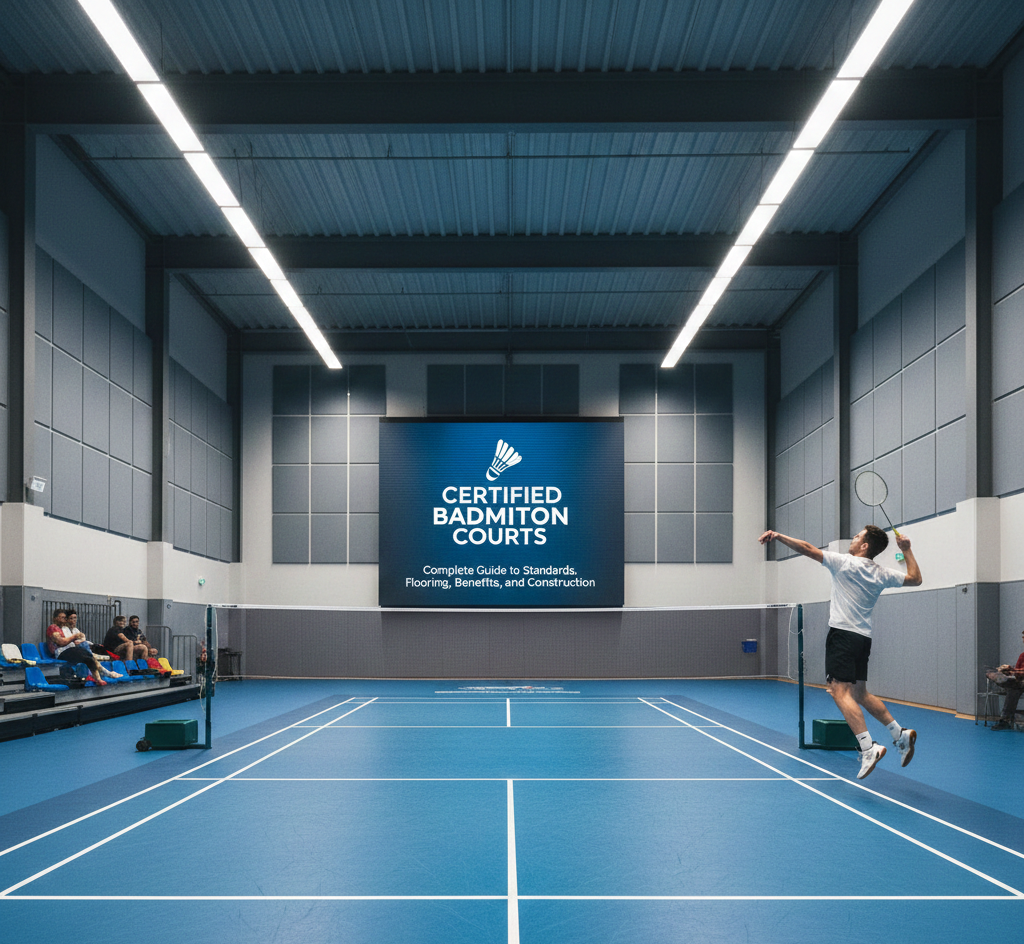
Badminton has evolved into one of the most competitive and technically demanding indoor sports in the world. As the game grows in popularity across schools, academies, clubs, and international arenas, the demand for Certified Badminton Courts has increased significantly. Certification is no longer optional—it is a benchmark of quality, safety, and professionalism.
A certified badminton court ensures that every element of the playing environment complies with internationally recognized standards. From court dimensions and flooring systems to lighting, ventilation, and safety features, certification guarantees a consistent and world-class playing experience for athletes at every level.
This comprehensive guide explains everything you need to know about Certified Badminton Courts, including their meaning, standards, flooring options, benefits, and construction process.
Badminton has evolved into one of the most competitive and technically demanding indoor sports in the world. As the game grows in popularity across schools, academies, clubs, and international arenas, the demand for Certified Badminton Courts has increased significantly. Certification is no longer optional—it is a benchmark of quality, safety, and professionalism.
A certified badminton court ensures that every element of the playing environment complies with internationally recognized standards. From court dimensions and flooring systems to lighting, ventilation, and safety features, certification guarantees a consistent and world-class playing experience for athletes at every level.
This comprehensive guide explains everything you need to know about Certified Badminton Courts, including their meaning, standards, flooring options, benefits, and construction process.
What Are Certified Badminton Courts?
Certified Badminton Courts are courts that are designed, constructed, and approved according to official guidelines issued by governing bodies such as the Badminton World Federation (BWF) and relevant national sports authorities. Certification confirms that the court meets strict performance, safety, and durability requirements.
A certified court is not just visually accurate—it is technically tested to ensure optimal playing conditions. These courts are suitable for professional training, competitive tournaments, and long-term institutional use.
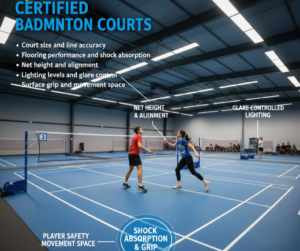
Certification typically evaluates:
-
Court size and line accuracy
-
Flooring performance and shock absorption
-
Net height and alignment
-
Lighting levels and glare control
-
Surface grip and slip resistance
-
Player safety and movement space
Only courts that meet these technical criteria are recognized as certified.
Why Certified Badminton Courts Are Important
The difference between a regular badminton court and a certified badminton court lies in precision and performance. Certification ensures that players experience the same conditions regardless of location, which is essential for fair competition and skill development.
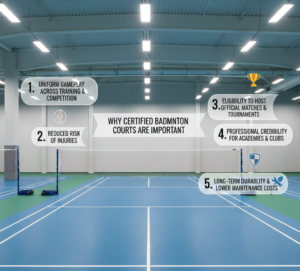
Key reasons to invest in certified badminton courts include:
-
Uniform gameplay across training and competition
-
Reduced risk of injuries
-
Eligibility to host official matches and tournaments
-
Professional credibility for academies and clubs
-
Long-term durability and lower maintenance costs
For institutions aiming to develop high-performance players, certification is a critical foundation.
Standard Dimensions of Certified Badminton Courts
All Certified Badminton Courts follow the official dimensions defined by the Badminton World Federation.
BWF-Approved Court Dimensions
-
Court Length: 13.40 meters (44 feet)
-
Court Width (Doubles): 6.10 meters (20 feet)
-
Court Width (Singles): 5.18 meters (17 feet)
The length remains the same for both singles and doubles matches, while the width changes based on the format of play.
Service Line Measurements
-
Short Service Line: 1.98 meters from the net
-
Long Service Line (Doubles): 0.76 meters inside the back boundary line
-
Long Service Line (Singles): Same as the back boundary line
Every line is considered part of the playing area, and accuracy in marking is essential for certification.
Net Specifications for Certified Badminton Courts
The net is a critical component in certified badminton courts and must meet precise standards.
-
Net height at posts: 1.55 meters
-
Net height at center: 1.524 meters
-
Net length: 6.10 meters
-
Net depth: 760 mm
The net must be made of fine, dark-colored mesh with a white tape band at the top. Proper tension and alignment are mandatory for certification approval.
Flooring Systems Used in Certified Badminton Courts
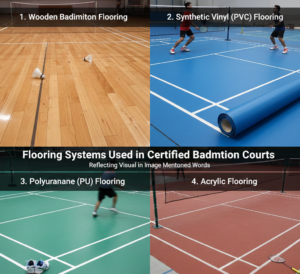
The playing surface is one of the most important aspects of Certified Badminton Courts, directly affecting player safety, movement, and performance.
1. Wooden Badminton Flooring
Wooden flooring is the traditional choice for elite indoor badminton courts.
-
Made from high-quality maple or teak wood
-
Installed over shock-absorbing sub-structures
-
Provides excellent grip, comfort, and bounce
-
Ideal for professional tournaments and academies
This flooring requires skilled installation and regular maintenance but delivers premium performance.
2. Synthetic Vinyl (PVC) Flooring
Vinyl flooring is one of the most widely used surfaces in certified badminton courts today.
-
Excellent shock absorption
-
Anti-slip and easy to maintain
-
Available in multiple thickness options
-
Cost-effective and durable
PVC flooring is commonly used in indoor stadiums, training centers, and schools.
3. Polyurethane (PU) Flooring
PU flooring is a seamless, high-performance surface suitable for multi-purpose halls.
-
Strong shock absorption
-
Smooth, joint-friendly surface
-
Long lifespan with minimal maintenance
-
Ideal for professional sports complexes
PU flooring is increasingly popular in modern certified facilities.
4. Acrylic Flooring
Acrylic surfaces are generally used for outdoor or semi-indoor badminton courts.
-
Weather and UV resistant
-
Smooth and uniform finish
-
Suitable for recreational and training use
While less common for international tournaments, acrylic courts can still meet certification standards when designed correctly.
Key Features of Certified Badminton Courts
Certified badminton courts stand apart due to their technical precision and player-centric design.
Accurate Court Markings
All lines are painted with approved materials, usually in white or yellow, with a standard thickness of 40 mm.
Shock Absorption
Certified flooring systems reduce impact stress on knees, ankles, and lower back during intense rallies.
Anti-Slip Performance
Surface friction levels are tested to prevent slipping without restricting movement.
Professional Lighting
Lighting levels typically range between 500 and 750 lux for training and higher for competitions, ensuring shadow-free visibility.
Controlled Environment
Proper ventilation and airflow help maintain temperature, humidity, and air quality inside indoor courts.
Benefits of Investing in Certified Badminton Courts
Professional Recognition
Certified courts allow facilities to host district, state, national, and international tournaments.
Improved Player Performance
Consistent bounce, traction, and comfort help players train more effectively.
Enhanced Safety
Shock-absorbing and non-slip surfaces significantly reduce injury risks.
Long-Term Cost Efficiency
Certified materials last longer, reducing repair and replacement costs.
Increased Facility Value
Certified badminton courts attract memberships, sponsorships, and partnerships with sports organizations.
Certification Authorities for Badminton Courts
The Badminton World Federation (BWF) is the primary global authority responsible for setting standards for badminton courts and equipment.
BWF certification tests surfaces for:
-
Shock absorption
-
Vertical deformation
-
Surface friction
-
Load resistance
In India, additional approvals may come from:
-
Sports Authority of India (SAI)
-
State Sports Councils
-
National badminton academies
These bodies ensure that certified badminton courts meet both international and national quality expectations.
Construction Process of Certified Badminton Courts
1. Site Evaluation
Assessment of space availability, ceiling height, and layout planning.
2. Base Preparation
Concrete or asphalt base construction with moisture control and leveling.
3. Flooring Installation
Professional installation of wooden, vinyl, PU, or acrylic flooring systems.
4. Court Marking
Precise marking according to BWF-approved measurements.
5. Testing and Certification
Inspection of dimensions, flooring performance, lighting, and safety compliance.
Only after passing these checks can a court be officially recognized as certified.
Conclusion
Certified Badminton Courts represent the highest standard of sports infrastructure in badminton. They combine precise engineering, professional materials, and strict compliance with international regulations to create a safe, consistent, and high-performance playing environment.
Certified Badminton Courts are courts that are designed, constructed, and approved according to official guidelines issued by governing bodies such as the Badminton World Federation (BWF) and relevant national sports authorities. Certification confirms that the court meets strict performance, safety, and durability requirements.
A certified court is not just visually accurate—it is technically tested to ensure optimal playing conditions. These courts are suitable for professional training, competitive tournaments, and long-term institutional use.
Certification typically evaluates:
-
Court size and line accuracy
-
Flooring performance and shock absorption
-
Net height and alignment
-
Lighting levels and glare control
-
Surface grip and slip resistance
-
Player safety and movement space
Only courts that meet these technical criteria are recognized as certified.
Why Certified Badminton Courts Are Important
The difference between a regular badminton court and a certified badminton court lies in precision and performance. Certification ensures that players experience the same conditions regardless of location, which is essential for fair competition and skill development.
Key reasons to invest in certified badminton courts include:
-
Uniform gameplay across training and competition
-
Reduced risk of injuries
-
Eligibility to host official matches and tournaments
-
Professional credibility for academies and clubs
-
Long-term durability and lower maintenance costs
For institutions aiming to develop high-performance players, certification is a critical foundation.
Standard Dimensions of Certified Badminton Courts
All Certified Badminton Courts follow the official dimensions defined by the Badminton World Federation.
BWF-Approved Court Dimensions
-
Court Length: 13.40 meters (44 feet)
-
Court Width (Doubles): 6.10 meters (20 feet)
-
Court Width (Singles): 5.18 meters (17 feet)
The length remains the same for both singles and doubles matches, while the width changes based on the format of play.
Service Line Measurements
-
Short Service Line: 1.98 meters from the net
-
Long Service Line (Doubles): 0.76 meters inside the back boundary line
-
Long Service Line (Singles): Same as the back boundary line
Every line is considered part of the playing area, and accuracy in marking is essential for certification.
Net Specifications for Certified Badminton Courts
The net is a critical component in certified badminton courts and must meet precise standards.
-
Net height at posts: 1.55 meters
-
Net height at center: 1.524 meters
-
Net length: 6.10 meters
-
Net depth: 760 mm
The net must be made of fine, dark-colored mesh with a white tape band at the top. Proper tension and alignment are mandatory for certification approval.
Flooring Systems Used in Certified Badminton Courts
The playing surface is one of the most important aspects of Certified Badminton Courts, directly affecting player safety, movement, and performance.
1. Wooden Badminton Flooring
Wooden flooring is the traditional choice for elite indoor badminton courts.
-
Made from high-quality maple or teak wood
-
Installed over shock-absorbing sub-structures
-
Provides excellent grip, comfort, and bounce
-
Ideal for professional tournaments and academies
This flooring requires skilled installation and regular maintenance but delivers premium performance.
2. Synthetic Vinyl (PVC) Flooring
Vinyl flooring is one of the most widely used surfaces in certified badminton courts today.
-
Excellent shock absorption
-
Anti-slip and easy to maintain
-
Available in multiple thickness options
-
Cost-effective and durable
PVC flooring is commonly used in indoor stadiums, training centers, and schools.
3. Polyurethane (PU) Flooring
PU flooring is a seamless, high-performance surface suitable for multi-purpose halls.
-
Strong shock absorption
-
Smooth, joint-friendly surface
-
Long lifespan with minimal maintenance
-
Ideal for professional sports complexes
PU flooring is increasingly popular in modern certified facilities.
4. Acrylic Flooring
Acrylic surfaces are generally used for outdoor or semi-indoor badminton courts.
-
Weather and UV resistant
-
Smooth and uniform finish
-
Suitable for recreational and training use
While less common for international tournaments, acrylic courts can still meet certification standards when designed correctly.
Key Features of Certified Badminton Courts
Certified badminton courts stand apart due to their technical precision and player-centric design.
Accurate Court Markings
All lines are painted with approved materials, usually in white or yellow, with a standard thickness of 40 mm.
Shock Absorption
Certified flooring systems reduce impact stress on knees, ankles, and lower back during intense rallies.
Anti-Slip Performance
Surface friction levels are tested to prevent slipping without restricting movement.
Professional Lighting
Lighting levels typically range between 500 and 750 lux for training and higher for competitions, ensuring shadow-free visibility.
Controlled Environment
Proper ventilation and airflow help maintain temperature, humidity, and air quality inside indoor courts.
Benefits of Investing in Certified Badminton Courts
Professional Recognition
Certified courts allow facilities to host district, state, national, and international tournaments.
Improved Player Performance
Consistent bounce, traction, and comfort help players train more effectively.
Enhanced Safety
Shock-absorbing and non-slip surfaces significantly reduce injury risks.
Long-Term Cost Efficiency
Certified materials last longer, reducing repair and replacement costs.
Increased Facility Value
Certified badminton courts attract memberships, sponsorships, and partnerships with sports organizations.
Certification Authorities for Badminton Courts
The Badminton World Federation (BWF) is the primary global authority responsible for setting standards for badminton courts and equipment.
BWF certification tests surfaces for:
-
Shock absorption
-
Vertical deformation
-
Surface friction
-
Load resistance
In India, additional approvals may come from:
-
Sports Authority of India (SAI)
-
State Sports Councils
-
National badminton academies
These bodies ensure that certified badminton courts meet both international and national quality expectations.
Construction Process of Certified Badminton Courts
1. Site Evaluation
Assessment of space availability, ceiling height, and layout planning.
2. Base Preparation
Concrete or asphalt base construction with moisture control and leveling.
3. Flooring Installation
Professional installation of wooden, vinyl, PU, or acrylic flooring systems.
4. Court Marking
Precise marking according to BWF-approved measurements.
5. Testing and Certification
Inspection of dimensions, flooring performance, lighting, and safety compliance.
Only after passing these checks can a court be officially recognized as certified.
Conclusion
Certified Badminton Courts represent the highest standard of sports infrastructure in badminton. They combine precise engineering, professional materials, and strict compliance with international regulations to create a safe, consistent, and high-performance playing environment.
Frequently Asked Questions (FAQ)
1. What is a certified badminton court?
A certified badminton court is a court that meets the standards set by the Badminton World Federation (BWF) for professional play, including dimensions, flooring, lighting, and safety clearances.
2. Why should I choose a certified badminton court?
Certified courts ensure:
-
Compliance with international standards
-
Player safety and optimal performance
-
Eligibility to host official tournaments or leagues
3. What are the dimensions of a certified badminton court?
-
Doubles court: 13.4 m × 6.1 m (44 ft × 20 ft)
-
Singles court: 13.4 m × 5.18 m (44 ft × 17 ft)
-
Net height: 1.55 m (5 ft 1 in) at edges, 1.524 m (5 ft) at center
4. What type of flooring is used for certified badminton courts?
-
PVC vinyl flooring: Shock-absorbing, slip-resistant, widely used
-
Wooden flooring: Professional-grade, durable, ideal for indoor certified courts
5. Can certified badminton courts be built indoors and outdoors?
Yes. Indoor certified courts follow strict BWF standards, while outdoor courts require additional considerations such as weather-resistant flooring, proper drainage, and fencing.
6. How much space is needed for a certified badminton court?
Including side and back clearances:
-
Width clearance: Minimum 2 m on sides
-
Back clearance: Minimum 3 m
-
Height clearance: Minimum 9 m
7. Are certified courts necessary for schools or academies?
While not mandatory, certified courts provide professional-quality training environments, improving player performance and safety. They are ideal for competitive academies and clubs.
8. How much does it cost to build a certified badminton court?
Cost depends on materials, indoor/outdoor setup, lighting, and location:
-
Budget certified court: ₹5–8 lakhs
-
Professional-grade court: ₹10–20+ lakhs
9. How long does it take to construct a certified court?
Construction typically takes 15–30 days, depending on site preparation, flooring type, and installation complexity.
10. Where can I find certified badminton courts near me?
Certified courts are available through BWF-approved suppliers and builders. Look for verified project references, warranties, and after-sales support when choosing a contractor.