Badminton is a fast-paced sport that demands precision, speed, and strategy. A properly marked badminton court ensures clarity in rules, facilitates accurate officiating, and enhances player performance. Badminton court markings are standardized by the Badminton World Federation (BWF), and understanding them is crucial for coaches, players, facility managers, and tournament organizers. This article delves into the details of badminton court markings, their purpose, and best practices for maintenance and installation.
1. Importance of Court Markings in Badminton
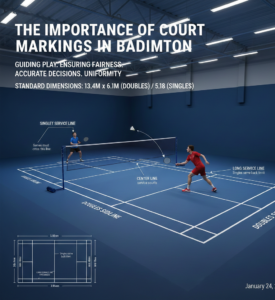
They define the boundaries, service areas, and zones that guide gameplay. Properly defined markings:
-
Ensure fair play by indicating legal areas for shots and serves.
-
Help umpires and referees make accurate decisions.
-
Assist players in judging distances and positioning.
-
Maintain uniformity for recreational, school-level, and professional tournaments.
2. Standard Dimensions of a Badminton Court
Before exploring markings in detail, it is essential to understand the overall dimensions:
-
Total Court Length: 13.4 meters
-
Total Court Width: 6.1 meters for doubles, 5.18 meters for singles
-
Net Height: 1.55 meters at the posts, 1.524 meters at the center
-
Free Zone: Minimum 2 meters on the sides, 3 meters behind the baseline (5 meters recommended for professional events)
These measurements form the framework on which court markings are drawn.
3. Main Types of Badminton Court Markings
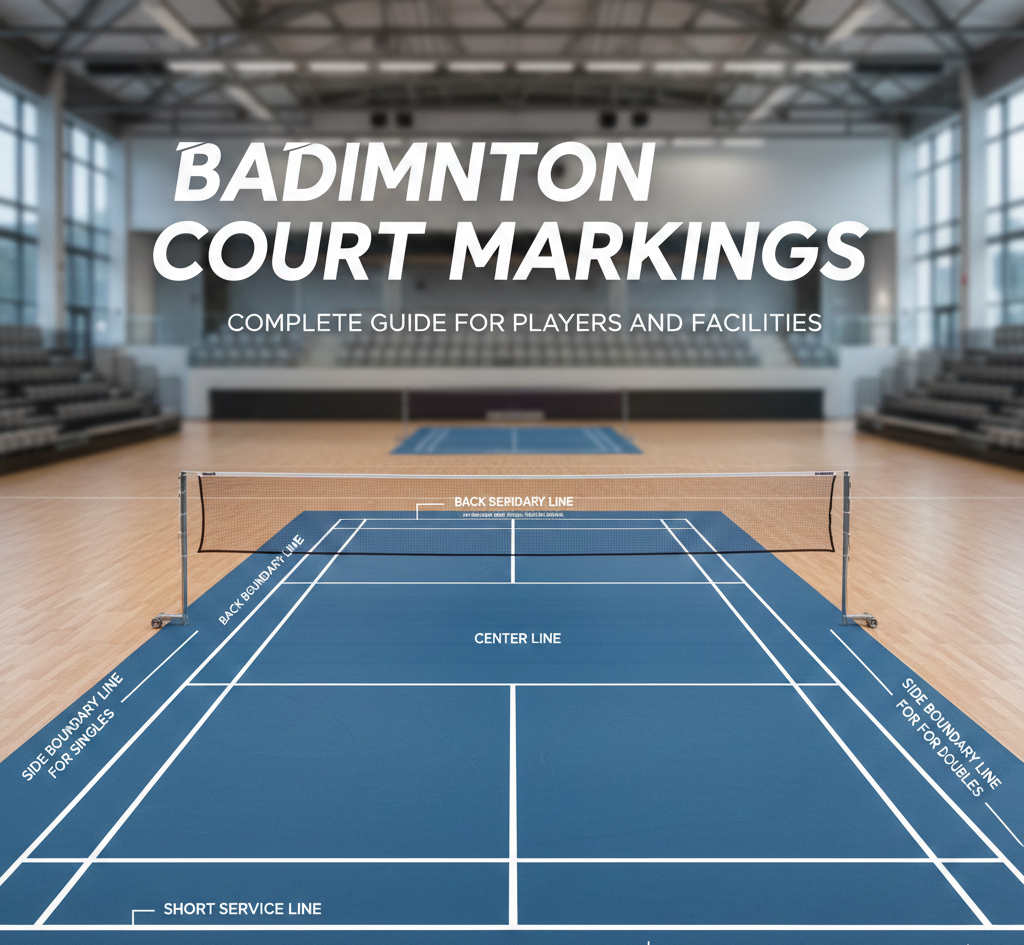
A badminton court has several types of markings, each serving a specific purpose. They are usually drawn with white or yellow lines that are 40 mm wide.
a. Boundary Lines
-
Doubles Sideline: Marks the side boundary for doubles matches.
-
Singles Sideline: Slightly inward from the doubles sideline, used for singles matches.
-
Baseline: Marks the back boundary for both singles and doubles.
-
Long Service Line for Doubles: The same as the baseline.
-
Short Service Line: 1.98 meters from the net, indicating the minimum distance a serve must travel.
Boundary lines ensure that every shuttle landing is clearly judged as in or out.
b. Center Line
The center line runs perpendicular from the short service line to the baseline, dividing the court into left and right service courts. It plays a crucial role during serves:
-
For singles, the server serves diagonally into the opponent’s service box.
-
For doubles, the center line separates the left and right service courts and helps prevent serving faults.
c. Service Lines
Service lines mark the service areas and are critical for maintaining proper serving rules:
-
Short Service Line: Located 1.98 meters from the net; serves must cross this line to be valid.
-
Long Service Line for Singles: Positioned 0.76 meters inside the baseline; defines the back limit for a legal singles serve.
-
These lines ensure precise serving, which is essential for competitive play.
4. Color and Visibility of Court Markings
. International standards recommend:
-
Color: White or yellow, depending on floor color contrast. Line Width: 40 mm is standard for clarity.
-
Material: Non-reflective paint or inlaid lines prevent glare from lighting.
5. Flooring and Marking Integration
The type of flooring affects marking application:
-
Wooden Courts: Lines can be painted or inlaid for durability. Sprung wooden floors offer shock absorption and even bounce.
-
Synthetic Courts: Lines are embedded or applied using high-quality adhesives compatible with PVC or PU mats.
-
Maintenance: Lines must be regularly inspected, repainted, or replaced to maintain sharpness and prevent peeling.
Correct integration ensures lines remain intact and visible even with heavy usage.
6. Maintenance of Badminton Court Markings
Regular maintenance includes:
-
Cleaning: Use soft brushes or non-abrasive cleaners to prevent damage.
-
Inspection: Check for fading, peeling, or cracks along lines.
-
Repainting: For wooden courts, repaint lines every few years or as needed. Synthetic surfaces may require professional line replacement.
-
Avoid Harsh Chemicals: Chemicals can erode line visibility and floor texture.
Proper maintenance ensures that markings remain in compliance with international standards.
7. Markings for Professional vs. Recreational Courts
-
BWF-sanctioned events require all markings to meet precise dimensions and visibility standards.
-
Consistency across courts is essential for player development and competitive integrity.
8. Common Mistakes and How to Avoid Them
Several errors in court marking can affect gameplay:
-
Faded Lines: Poor visibility may cause wrong judgments for in/out calls.
-
Non-Contrasting Colors: White lines on a light floor or yellow on a bright surface reduce line visibility.
-
Slippery Line Material: Some paints or adhesives may reduce traction, increasing injury risk.
Professional court constructors follow BWF standards strictly to avoid such issues.
Badminton Court Markings — FAQ
1. What are badminton court markings?
Badminton court markings are painted or taped lines on the floor that define the playing area, service courts, net line, and boundary limits used in singles and doubles play.
2. Why are court markings important?
Markings ensure the game is played fairly and according to rules. They determine whether a shuttlecock is “in” or “out” and which service court is valid during play.
3. What are the standard dimensions for a badminton court?
📏 Overall court size (play area):
-
13.40 m (44 ft) long
-
6.10 m (20 ft) wide
This is the same for singles and doubles — the difference is how the lines are used for play.
(Runsings are outside the marked lines.)
4. What’s the net line marking?
-
The net is placed across the width of the court at the midpoint.
-
The net height at the center is 1.524 m (5 ft) above the ground (measured just over the top of the net).
-
Markings are not drawn on the floor for net height — the posts hold the net.
**5. What lines define the singles playing area?
-
Long service line: at the back end of the court.
-
Singles sidelines: the inner side lines.
-
Front service line: 1.98 m (6 ft 6 in) from the net on each side.
In singles, the court is narrower (6.10 m wide) and longer for serves.
**6. What lines define the doubles playing area?
-
Long service line for doubles: 2.13 m (7 ft) from the back boundary (closer than singles).
-
Doubles sidelines: the outer side lines.
-
Front service line: 1.98 m (6 ft 6 in) from the net.
In doubles, the court is wider (6.10 m wide) and shorter in depth for service.
7. How wide and what color should the lines be?
-
Line width: Typically 40 mm (4 cm).
-
Color: High-contrast with the floor — usually white or yellow on darker floors.
Lines must be even and continuous so players/judges can clearly see them.
8. How many service courts are there?
Each side of the net has two service courts:
-
Left service court
-
Right service court
9. What is the center line?
The center line runs perpendicular from the front service line to the back service line, dividing the court into left and right service courts.
10. What’s the difference between in-play lines and out-of-bounds lines?
-
All outer boundary lines are in play for doubles (width and length).
9. Conclusion
Badminton court markings are fundamental to the sport’s structure, fairness, and quality of play. From boundary lines and service boxes to center lines and specialized markings, each element ensures that players compete under uniform conditions. Proper line width, color, placement, and maintenance guarantee visibility, safety, and compliance with international standards.
For players, understanding these markings improves positioning, strategy, and serving accuracy. For facility managers, precise marking enhances the facility’s professionalism, usability, and appeal for tournaments.