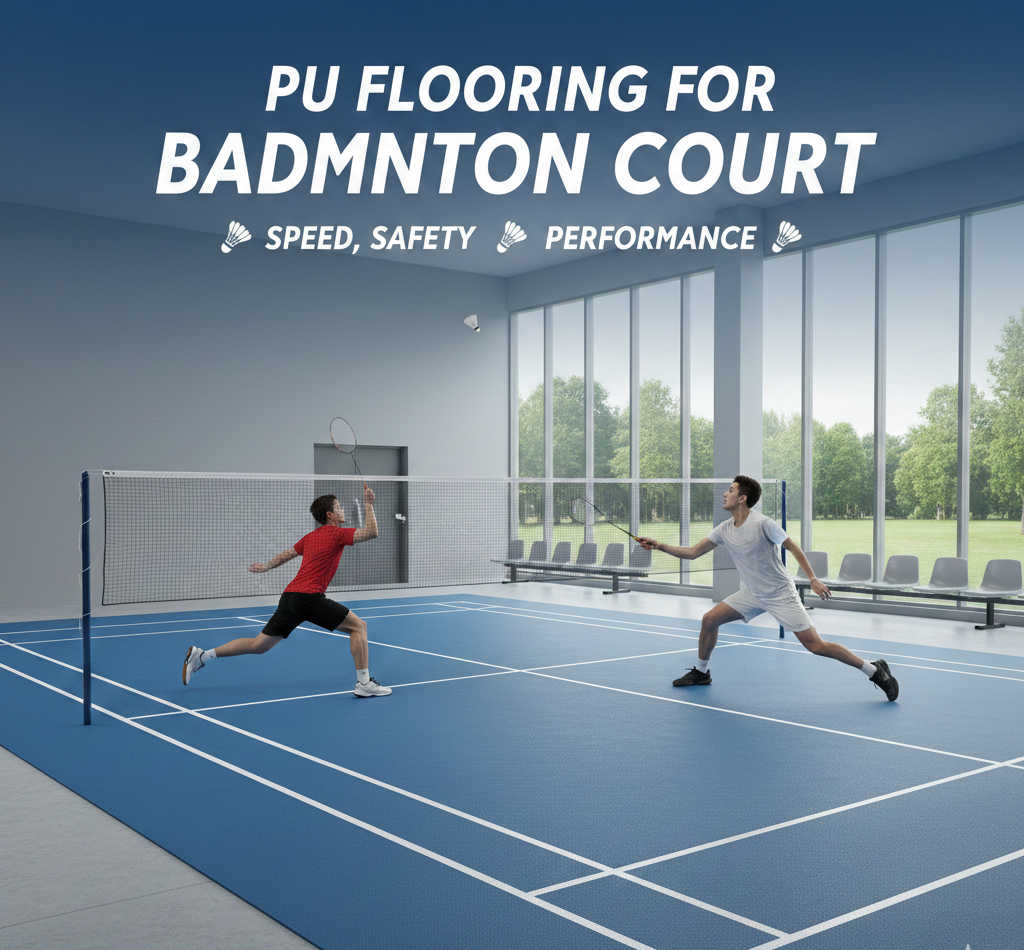
Badminton is one of the fastest racket sports in the world, demanding explosive footwork, sudden direction changes, jumps, and precise landings. To support this level of movement, the playing surface plays a critical role in player performance, comfort, and injury prevention. PU flooring for badminton courts has emerged as one of the most reliable and advanced sports flooring solutions, trusted by professional arenas, sports academies, schools, and indoor stadiums worldwide.
Polyurethane (PU) sports flooring combines elasticity, strength, and seamless construction to create a surface that enhances gameplay while protecting athletes. Its durability, low maintenance, and professional finish make it a long-term investment for any modern badminton facility.
Understanding PU Flooring for Badminton Courts
PU (Polyurethane) flooring is a synthetic sports surface system created by applying multiple layers of liquid polyurethane over a prepared base. Once cured, it forms a smooth, seamless, and elastic floor designed specifically for high-impact sports like badminton.
Unlike traditional wooden flooring or modular PVC mats, PU flooring is installed on-site, resulting in a joint-free surface with consistent performance across the entire court. This uniformity is especially important in badminton, where even minor surface irregularities can affect balance, footwork, and injury risk.
PU flooring is suitable for:
-
Professional badminton courts
-
Indoor sports halls
-
Schools and colleges
-
Training academies
-
Multi-purpose indoor arenas
Structure of PU Flooring System for Badminton Courts
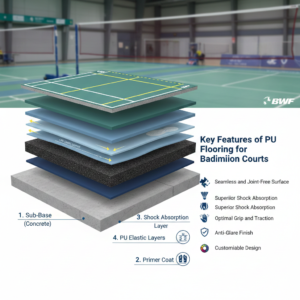
A PU badminton flooring system is carefully engineered with multiple layers, each serving a specific function. Together, these layers provide comfort, stability, and durability.
1. Sub-Base (Concrete or Asphalt)
The foundation of any PU flooring system is a well-prepared sub-base. It must be:
-
Smooth and level
-
Properly cured
-
Free from cracks, dust, and moisture
A strong sub-base ensures long-term stability and prevents surface deformation.
2. Primer Coat
A high-quality primer is applied to the base to:
-
Improve adhesion between the base and PU layers
-
Seal pores and prevent moisture migration
-
Increase overall lifespan of the flooring system
3. Shock Absorption Layer
This layer typically consists of prefabricated rubber mats made from SBR or EPDM rubber. It plays a crucial role in:
-
Absorbing impact from jumps and quick movements
-
Reducing stress on knees, ankles, and lower back
-
Enhancing player comfort during long matches
4. PU Elastic Layers
Multiple layers of polyurethane are poured and spread evenly across the surface. These layers provide:
-
Elasticity and flexibility
-
Seamless surface uniformity
-
Resistance to wear and abrasion
5. PU Topcoat (Wear Layer)
The top layer determines the playing characteristics of the court. It is designed to be:
-
Slip-resistant
-
Anti-glare
-
UV-resistant
-
Durable under heavy foot traffic
6. Court Line Markings
Badminton court markings are applied using PU-compatible, high-visibility paints as per BWF (Badminton World Federation) standards. These lines remain sharp and fade-resistant even after years of use.
Key Features of PU Flooring for Badminton Courts
PU sports flooring is designed to meet international standards for competitive badminton. Its features directly support performance and safety.
Seamless and Joint-Free Surface
The absence of joints eliminates uneven areas, ensuring consistent foot grip and reducing the risk of tripping or slipping.
Superior Shock Absorption
The elastic PU system significantly reduces impact forces, protecting players from joint injuries and muscle fatigue.
Optimal Grip and Traction
The surface texture is engineered to provide the right balance between grip and slide, allowing quick lunges and controlled stops.
High Durability
PU flooring resists wear, scratches, moisture, and UV exposure, maintaining its performance and appearance for many years.
Anti-Glare Finish
Special coatings reduce light reflection, improving visibility during fast rallies under bright indoor lighting.
Customizable Design
PU flooring is available in various colors and thickness options, allowing facilities to match branding or aesthetic preferences.
Advantages of Flooring for Badminton Courts
PU flooring offers long-term benefits that go beyond initial installation.
Enhanced Player Safety
The cushioned surface minimizes the risk of impact-related injuries, making it suitable for players of all ages.
Professional Playing Experience
Consistent ball response and stable footing replicate tournament-level conditions.
Long Service Life
With proper maintenance, PU badminton flooring can last 15 to 20 years without major repairs.
Low Maintenance Requirements
Routine cleaning is sufficient to keep the surface in excellent condition, reducing operational costs.
Water and Moisture Resistance
Unlike wooden floors, PU flooring is not affected by humidity or accidental spills.
Multi-Sport Compatibility
The same PU surface can support other indoor sports such as volleyball, basketball, handball, and fitness activities.
Environmentally Responsible
Modern PU systems use low-VOC, non-toxic materials that are safe for indoor environments.
Ideal Thickness for Badminton Flooring
PU flooring thickness is selected based on usage intensity and performance expectations:
-
4 mm PU Flooring: Suitable for schools and recreational courts
-
6 mm PU Flooring: Ideal for training academies and sports clubs
-
8 mm PU Flooring: Recommended for professional and tournament-level courts
Thicker systems provide greater shock absorption and comfort, especially for high-level play.
Maintenance and Care for PU Badminton Courts
One of the biggest advantages of PU flooring is its ease of maintenance. Simple care routines help preserve performance and appearance.
-
Sweep or vacuum daily to remove dust
-
Clean periodically with a damp mop and mild detergent
-
Avoid harsh chemicals or abrasive cleaning tools
-
Ensure proper ventilation in indoor courts
-
Reapply topcoat every few years if required
Regular maintenance ensures consistent grip, appearance, and longevity.
Cost of Flooring for Badminton Courts
The cost of PU badminton flooring depends on several factors:
-
Total court area
-
Thickness of the PU system
-
Quality of materials used
-
Site conditions and base preparation
Approximate Cost Range in India:
-
4 mm PU Flooring: ₹250 – ₹300 per sq. ft.
-
6 mm PU Flooring: ₹300 – ₹375 per sq. ft.
-
8 mm PU Flooring: ₹400 – ₹450 per sq. ft.
While PU flooring may have a higher initial cost compared to PVC or basic surfaces, its durability and performance make it more economical over time.
Comparison: PU Flooring vs Other Badminton Court Surfaces
| Feature | PU Flooring | Wooden Flooring | PVC Flooring |
|---|---|---|---|
| Surface Type | Seamless | Plank-based | Modular |
| Shock Absorption | Excellent | Excellent | Good |
| Water Resistance | High | Low | High |
| Maintenance | Low | Moderate | Easy |
| Durability | Very High | High | Moderate |
| Installation | On-site | Complex | Fast |
| Indoor/Outdoor Use | Both | Indoor Only | Indoor |
PU flooring offers the best balance of performance, durability, and ease of maintenance.
Conclusion
for Badminton Court is a modern, high-performance solution designed to meet the demands of fast-paced play and long-term facility use. Its seamless structure, shock-absorbing layers, and superior grip provide players with a safe and professional playing environment.
From schools and academies to professional sports complexes, PU badminton flooring delivers consistent performance, reduced injury risk, and outstanding durability. With minimal maintenance and customizable design options, it represents a smart and future-ready investment for any indoor sports facility.