Badminton is a fast-paced, skillful, and highly strategic sport that demands precision, agility, and control. But one of the most important — and often overlooked — aspects of the game is the type of badminton court you play on. The playing surface significantly affects performance, comfort, and even injury risk.
Whether you’re building a badminton court for a sports academy, school, or residential complex, understanding which court is best for badminton can make all the difference in player experience and long-term durability.
In this detailed guide, we’ll explore the different types of badminton courts, compare their advantages and drawbacks, and help you choose the best court for badminton based on your needs, budget, and playing conditions.
1. Understanding the Importance of a Good Badminton Court
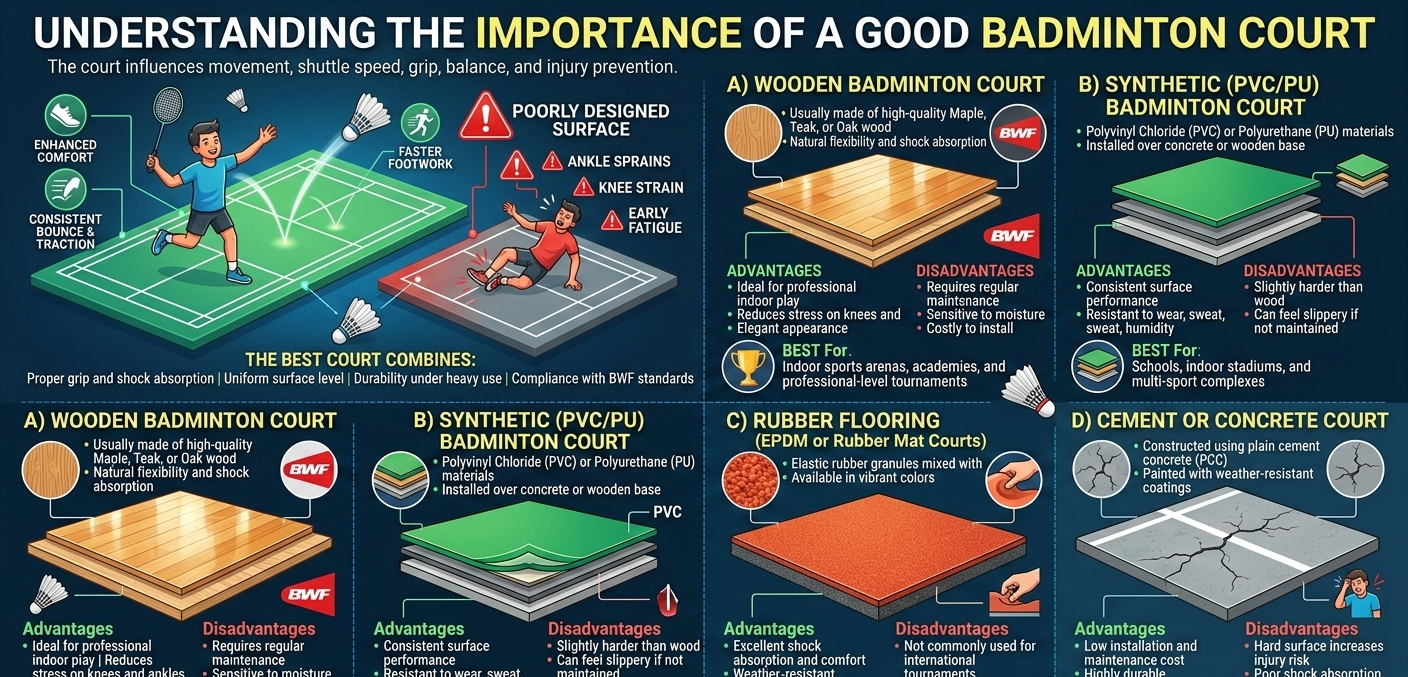
The badminton court is the foundation of the sport. It influences everything — from player movement and shuttle speed to grip, balance, and injury prevention.
A poorly designed or unsuitable surface can cause ankle sprains, knee strain, or early fatigue. On the other hand, a well-constructed badminton court enhances comfort, supports faster footwork, and ensures consistent bounce and traction.
The best badminton court is one that combines:
-
Proper grip and shock absorption
-
Uniform surface level
-
Durability under heavy use
-
Compliance with Badminton World Federation (BWF) standards
2. Types of Badminton Courts
There are several types of badminton courts, each with unique properties and uses. The most common ones include:
a) Wooden Badminton Court
Wooden courts are the traditional and most widely preferred type of indoor badminton flooring. They provide an excellent balance between performance and safety.
Features:
-
Usually made of high-quality Maple, Teak, or Oak wood
-
Offers natural flexibility and shock absorption
-
Provides good bounce and consistent grip
Advantages:
-
Ideal for professional indoor play
-
Reduces stress on knees and ankles
-
Maintains a consistent speed of play
-
Elegant and premium appearance
Disadvantages:
-
Requires regular maintenance and polishing
-
Sensitive to moisture and humidity
-
Can be costly to install
Best For:
Indoor sports arenas, academies, and professional-level tournaments
b) Synthetic (PVC/PU) Badminton Court
Synthetic flooring is one of the most popular modern options for badminton courts. It’s designed to deliver uniform play characteristics, durability, and easy maintenance.
Features:
-
Made from Polyvinyl Chloride (PVC) or Polyurethane (PU) materials
-
Comes in multiple layers for shock absorption and grip
-
Installed over a concrete or wooden base
Advantages:
-
Consistent surface performance
-
Resistant to wear, sweat, and humidity
-
Easy to clean and maintain
-
Affordable compared to pure wooden courts
Disadvantages:
-
Slightly harder underfoot than wood
-
Can feel slippery if not maintained properly
Best For:
Schools, indoor stadiums, and multi-sport complexes
c) Rubber Flooring (EPDM or Rubber Mat Courts)
Rubberized badminton courts, especially EPDM (Ethylene Propylene Diene Monomer), are becoming increasingly popular for both indoor and outdoor applications.
Features:
-
Made of elastic rubber granules mixed with binders
-
Provides excellent cushioning and impact absorption
-
Available in vibrant colors
Advantages:
-
Excellent shock absorption and comfort
-
Weather-resistant for outdoor use
-
Long-lasting and slip-resistant
Disadvantages:
-
Not commonly used for international tournaments
-
Slightly slower surface compared to wood
Best For:
Outdoor badminton courts, jogging tracks, schools, and residential areas
d) Cement or Concrete Court
Cement or concrete badminton courts are the most economical but least player-friendly option. They are common in open-air recreational areas.
Features:
-
Constructed using plain cement concrete (PCC)
-
Painted with weather-resistant coatings
-
Often used for community and residential spaces
Advantages:
-
Low installation and maintenance cost
-
Highly durable and weatherproof
-
Suitable for outdoor recreational play
Disadvantages:
-
Hard surface increases injury risk
-
Poor shock absorption
-
Uneven bounce and low comfort
Best For:
Outdoor practice areas and low-budget installations
e) Modular Tile Court
Modular interlocking tile courts are portable and easy-to-install systems made of polypropylene or other synthetic materials.
Features:
-
Quick installation with interlocking tiles
-
Can be placed on existing cement or asphalt floors
-
Designed for multi-sport usage
Advantages:
-
Portable and reconfigurable
-
Weather-resistant
-
Minimal maintenance
Disadvantages:
-
Expensive compared to cement or synthetic roll flooring
-
Slightly less grip than wood or PU courts
Best For:
Temporary setups, events, or outdoor multi-sport areas
3. Which Court Surface Is the Best for Badminton?
Choosing the best badminton court depends on your purpose, location, and budget. Let’s analyze which surface suits different needs best:
| Category | Recommended Court Type | Why It’s Best |
|---|---|---|
| Professional Tournaments | Wooden Court with Synthetic Overlay | Meets BWF standards, ensures superior play and shock absorption |
| Indoor Training Academies | PU or PVC Synthetic Flooring | Cost-effective, durable, easy to maintain |
| Outdoor Playgrounds | EPDM Rubber or Modular Tile Surface | Weatherproof, comfortable, non-slip surface |
| Schools & Residential Complexes | Synthetic (PU/PVC) Flooring | Long-lasting, safe for all age groups |
| Budget-Friendly Setup | Cement Court (with Acrylic Coating) | Economical, low maintenance but not ideal for long play |
So, the best court for badminton overall is the Wooden Court (with Synthetic Top Layer). It offers the right mix of comfort, safety, and professional play quality, making it the preferred choice for indoor arenas worldwide.
4. Factors to Consider When Choosing the Best Badminton Court
Before finalizing your court type, consider these important factors:
a) Location
-
Indoor courts: Choose wooden or synthetic surfaces.
-
Outdoor courts: Opt for EPDM rubber or acrylic-coated concrete to handle weather conditions.
b) Budget
Wooden courts are premium, while synthetic and cement options are more cost-effective. Choose based on long-term use and maintenance expectations.
c) Player Level
-
Beginners: Synthetic or cement courts (affordable and durable).
-
Professionals: Wooden or PU courts (better performance and safety).
d) Maintenance
Wooden courts require regular polishing; synthetic and rubber courts need only simple cleaning.
e) Comfort and Safety
Prioritize flooring with good shock absorption and anti-slip properties to prevent injuries.
5. BWF Recommendations for Court Flooring
The Badminton World Federation specifies that official courts must:
-
Have non-slippery, matte-finished flooring.
-
Use wooden or approved synthetic surfaces.
-
Maintain uniform bounce and friction levels.
-
Follow standard dimensions of 13.40 m × 6.10 m.
Courts that meet these standards ensure fair competition and high-quality gameplay.
6. Conclusion
So, which court is best for badminton?
The answer depends on where and how the game is played — but for professional performance and player comfort, a wooden court with a synthetic overlay stands out as the best choice. It combines natural elasticity, grip, and visual appeal with modern durability and minimal maintenance.
However, for schools, community centers, and outdoor spaces, synthetic and rubber courts offer excellent alternatives. They provide good comfort, are easier to install, and withstand diverse weather conditions.
Ultimately, the best badminton court is one that ensures safety, enhances performance, and fits your specific environment and budget. When built with precision and the right materials, a well-designed badminton court becomes not just a play area — but a space for skill, passion, and athletic excellence.