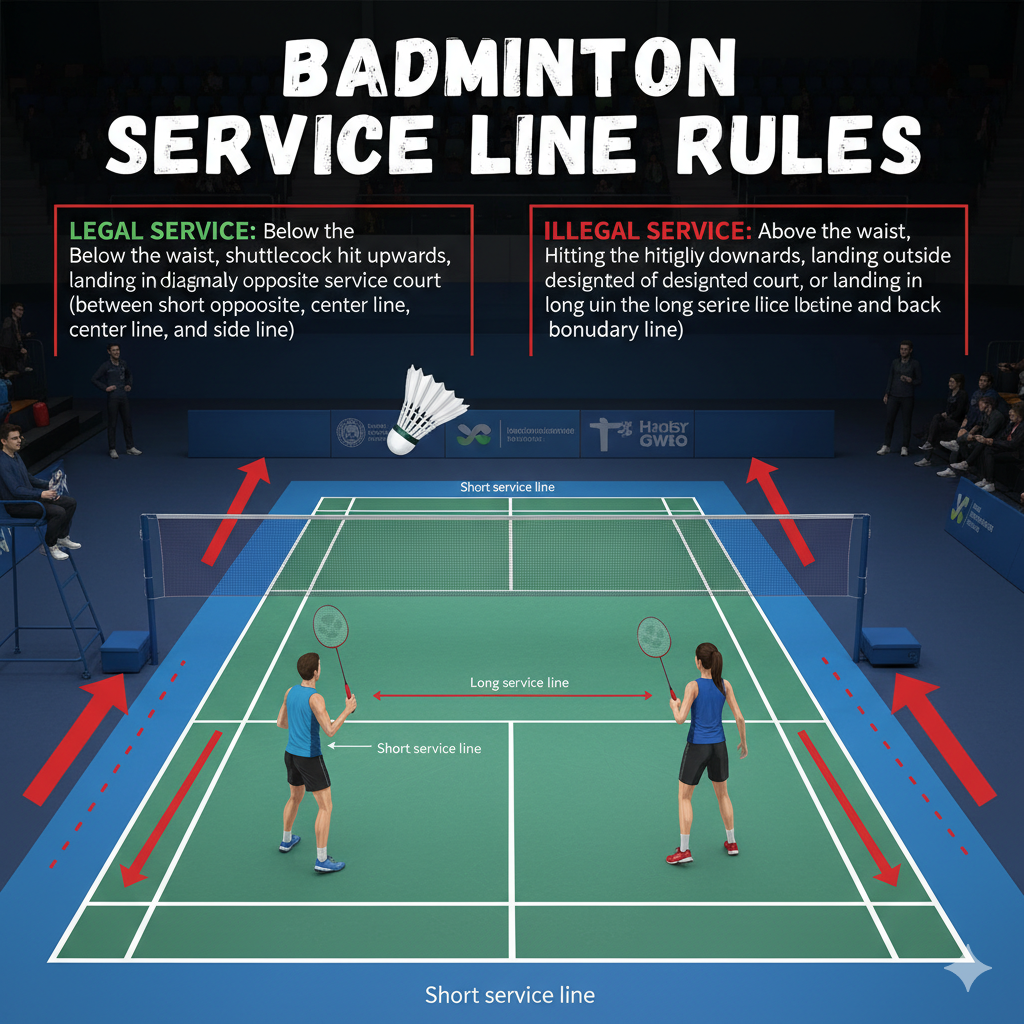
Badminton is a fast-paced, highly strategic sport that requires agility, precision, and adherence to strict rules. Among the most critical aspects of the game is serving, which sets the pace for every rally and can often determine the outcome of a match. Central to correct serving is a clear understanding of badminton service line rules, including the positions, dimensions, and regulations governing where the shuttle must land.
This comprehensive guide covers badminton service line rules, their significance, court dimensions, serving regulations, common faults, and professional tips for improving serve accuracy. It is designed for players, coaches, referees, and sports facility managers who want to ensure competitive and professional-level play.
1. Introduction to Service Lines in Badminton
In badminton, the court is divided by multiple lines that define boundaries, service areas, and playing zones. Among these, the service lines are particularly important because they determine:
-
Where the server must stand while serving
-
The legal landing area for the shuttlecock
-
Fairness and consistency in both singles and doubles play
Key Service Lines
-
Short Service Line: Marks the minimum distance a shuttle must travel during a serve.
-
Long Service Line: Marks the maximum distance for a serve; differs slightly between singles and doubles.
-
Center Line: Divides the court into left and right service courts, ensuring the correct serving position based on score.
Proper knowledge of these lines helps players avoid faults, maintain smooth gameplay, and comply with BWF standards.
2. Badminton Court Dimensions Related to Service
The Badminton World Federation (BWF) provides standardized court dimensions to ensure consistency in professional play. Understanding these measurements is essential for both players and facility managers.
Court Dimensions
-
Court Length: 13.4 meters (44 feet)
-
Court Width: 6.1 meters (20 feet) for doubles, 5.18 meters (17 feet) for singles
Service Line Distances
-
Short Service Line: 1.98 meters (6 feet 6 inches) from the net
-
Long Service Line for Singles: At the back boundary line (11.88 meters from net)
-
Long Service Line for Doubles: 0.76 meters (2 feet 6 inches) inside the back boundary line
These measurements define the legal service area and ensure fairness in competitive matches.
3. The Role of Service Courts
Each side of the badminton court is divided into two service courts: the right service court and the left service court. Players must serve diagonally into the opponent’s corresponding service court.
Right Service Court
-
Used when the server’s score is even.
-
In singles, the shuttle must land in the opponent’s right service court.
-
In doubles, the shuttle must land in the right service court of the receiving team.
Left Service Court
-
Used when the server’s score is odd.
-
Shuttle must land in the opponent’s left service court.
This alternating service pattern ensures fairness, balanced rotation, and proper gameplay flow.
4. Rules of Serving in Badminton
The serve is one of the most crucial skills in badminton. BWF regulations clearly define how a serve must be executed to be considered legal.
Server Positioning
-
The server must stand within the designated service court without touching the boundary lines.
-
Both feet must remain stationary and in contact with the floor until the shuttle is struck.
Shuttle Contact
-
The shuttle must be struck below the server’s waist, defined as the lowest rib level.
-
The racket head must point downwards at the moment of contact.
Serve Direction
-
The shuttle must travel diagonally into the opponent’s corresponding service court.
-
Any deviation from this diagonal direction is considered a fault.
Faults Related to Service Lines
-
Shuttle lands short of the short service line.
-
Shuttle lands beyond the long service line.
-
Shuttle touches the net or the server steps outside the service court.
Adhering to these rules ensures fair, competitive, and professional gameplay.
5. Service Rules in Singles
In singles badminton, service rules are slightly different from doubles due to narrower court width.
-
Serves must land between the short and long service lines on the opponent’s side.
-
Players serve from the right service court when their score is even, and from the left service court when their score is odd.
-
After each point, the server changes service courts to maintain proper rotation.
Singles service emphasizes precision, accuracy, and strategic placement of the shuttle within a smaller court area.
6. Service Rules in Doubles
Doubles matches require additional coordination between partners:
-
The short service line remains the same as in singles, but the long service line for doubles is closer to the net.
-
The shuttle must land inside the diagonal service box of the opponent’s side.
-
Partners alternate positions after the initial serve to maintain correct service rotation.
-
Serves landing outside these boundaries are faults, resulting in point loss or service turnover.
Doubles service requires teamwork, strategic angles, and precise placement to gain an advantage.
7. Common Faults During Serving
Even experienced players can commit service faults. Common errors include:
-
Standing outside service court boundaries
-
Feet leaving the floor during service
-
Shuttle hitting the net and not landing in the correct court
-
Serving from the wrong side based on score
-
Shuttle landing outside the short or long service lines
Training and practice can help players minimize faults and improve consistency in competitive play.
8. Strategic Importance of Proper Serving
Serving is not just a rule requirement; it is a strategic weapon in badminton:
-
A well-executed serve can force the opponent into a defensive position.
-
Different serves, such as high serve, low serve, flick serve, and drive serve, rely on correct service line placement.
-
Mastery of service lines allows players to control angles, pace, and shuttle placement, creating opportunities to dominate rallies.
Proper understanding and usage of service lines can significantly enhance competitive performance.
9. Training Tips for Service Line Accuracy
To ensure consistent and legal serving, players should focus on:
-
Mark Your Court: Use visible targets to practice landing shuttles within service lines.
-
Foot Positioning Drills: Keep both feet inside the service court during serves.
-
Target Practice: Focus on diagonal areas of the opponent’s service court.
-
Serve Variety: Practice different serves—high, low, flick, drive—ensuring all are within the legal service area.
Regular practice builds muscle memory, accuracy, and confidence in competitive settings.
10. Badminton Court Construction Considerations
For professional or recreational court setup:
-
Service line accuracy is essential for both singles and doubles.
-
Use contrasting colors for service lines to enhance visibility.
-
Ensure indoor courts have non-glare lighting for clear line perception.
-
Flooring must allow players to move quickly without slipping during serving or receiving.
Accurate service line marking ensures BWF compliance, professional-standard play, and long-term court durability.
11. Conclusion
Badminton service line rules are fundamental to fair play, strategic advantage, and competitive integrity.
-
Singles: Serve between short and long service lines, alternating left and right courts based on score.
-
Doubles: Serve diagonally within defined boundaries, with a closer long service line.
Players who understand and respect service line rules minimize faults, improve precision, and can leverage serving as a strategic tool. Coaches, referees, and facility managers benefit from correct court construction and accurate line marking, ensuring professional-standard training and gameplay.