Tennis is a sport that demands precision—not only from players but also from the court they play on. The design, size, and layout of a tennis court directly influence gameplay, safety, and performance. Whether it’s a professional arena or a backyard recreational setup, understanding the area of a tennis court is essential for proper planning and construction.
This comprehensive guide explains the standard dimensions, total area coverage, layout details, and important considerations that define a world-class tennis court.
1. Standard Area of a Tennis Court
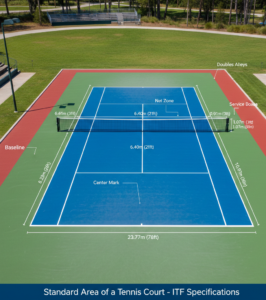
The International Tennis Federation (ITF), the governing body for tennis worldwide, has standardized the dimensions of tennis courts to ensure consistency in play. These specifications are applicable to all professional and recreational courts.
Tennis Court Dimensions:
| Specification | Metric Measurement | Imperial Measurement |
|---|---|---|
| Length | 23.77 meters | 78 feet |
| Width (Singles) | 8.23 meters | 27 feet |
| Width (Doubles) | 10.97 meters | 36 feet |
| Net Height (Center) | 0.91 meters | 3 feet |
| Net Height (Posts) | 1.07 meters | 3 feet 6 inches |
| Service Line Distance | 6.40 meters from the net | 21 feet |
| Baseline to Baseline | 23.77 meters | 78 feet |
Total Play Area:
For singles, the total playable area is approximately 195.65 square meters (2,106 square feet).
For doubles, the total area expands to 260.87 square meters (2,808 square feet).
However, this is just the playing area. The complete court area, including the safety run-off zones around the court, is larger.
2. Recommended Total Court Area Including Run-Off Zones
To ensure safe player movement and prevent collisions, the ITF recommends a minimum clearance area around the main court.
Standard Total Area:
| Court Type | Length (with Run-Off) | Width (with Run-Off) | Total Area |
|---|---|---|---|
| Minimum (Recreational) | 34.77 meters (114 feet) | 17.07 meters (56 feet) | 593 square meters (6,380 sq. ft.) |
| Recommended (Professional) | 36.58 meters (120 feet) | 18.29 meters (60 feet) | 668 square meters (7,200 sq. ft.) |
This ensures ample space for players to chase wide shots and deep returns safely, especially during competitive matches.
3. Key Zones of a Tennis Court
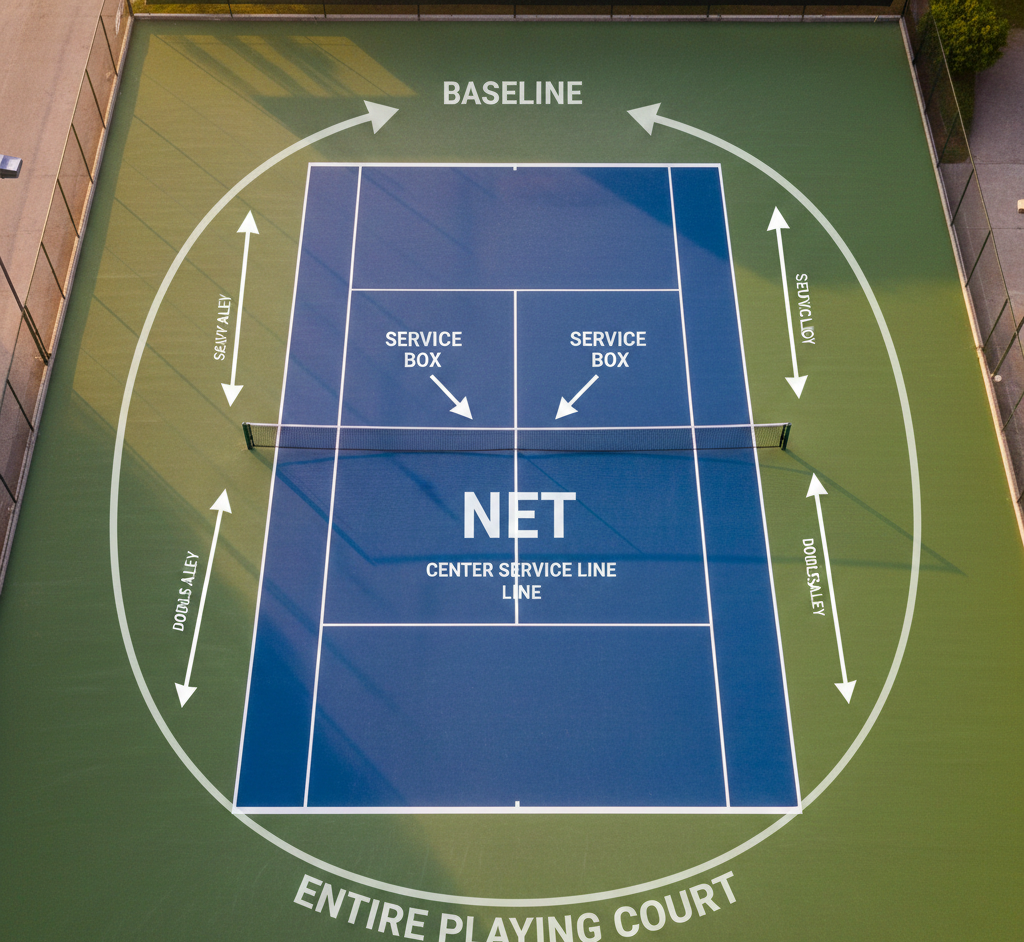
A tennis court is divided into several key areas, each designed for specific gameplay functions.
a) Baseline
The baseline marks the farthest boundary of the court. Players serve and rally from this line. It runs parallel to the net and defines the length of play.
b) Service Boxes
Each side of the court has two service boxes divided by the center line. The area between the net and the service line (6.4 meters) defines where serves must land.
c) Doubles Alleys
Located on the outer sides of the singles sidelines, these narrow strips are only used during doubles play. They increase the total court width from 8.23 meters to 10.97 meters.
d) Center Mark
A small mark at the midpoint of each baseline that divides it for serving positions (left or right service courts).
e) Net Zone
The net divides the court into two equal halves. It is 0.91 meters high at the center and attached to two posts outside the sidelines.
Each of these zones contributes to gameplay dynamics—affecting movement, angles, and shot placement.
4. Indoor vs Outdoor Court Area Requirements
Indoor Courts:
-
Require a minimum ceiling height of 9 meters (30 feet) to allow unobstructed ball trajectory.
-
Total indoor area: around 700–720 square meters, depending on lighting and ventilation systems.
Outdoor Courts:
-
Need additional space for fencing, lighting poles, and spectator areas.
-
The ideal total space for a standard outdoor court is 36.5 m × 18.3 m, including safety and drainage zones.
The layout must also consider wind direction and sun orientation—outdoor courts are ideally aligned north-south to minimize glare during play.
5. Tennis Court Layout Design and Marking
A properly marked court ensures fair play and easy rule enforcement. Line markings are typically white or yellow, with a width of 5 cm (2 inches).
Court Line Specifications:
-
Baseline: 10 cm (4 inches) wide
-
Sidelines, Service Lines, Center Lines: 5 cm (2 inches) wide
-
Center Mark: 10 cm (4 inches) long, 5 cm (2 inches) wide
All lines must be contrasting in color from the surface to ensure clear visibility under lighting.
6. Surface Area and Flooring Options
The type of surface material determines not only the area’s appearance but also its bounce, speed, and comfort.
a) Hard Court
-
Material: Acrylic or polyurethane coating over asphalt or concrete base
-
Area Durability: High; long lifespan and low maintenance
-
Ideal for: Professional training and tournaments
b) Clay Court
-
Material: Crushed brick or shale
-
Area Features: Softer on joints; slower gameplay
-
Ideal for: Outdoor academies and competitive training
c) Grass Court
-
Material: Natural grass with soil foundation
-
Area Features: Traditional, fast surface
-
Ideal for: Exclusive clubs and international events
d) Synthetic Court
-
Material: Artificial turf or cushioned synthetic layers
-
Area Features: Weather-resistant and all-season use
-
Ideal for: Residential, institutional, and recreational setups
Each surface covers the same standard area but requires unique base preparation and maintenance routines.
7. Space Planning and Construction Considerations
Building a tennis court requires engineering precision and space optimization. Here are some key factors:
-
Orientation: North-South direction minimizes sunlight interference.
-
Drainage: Slight slope (1%) ensures water runoff without puddles.
-
Fencing: Typically 10–12 feet high around the perimeter for safety.
-
Lighting: For night play, maintain uniform brightness of 500–700 lux.
-
Spectator Seating: Optional, but adds around 50–100 square meters for viewing zones.
-
Access Pathways: Provide walkways and maintenance access without interfering with the play area.
8. Cost Estimation Based on Area
The cost of constructing a tennis court depends on the total area and surface type.
| Surface Type | Total Area (sq. m) | Approx. Cost per sq. ft (₹) | Estimated Total Cost (₹) |
|---|---|---|---|
| Acrylic Hard Court | 668 | ₹900–₹1,200 | ₹6.5–₹8.0 lakh |
| Synthetic Turf | 668 | ₹1,000–₹1,400 | ₹7–₹9 lakh |
| Clay Court | 668 | ₹800–₹1,000 | ₹5.5–₹6.5 lakh |
| Grass Court | 668 | ₹1,200–₹1,800 | ₹8–₹11 lakh |
These figures include base preparation, surfacing, marking, fencing, and accessories.
9. Maintenance and Area Preservation
Maintaining the court’s area and surface quality ensures consistent play and extends the life of the facility.
-
Clean regularly to prevent dust or moss buildup.
-
Check markings and repaint if faded.
-
Inspect drainage to avoid water accumulation.
-
Maintain fences and lighting systems for safety.
A well-maintained area not only improves playability but also enhances the court’s visual appeal and longevity.https://www.sports-facility.in/index.php
10. Conclusion
Understanding the area of a tennis court is essential for anyone planning to construct or renovate one. The total area—approximately 668 square meters for a professional setup—is designed for performance, safety, and comfort. From ITF-standard dimensions to surface selection and layout design, every detail impacts gameplay quality and court durability.
Whether you are building a court for a school, academy, or residential community, adhering to these standards ensures players experience professional-grade tennis in every match. A well-constructed court is more than a sports surface—it’s a long-term investment in fitness, competition, and community development.