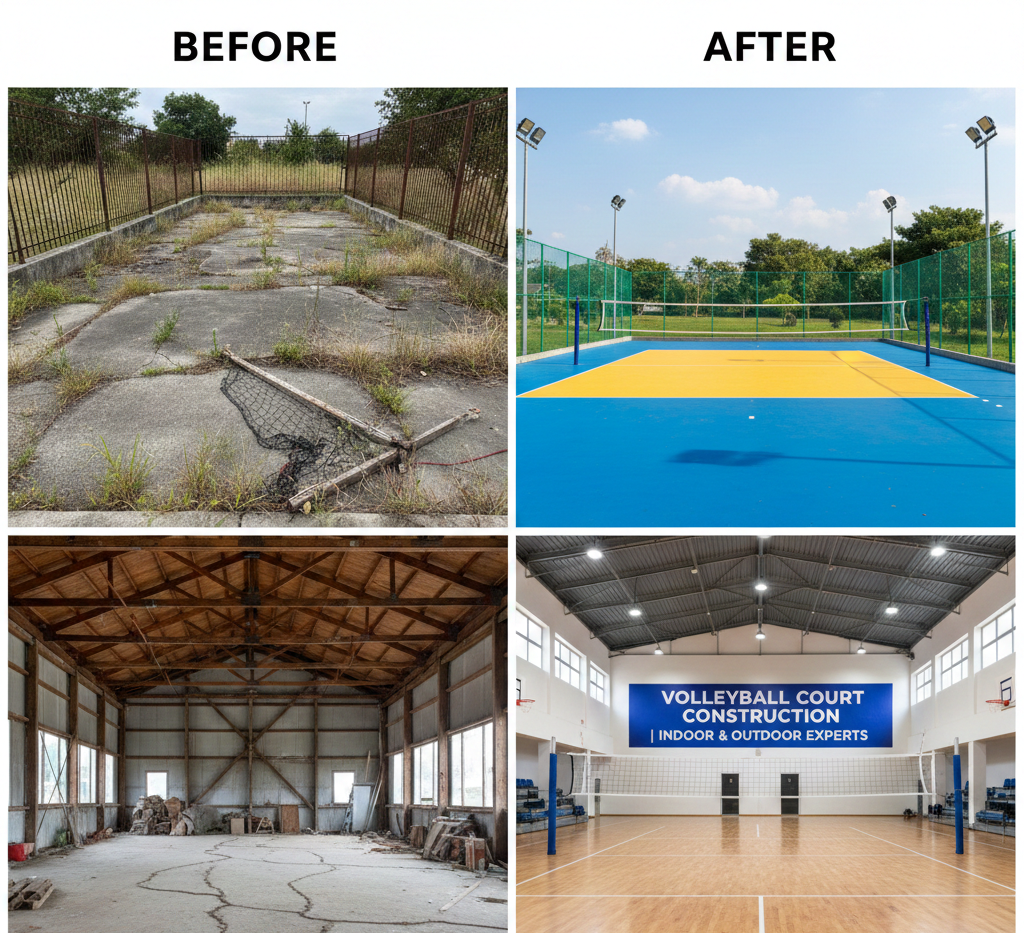
Volleyball has become one of the most popular sports worldwide, gaining significant traction in schools, colleges, sports academies, and residential communities. Proper volleyball court construction requires meticulous planning, the right materials, and adherence to international standards.
This guide provides a detailed overview of volleyball court construction, covering site selection, dimensions, types, flooring, equipment, and maintenance, ensuring you can create a professional-quality court.
1. Planning and Site Selection
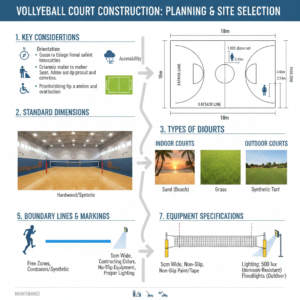
Successful volleyball court construction begins with careful planning and site selection. This step ensures the court is safe, functional, and accessible.
Key Considerations:
-
Location: Choose a flat, open area free from trees, poles, or other obstructions.
-
Orientation: For outdoor courts, align the court along a north-south axis to minimize sun glare affecting players.
-
Accessibility: Ensure easy access for players, coaches, spectators, and maintenance staff.
-
Drainage: Outdoor courts must have proper drainage to prevent waterlogging and damage.
The purpose of the court—whether for recreational, professional, or training use—also influences site planning and material selection.
2. Standard Volleyball Court Dimensions
Adhering to FIVB international standards ensures that the court meets professional specifications:
-
Court Size: 18 meters (length) × 9 meters (width)
-
Center Line: Divides the court into two equal halves of 9 × 9 meters
-
Attack Line: 3 meters from the center line, separating front and back zones
-
Free Zone: Minimum 3 meters surrounding the court for safe movement
-
Safety Zone: Recommended 5 meters outside the boundaries for professional play
-
Net Height: Men – 2.43 meters; Women – 2.24 meters
-
Net Width: 1 meter
-
Antennae: 1.80 meters above the net at the sidelines
Indoor Court Ceiling Clearance: Minimum 7 meters, preferably higher for tournament-level play.
3. Types of Volleyball Courts
Volleyball courts are classified into indoor and outdoor, with flooring and construction tailored to the environment and usage.
a) Indoor Courts
-
Flooring: Hardwood (maple) or synthetic polyurethane
-
Advantages: Smooth bounce, consistent play, reduced joint injuries
-
Use Case: Schools, sports complexes, professional training, and tournaments
b) Outdoor Courts
-
Sand (Beach Volleyball) Courts
-
Depth: 40–50 cm for safety and cushioning
-
Advantages: Soft surface, reduced injury risk, ideal for recreational and professional beach volleyball
-
-
Grass Courts
-
Advantages: Cost-effective, eco-friendly
-
Disadvantages: High maintenance, uneven bounce
-
-
Synthetic Turf Courts
-
Advantages: Low-maintenance, weather-resistant, durable
-
Suitable for residential communities and outdoor sports facilities
-
Step 5: Boundary Lines and Markings
-
Use 5 cm wide lines in contrasting colors
-
Mark center line, attack lines, and sidelines accurately
-
Use non-slip paint for indoor courts or durable tapes for outdoor courts
Step 6: Safety Measures
-
Maintain free zones around the court
-
Ensure non-slip surfaces
-
Secure net posts and other equipment
-
For indoor courts, provide proper ceiling clearance and lighting
5. Equipment Specifications
Net and Posts:
-
Net height: 2.43 m for men, 2.24 m for women
-
Width: 1 meter
-
Posts: Adjustable, stable, corrosion-resistant
Antennae:
-
Height: 1.80 meters above net
-
Mark the lateral boundaries of the playing area
Lighting (Indoor/Outdoor):
-
Indoor: Minimum 500 lux uniform illumination
-
Outdoor: Adequate natural light or floodlights for evening games
6. Maintenance of Volleyball Courts
Regular maintenance ensures longevity and consistent performance:
-
Indoor Hardwood: Clean daily, polish periodically, check net and posts
-
Indoor Synthetic: Clean regularly, inspect for wear and tear
-
Sand Courts: Rake regularly, remove debris, inspect depth
-
Grass Courts: Mow, irrigate, treat for pests
-
Synthetic Turf: Brush surface, remove debris, check shock-absorbing layer
Proper maintenance prevents injuries and prolongs the life of the court.
7. Choosing the Right Volleyball Court
| Factor | Indoor Hardwood | Indoor Synthetic | Sand Outdoor | Grass Outdoor | Synthetic Outdoor |
|---|---|---|---|---|---|
| Usage Frequency | High | High | Medium | Low | Medium-High |
| Maintenance Requirement | Moderate | Low | Medium | High | Low |
| Player Safety | High | High | High | Medium | High |
| Durability | Very High | High | Medium | Medium | High |
| Cost | High | Medium | Medium | Low | Medium-High |
8. Conclusion
Volleyball court construction is a detailed process that requires careful planning, high-quality materials, and adherence to international specifications. A well-constructed court ensures player safety, promotes skill development, and supports recreational or competitive play.
Investing in quality volleyball court construction is not just building a sports facility—it is fostering a community of athletes, enthusiasts, and students passionate about volleyball.
FAQ: Volleyball Court Construction – Complete Guide
1. What is involved in volleyball court construction?
Volleyball court construction includes:
-
Site survey and layout planning
-
Subfloor or base preparation
-
Flooring installation (wood, vinyl, synthetic, or sand)
-
Net posts and net setup
-
Boundary line marking
-
Lighting, ventilation, and drainage (for indoor courts)
-
Optional spectator seating, scoreboards, and fencing
The goal is a safe, durable, and regulation-compliant court.
2. What are the standard dimensions of a volleyball court?
-
Court size: 18 m × 9 m (59 ft × 29.5 ft)
-
Free zone: Minimum 3 m on all sides
-
Ceiling height for indoor courts: Minimum 7 m (preferably 9–12 m for professional play)
-
Attack line: 3 m from the centerline
These dimensions follow FIVB regulations.
3. What types of flooring are used in volleyball court construction?
-
Wooden flooring: Maple or engineered wood for indoor professional courts
-
Vinyl or synthetic sports flooring: Cost-effective, durable, easy to maintain
-
Rubberized flooring: Ideal for recreational courts
-
Sand: For beach volleyball or outdoor recreational courts
4. Can indoor volleyball courts be multi-purpose?
Yes. Multi-sport flooring allows the same court to be used for:
-
Badminton
-
Basketball
-
Handball
-
Futsal
Line markings and court padding should be designed to accommodate multiple sports safely.
5. What is the ideal lighting and ventilation setup?
-
Lighting: Minimum 300–500 lux for recreational, 1000 lux for tournaments; even, glare-free distribution
-
Ventilation: Proper airflow to regulate temperature, reduce humidity, and maintain air quality for player comfort
6. How long does volleyball court construction take?
-
Outdoor sand court: 1–2 weeks
-
Indoor synthetic court: 2–4 weeks
-
Indoor professional wooden court: 3–6 weeks, including subfloor preparation
7. What is the approximate cost of volleyball court construction in India?
Costs vary based on court type and amenities:
-
Outdoor sand court: ₹5–12 lakh
-
Indoor synthetic court: ₹15–30 lakh
-
Professional wooden indoor court: ₹30–50 lakh
Additional costs include net systems, lighting, ventilation, and seating.
8. Do volleyball courts require special subfloor preparation?
Yes. Subfloor preparation ensures:
-
Level surface for uniform gameplay
-
Shock absorption to reduce injuries
-
Proper drainage to prevent water accumulation (outdoor courts)
-
Durability and long lifespan
9. What safety measures are needed in court construction?
-
Non-slip flooring
-
Padding around net posts and walls
-
Adequate clearance in free zones
-
Proper lighting and ventilation
-
Smooth, debris-free surfaces for sand courts
10. What materials are recommended for net posts and accessories?
-
Indoor posts: Steel or aluminum with padding
-
Outdoor posts: Galvanized steel or heavy-duty plastic with secure anchoring
-
High-quality nets compliant with FIVB standards
11. Can volleyball courts be customized?
Yes. Customization options include:
-
Court colors and branding
-
Multi-sport markings
-
Integrated lighting and ventilation
-
Spectator seating and scoreboards