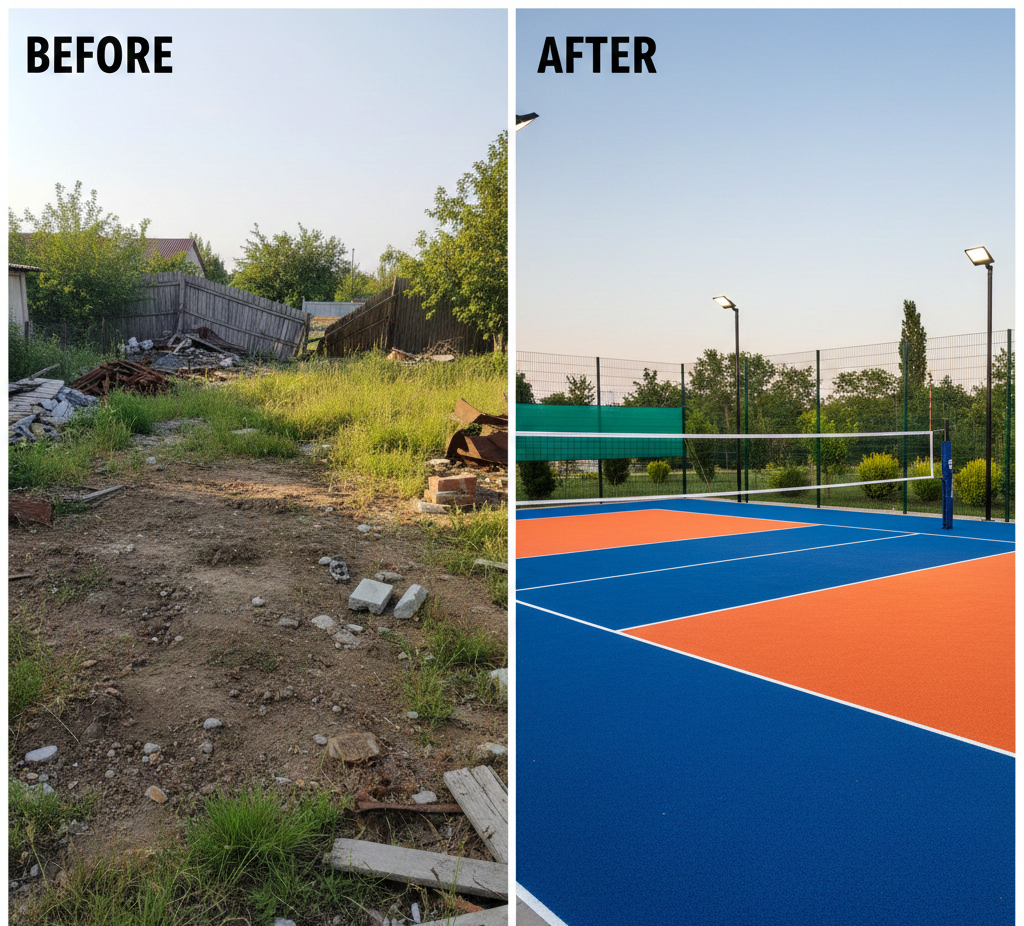
Volleyball is one of the fastest-growing sports in India and around the world. From schools and colleges to residential complexes and professional sports academies, the demand for high-quality volleyball courts has skyrocketed. Constructing a volleyball court involves careful planning, selecting the right materials, and understanding the different types of courts to ensure both durability and player safety.
In this guide, we will explore the essential aspects of volleyball court construction, the types of courts available, and what to consider before building one.
Volleyball courts are generally classified into indoor and outdoor courts. Each type has specific construction requirements based on the playing surface, weather conditions, and usage frequency.
a) Indoor Volleyball Courts
Indoor courts are usually found in sports complexes, schools, and professional training facilities.
Key Features:
Surface Material: Hardwood (maple) or synthetic polyurethane
Durability: High; can withstand heavy use
Maintenance: Moderate; needs periodic polishing and cleaning
Advantages: Provides a consistent bounce, reduces injury risk, and allows year-round play
Construction Steps:
Site Preparation: Level the area and install a drainage system if necessary.
Foundation: Construct a reinforced concrete base to support the flooring.
Flooring Installation: Lay wooden panels or synthetic flooring with proper cushioning.
Net Posts & Accessories: Install adjustable net posts, boundary lines, and lighting systems.
b) Outdoor Volleyball Courts
Outdoor courts are perfect for recreational play in parks, residential societies, and beach areas.
Types of Outdoor Courts:
Sand Volleyball Court (Beach Volleyball)
Surface: Fine sand with good drainage
Advantage: Soft landing reduces injury risk; ideal for casual and professional beach volleyball
Special Considerations: Sand depth should be 40–50 cm, and court must be leveled for consistent play
Grass Volleyball Court
Surface: Natural grass
Advantage: Cost-effective, visually appealing
Disadvantage: Requires regular maintenance and irrigation; inconsistent bounce
Synthetic/Artificial Turf Court
Surface: Artificial turf with shock-absorbing layers
Advantage: Low maintenance, durable, and usable in all weather conditions
Disadvantage: Higher initial cost compared to grass
Constructing a volleyball court requires attention to detail to ensure safety, durability, and compliance with international standards. Here are key factors to consider:
Leveling & Drainage: Proper leveling and a drainage system prevent waterlogging and surface damage, especially for outdoor courts.
Surface Material: Choose the surface based on indoor/outdoor usage, player safety, and maintenance feasibility.
Boundary Markings: Use durable, non-slip paint or tapes for clear court markings.
Net System: Install adjustable, high-quality net posts with tensioning mechanisms.
Lighting (Indoor & Outdoor): Ensure proper illumination to allow evening or night games without glare or shadows.
Safety Zones: Maintain adequate free zones around the court for player movement and emergency access.
4. Maintenance Tips for Volleyball Courts
Regular maintenance prolongs the life of the court and ensures safe play:
Indoor Courts: Clean surfaces daily, polish hardwood floors periodically, and inspect nets and posts for wear.
Outdoor Courts: Rake sand courts regularly, remove debris from grass courts, check artificial turf for damage, and maintain proper drainage.
Seasonal Checks: Ensure net tension, boundary lines, and surface integrity are consistent before each playing season.
5. Choosing the Right Type of Volleyball Court
The choice of court depends on several factors:
Factor
Indoor Court
Outdoor Sand
Grass Court
Synthetic Turf
Usage Frequency
High
Medium
Low
Medium-High
Maintenance Requirement
Moderate
Medium
High
Low
Durability
Very High
Medium
Medium
High
Player Safety
Very High
High
Medium
High
Cost
High
Medium
Low
Medium-High
Conclusion
Volleyball is a sport that combines agility, teamwork, and skill. Building the right type of volleyball court ensures a safe, enjoyable, and professional experience for players of all levels. Whether it’s a hardwood indoor court for competitive play or a beach volleyball setup for recreational fun, proper planning, material selection, and construction standards are critical.
By investing in high-quality construction and maintenance, sports facilities can promote volleyball as a safe and popular sport in schools, clubs, and residential communities across India.
FAQ: Volleyball Court Construction and Types
1. What are the main types of volleyball courts?
Volleyball courts can be classified based on location, surface, and usage:
Indoor Volleyball Courts
Flooring: Maple wood, synthetic vinyl, or rubberized sports flooring
Suitable for professional matches, schools, gyms, and clubs
Requires proper ventilation, lighting, and ceiling height
Outdoor Sand (Beach) Volleyball Courts
Surface: Fine, leveled sand, minimum 40 cm depth
Ideal for recreational or professional beach volleyball tournaments
Requires good drainage and sun protection
Outdoor Grass or Synthetic Courts
Grass or artificial turf with volleyball lines
Suitable for casual play or multi-purpose fields
Lower installation cost compared to sand or indoor courts
Multi-purpose Courts
Indoor or outdoor courts designed to accommodate volleyball, badminton, basketball, or handball
Floor markings and modular equipment allow flexibility
2. What are the standard dimensions for a volleyball court?
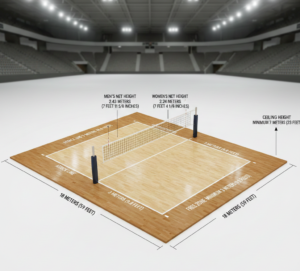
Court size: 18 m × 9 m (59 ft × 29.5 ft)
Free zone: Minimum 3 m around the court
Ceiling height: At least 7 m for indoor, 9–12 m for professional play
Attack line: 3 m from the centerline
3. What materials are used in volleyball court construction?
Indoor courts: Maple wood, engineered wood, vinyl, or synthetic sports flooring
Outdoor sand courts: Fine, clean sand free of debris
Synthetic grass/astro turf: Low maintenance, ideal for multi-use outdoor facilities
Other materials: Net posts, padding, lighting fixtures, and boundary markings.
4. How is an indoor volleyball court constructed?
Steps include:
Site survey and court layout
Subfloor preparation for shock absorption
Flooring installation (wood or synthetic)
Net posts and net setup
Line marking and boundary setup
Lighting, ventilation, and optional spectator seating
5. How is an outdoor volleyball court constructed?
Sand court: Level the ground, install drainage, fill with sand, compact and rake for smoothness
Grass/synthetic: Level the ground, install turf, mark boundaries, and secure net posts
6. What is the cost of volleyball court construction?
Approximate costs in India:
Outdoor sand court: ₹5–12 lakh
Indoor synthetic court: ₹15–30 lakh
Professional wooden indoor court: ₹30–50 lakh
Additional features like lighting, ventilation, or seating will increase costs.
7. What safety measures are required?
Non-slip flooring
Padded net posts and walls
Adequate free zone (≥3 m)
Proper lighting and ventilation
Clean and level playing surface
8. Can volleyball courts be multi-purpose?
Yes. Indoor and outdoor courts can be designed for multi-sport use, including badminton, basketball, or futsal, with clear line markings and modular equipment.