Introduction
Tennis is one of the most popular and prestigious sports worldwide, known for its elegance, skill, and energy. In India, the demand for professional tennis court construction has grown rapidly in schools, clubs, residential societies, sports complexes, and private estates. A well-constructed tennis court not only enhances player performance but also ensures durability, safety, and low maintenance.
Whether you are planning an indoor or outdoor tennis court, the flooring plays a crucial role in defining the game’s speed, bounce, and comfort. Choosing the right tennis court flooring system and ensuring professional construction can make a huge difference in the court’s lifespan and quality.
Types of Tennis Court Flooring
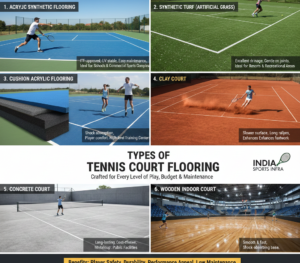
Different types of flooring systems are used in tennis courts depending on the level of play, maintenance requirements, and budget. The most common tennis court flooring types include:
1. Acrylic Synthetic Flooring
Acrylic flooring is one of the most preferred surfaces for both amateur and professional tennis players. It offers excellent bounce, smoothness, and weather resistance.
Features:
-
ITF-approved playing surface
-
Slip-resistant and UV stable
-
Suitable for outdoor and indoor use
-
Easy maintenance and long life
Ideal for: Schools, academies, residential societies, and commercial sports complexes.
2. Synthetic Turf (Artificial Grass)
Synthetic turf courts provide a softer feel and are gentle on players’ joints. The grass texture offers moderate speed and consistent bounce.
Features:
-
Excellent drainage and weather resistance
-
Aesthetic natural grass look
-
Low maintenance compared to natural grass
Ideal for: Resorts, clubs, and recreational areas.
3. Cushion Acrylic Flooring
This is a layered acrylic system with a cushioned base that provides extra comfort for players.
Features:
-
Shock absorption for injury prevention
-
Multi-layer cushioning for player comfort
-
Suitable for professional tournaments
Ideal for: High-level training centers and sports academies.
4. Clay Court
Clay courts are traditional and popular in Europe and South America. They are made using crushed brick or shale.
Features:
-
Slower surface, ideal for long rallies
-
Requires regular maintenance
-
Enhances footwork and stamina
Ideal for: Professional clubs and training academies.
5. Concrete Court
Concrete courts are durable, affordable, and low-maintenance. However, they can be harder on players’ joints.
Features:
-
Long-lasting and cost-effective
-
Requires acrylic or synthetic coating for performance
-
Minimal upkeep
Ideal for: Public facilities and schools.
6. Wooden Indoor Court
Used mostly for indoor stadiums and events, wooden flooring gives a premium playing experience.
Features:
-
Smooth and fast surface
-
Shock-absorbing wooden base
-
Limited to indoor use
Ideal for: Indoor sports arenas and clubs.
Tennis Court Construction Process
Building a standard tennis court requires expert planning, high-quality materials, and skilled workmanship. Below is the step-by-step construction process:
1. Site Inspection and Planning
The process begins with surveying the land and identifying the best location. The site must have proper drainage, minimal slope, and open space. A standard tennis court measures 78 feet × 36 feet for doubles and 78 feet × 27 feet for singles.
Key Considerations:
-
Orientation (north-south for sunlight control)
-
Wind direction and surroundings
-
Drainage system and soil condition
2. Base Preparation
A strong and stable base is crucial for a long-lasting court. The soil is compacted, and a granular sub-base is prepared with proper leveling and slope for water drainage.
Base materials used:
-
Compacted soil
-
Crushed stone or gravel
-
Water-permeable base layer
3. Surface Layer Installation
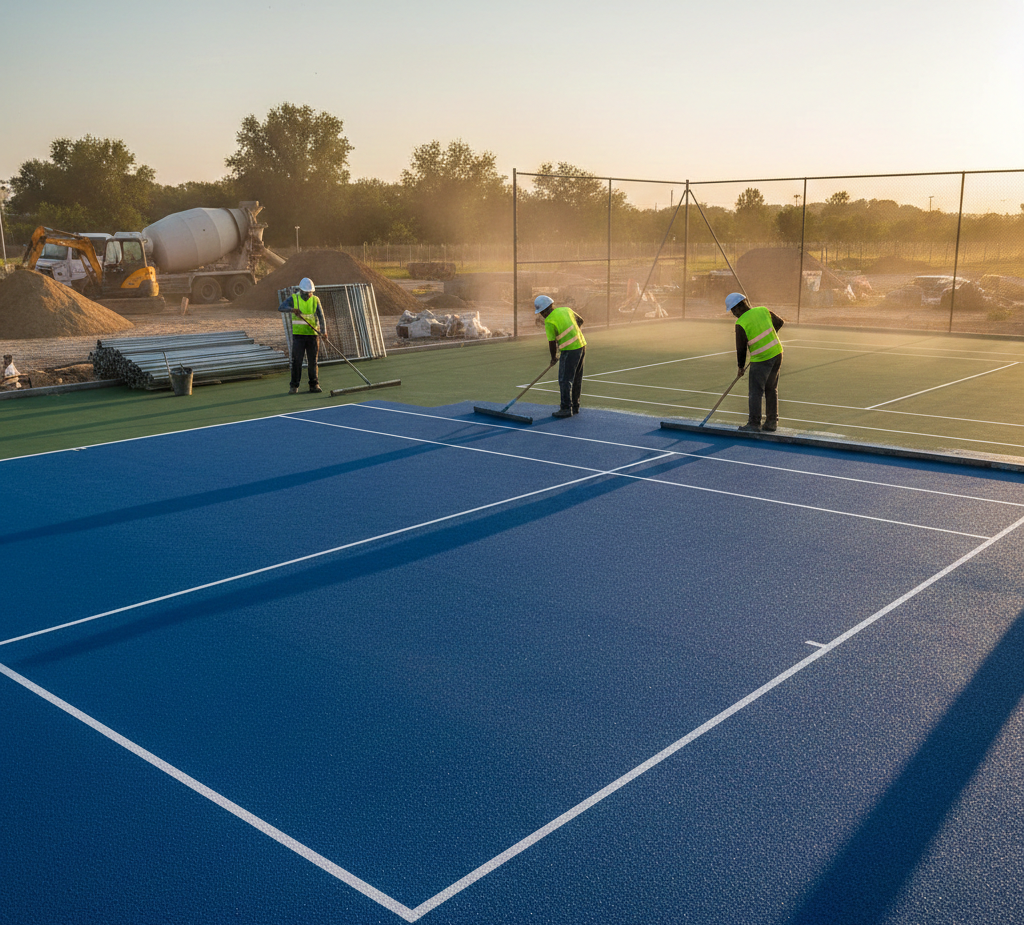
Depending on the chosen flooring type, layers of acrylic, synthetic turf, or clay are installed. Each layer is applied uniformly to ensure a smooth, even surface.
For Acrylic Courts:
-
Multiple coats of acrylic resins and silica sand
-
Cushion layers (optional) for comfort
-
Finishing with color coating and line marking
4. Line Marking and Accessories
After the surface is ready, professional line marking is done as per ITF standards using durable, non-fading paints. Accessories such as:
-
Net posts and center strap
-
Perimeter fencing
-
Floodlights for night play
-
Seating area and benches
are installed to complete the court.
5. Final Inspection and Quality Check
The last step involves quality inspection to ensure surface evenness, proper bounce, line accuracy, and safety compliance before handover.
Maintenance of Tennis Court Flooring
Regular maintenance is key to extending the lifespan of a tennis court.
Maintenance Tips:
-
Clean the surface regularly to prevent dust and algae buildup.
-
Inspect for cracks or surface wear annually.
-
Recoat the acrylic surface every 4–5 years for optimal performance.
-
Maintain proper drainage and avoid waterlogging.
Cost of Tennis Court Construction in India
The cost depends on the flooring type, materials used, and add-ons. On average:
-
Acrylic Court: ₹6 to ₹10 lakh
-
Cushion Acrylic Court: ₹10 to ₹14 lakh
-
Synthetic Turf Court: ₹8 to ₹12 lakh
-
Clay Court: ₹5 to ₹8 lakh
-
Wooden Indoor Court: ₹15 lakh and above
These are approximate values and may vary based on location, design, and brand preferences.
Why Choose Us for Tennis Court Construction
If you’re looking for a trusted tennis court construction company in India, we provide end-to-end solutions – from design to installation and maintenance.
Our Advantages:
-
Experienced team with 100+ completed sports projects
-
ITF-approved materials and international standards
-
Weather-resistant, long-lasting surfaces
-
Custom designs for residential, commercial, and institutional clients
-
On-time project completion and post-installation support
Benefits of a Professionally Built Tennis Court
-
Player Safety: Proper cushioning and slip resistance reduce injuries.
-
Durability: High-quality flooring materials last longer under heavy use.
-
Performance: Consistent bounce and grip enhance game quality.
-
Aesthetic Appeal: A professional finish adds beauty and value to the facility.
-
Low Maintenance: Expert construction minimizes long-term costs.https://www.sports-facility.in/index.php
Conclusion
Constructing a tennis court is a long-term investment that demands quality, precision, and expertise. The right tennis court flooring not only enhances player experience but also ensures durability and safety. Whether you need a synthetic, acrylic, or turf tennis court, our professional team guarantees world-class construction, ITF standards compliance, and complete customer satisfaction.
Bring your dream tennis court to life with premium flooring and expert craftsmanship – built to perform and built to last.