Badminton is one of India’s most popular indoor sports, valued for its speed, precision, and physical intensity. While player skill is crucial, the quality and accuracy of the badminton court itself play an equally important role in ensuring fair competition, player safety, and optimal performance.
Understanding how a badminton court is designed—its dimensions, markings, flooring, and construction standards—is essential for players, coaches, academies, and sports facility developers. This comprehensive guide explains every aspect of a badminton court, from official measurements to flooring options and construction essentials.
Official Badminton Court Dimensions (BWF Standards)
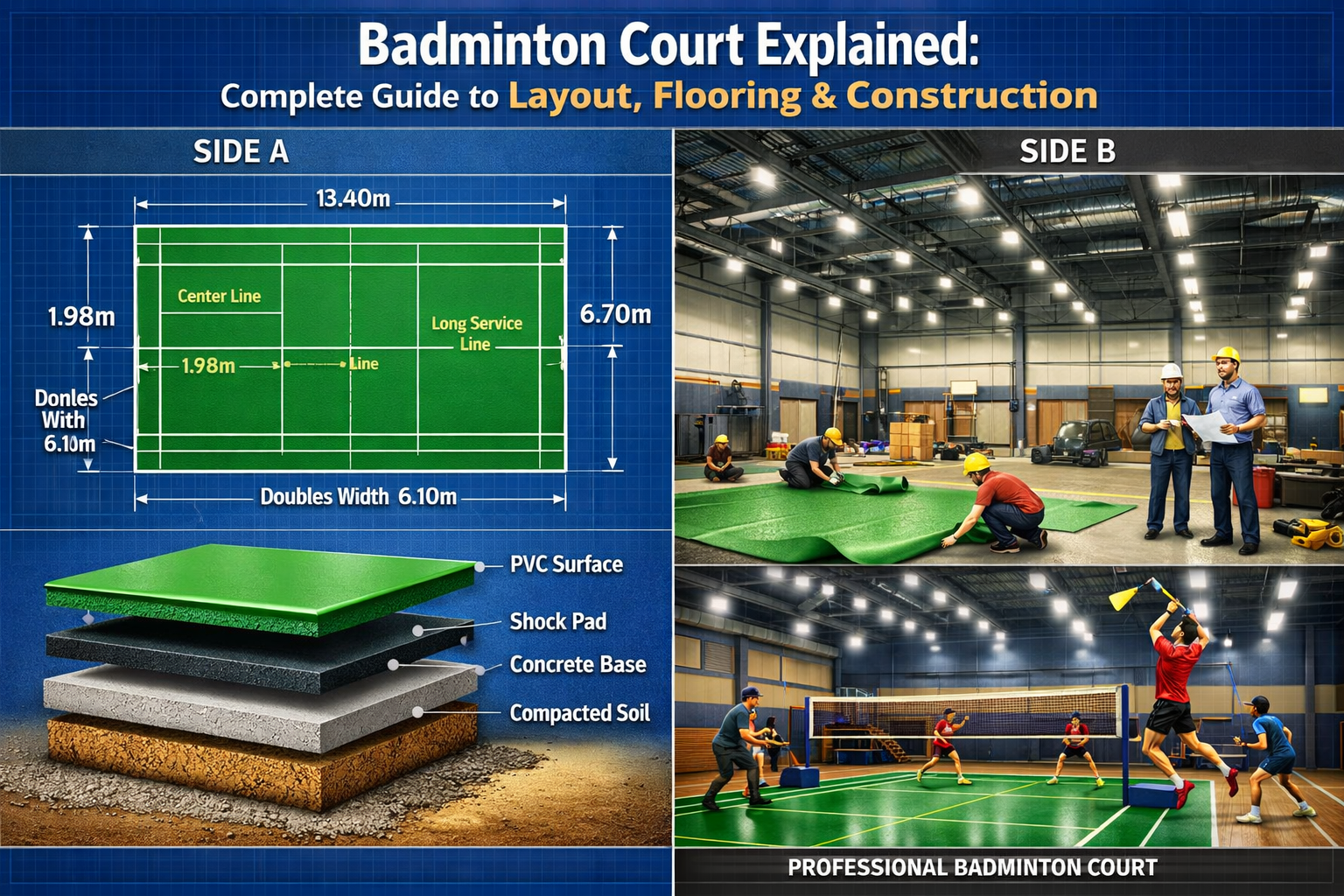
A standard badminton court is constructed according to specifications defined by the Badminton World Federation (BWF) to maintain consistency across all levels of play.
-
Court Length: 13.40 meters (44 feet)
-
Court Width (Doubles): 6.10 meters (20 feet)
-
Court Width (Singles): 5.18 meters (17 feet)
-
Short Service Line Distance: 1.98 meters (6 feet 6 inches) from the net
-
Long Service Line (Doubles): 0.76 meters (2 feet 6 inches) inside the back boundary
-
Net Height at Posts: 1.55 meters (5 feet 1 inch)
-
Net Height at Center: 1.524 meters (5 feet)
Key Components of a Badminton Court
A badminton court consists of multiple elements, each contributing to safety, performance, and durability.
Playing Surface (Flooring)
The floor provides traction, shock absorption, and stability. High-quality flooring reduces stress on joints and minimizes injury risks.
Net and Support Posts
The net divides the court into equal halves and must maintain correct height and tension. Posts should be strong, corrosion-resistant, and positioned outside the doubles sidelines.
Court Markings
Boundary and service lines define the legal play area. Lines must be clearly visible, accurately measured, and applied using non-slip paint.
Safety Clearance Zones
Clear space around the court prevents player collisions with walls or obstacles during fast rallies.
Lighting and Ventilation (Indoor Courts)
Uniform lighting improves shuttle visibility, while proper airflow maintains comfort and controls humidity.
Indoor vs Outdoor Badminton Courts
Indoor Badminton Courts
-
Constructed with wooden or synthetic sports flooring
-
Protected from weather conditions
-
Ideal for schools, academies, and professional competitions
-
Provides consistent playing conditions year-round
Outdoor Badminton Courts
-
Built on concrete bases with acrylic or synthetic coatings
-
Designed to withstand sunlight, rain, and temperature changes
-
Suitable for residential societies, parks, and recreational areas
Badminton Court Flooring Types Explained
Selecting the right flooring is one of the most critical decisions in court construction.
Wooden Sports Flooring
-
Made from maple or teak
-
Excellent shock absorption and playing comfort
-
Preferred choice for professional indoor courts
Synthetic Flooring (PU / PVC)
-
Multi-layered system installed over concrete
-
Anti-slip, durable, and low maintenance
-
Widely used in schools and training centers
Acrylic Flooring
-
Weather-resistant surface for outdoor courts
-
Provides consistent grip and smooth shuttle response
Concrete Base
-
Economical option
-
Must be coated with synthetic or acrylic layers for safe play
Badminton Court Markings Explained
Each line on the court serves a specific purpose:
-
Center Line: Divides service courts into left and right
-
Short Service Line: Defines the front service boundary
-
Long Service Line: Determines service depth in doubles play
-
Side Lines: Differentiate singles and doubles court widths
-
Baseline: Marks the rear boundary of the court
Precision in line placement is essential for fair play and competitive use.
Overview of the Badminton Court Construction Process
-
Site Evaluation: Assess space, ground condition, and ceiling height
-
Base Preparation: Construct a level concrete foundation
-
Flooring Installation: Apply wooden, synthetic, or acrylic surface
-
Court Marking: Accurate layout using BWF measurements
-
Net Installation: Fix posts and net at standard heights
-
Lighting & Ventilation: Optimize indoor playing conditions
-
Final Inspection: Ensure safety, accuracy, and surface performance
Advantages of a Properly Constructed Badminton Court
-
Improved player safety and reduced injury risk
-
Consistent gameplay with accurate dimensions
-
Enhanced performance and comfort
-
Long-lasting surface with minimal maintenance
-
Suitable for tournaments, coaching, and recreational use
Common Badminton Court Size Variations
-
Standard Adult Court:
13.40 m × 6.10 m (doubles) | 5.18 m (singles) -
Junior Training Courts:
Reduced dimensions for children’s coaching programs -
Indoor Height Clearance:
Minimum recommended ceiling height of 9 meters
Estimated Cost of Badminton Court Construction
-
Indoor Wooden Court: ₹8 – ₹12 lakhs
-
Indoor Synthetic Court: ₹6 – ₹10 lakhs
-
Outdoor Acrylic Court: ₹4 – ₹7 lakhs
-
Basic Concrete Court: ₹2 – ₹4 lakhs
Costs may vary based on location, accessories, lighting, and additional facilities.
Frequently Asked Questions (FAQs) – Badminton Court Explanation
1. What are the standard badminton court dimensions?
A standard badminton court, as per BWF guidelines, measures 13.40 meters in length. The width is 6.10 meters for doubles and 5.18 meters for singles. These measurements are mandatory for professional and competitive play.
2. What is the correct net height for a badminton court?
The badminton net must be fixed at a height of 1.55 meters at the posts and 1.524 meters at the center. Maintaining correct net height ensures fair serving and shot execution.
3. What flooring is best for a badminton court?
The best flooring options for badminton courts include:
-
Wooden sports flooring for professional indoor courts
-
Synthetic PU or PVC flooring for durability and safety
-
Acrylic flooring for outdoor courts
These surfaces provide proper grip, shock absorption, and long-term performance.
4. What is the difference between singles and doubles badminton courts?
The length of the court remains the same for both formats, but the width changes. Singles courts are narrower, while doubles courts use the full width. Service court boundaries also differ for doubles play.
5. How much space is required around a badminton court?
A minimum of 2 meters of clear space around all sides of the court is recommended. This safety zone allows free movement and prevents player injuries during fast rallies.
6. Can badminton courts be built outdoors?
Yes, badminton courts can be constructed outdoors using acrylic or synthetic coatings on concrete bases. However, indoor courts are preferred for professional play as wind and weather can affect shuttle movement.
7. What is the minimum ceiling height for an indoor badminton court?
For professional and academy-level play, a minimum ceiling height of 9 meters is recommended to allow high clears and smashes without obstruction.
8. Why are accurate court markings important in badminton?
Correct court markings ensure:
-
Fair play and rule compliance
-
Accurate serving and boundary decisions
-
Eligibility for tournaments and official matches
Incorrect markings can lead to disputes and disqualification from competitions.
9. What are the main lines marked on a badminton court?
A badminton court includes:
-
Center line
-
Short service line
-
Long service line (doubles)
-
Singles and doubles sidelines
-
Baseline
Each line has a specific purpose in defining legal play areas.
10. How long does a badminton court last?
With proper construction and maintenance:
-
Wooden courts last 15–20 years
-
Synthetic courts last 8–12 years
-
Acrylic outdoor courts last 6–10 years
Regular cleaning and resurfacing extend court life significantly.
11. What is the average cost of building a badminton court in India?
The cost depends on flooring type and setup:
-
Indoor wooden court: ₹8–12 lakhs
-
Indoor synthetic court: ₹6–10 lakhs
-
Outdoor acrylic court: ₹4–7 lakhs
Additional features like lighting and seating increase the total cost.
12. Is concrete flooring suitable for badminton?
Bare concrete is not recommended due to high injury risk. If used, it must be covered with synthetic or acrylic layers to provide grip and shock absorption.
13. How wide should badminton court lines be?
All badminton court lines should be 40 mm wide, clearly visible, and painted in non-slip white or yellow color as per BWF recommendations.
14. Can a badminton court be used for other sports?
Multi-purpose use is possible with synthetic or modular flooring, but permanent wooden courts are best reserved exclusively for badminton to maintain surface integrity.
15. Why should badminton courts follow BWF standards?
BWF standards ensure:
-
Uniformity across all courts
-
Fair competition
-
Player safety
-
Acceptance for tournaments and professional training
Conclusion
A badminton court is a carefully engineered sports surface designed to support fairness, safety, and high-performance play. Understanding court dimensions, flooring options, markings, and construction standards is essential for players, coaches, and facility owners alike.
Frequently Asked Questions (FAQ) – Badminton Court Layout, Flooring & Construction
1. What is the standard layout of a badminton court?
A standard badminton court has a rectangular layout measuring 13.40 m in length and 6.10 m in width for doubles, while the singles court width is 5.18 m. The layout includes baselines, sidelines, center line, short service line, long service line, and doubles service line, marked as per BWF regulations.
2. What are the official badminton court dimensions according to BWF?
According to the Badminton World Federation (BWF), the court dimensions are:
-
Singles Court: 13.40 m × 5.18 m
-
Doubles Court: 13.40 m × 6.10 m
A minimum run-off space of 1.5–2.0 meters around the court is recommended for safe play.
3. Which flooring is best for a badminton court?
The best flooring options for badminton courts include PVC vinyl sports flooring, synthetic acrylic flooring, and wooden sports flooring. PVC badminton flooring is the most popular choice for indoor courts due to its excellent shock absorption, slip resistance, and joint protection.
5. What is the ideal ceiling height for an indoor badminton court?
The recommended ceiling height for an indoor badminton court is at least 9 meters, while 12 meters or more is ideal for professional and tournament-level play to allow unrestricted shuttle movement.
6. How is badminton court construction carried out?
Badminton court construction involves site inspection, base preparation, surface leveling, installation of sports flooring, line marking, and final finishing. Each stage is executed according to sports standards to ensure safety, durability, and performance.
7. How long does it take to construct a badminton court?
Construction time usually ranges from 7 to 15 days, depending on the flooring type, number of courts, and site conditions. Renovation or overlay projects may take less time.
8. What is the cost of badminton court construction?
The cost depends on factors such as court size, flooring system, base condition, indoor or outdoor setup, and location. A detailed site assessment helps determine accurate pricing and material selection.