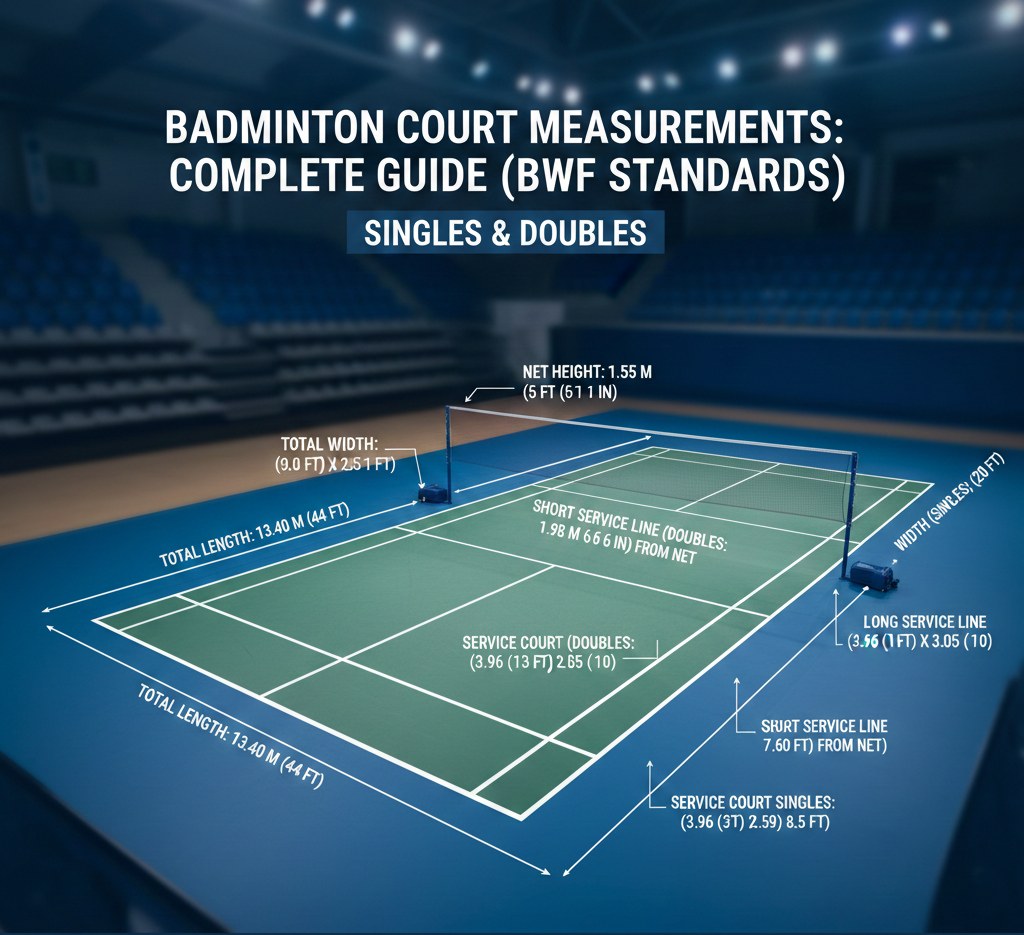
Badminton is a fast-paced and highly technical sport that demands accuracy not only from players but also from the playing surface itself. One of the most important aspects of the game is a correctly designed and precisely marked badminton court. Whether you are planning to build a professional indoor stadium, a school sports facility, or a recreational badminton court, understanding official badminton court measurements is essential.
The Badminton World Federation (BWF) governs the international standards for court dimensions, markings, and net height. These measurements are followed worldwide to ensure fair play, consistency, and safety during matches. In this detailed guide, we will explain badminton court size, layout, markings, net specifications, flooring requirements, and space guidelines in a simple yet professional manner.
Official Badminton Court Dimensions (BWF Approved)
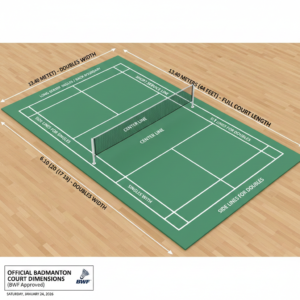
A standard badminton court is rectangular in shape and remains the same length for both singles and doubles matches. The width varies depending on the format of play.
Overall Badminton Court Size
-
Length: 13.40 meters (44 feet)
-
Width (Doubles): 6.10 meters (20 feet)
-
Width (Singles): 5.18 meters (17 feet)
The length of the court does not change, but the side boundaries differ between singles and doubles play.
Badminton Court Size for Singles Matches
In singles badminton, the court becomes narrower while maintaining the full length.
Singles Court Measurements
-
Length: 13.40 meters (44 feet)
-
Width: 5.18 meters (17 feet)
The singles sidelines are drawn inside the doubles sidelines, reducing the total playing width. This narrower court increases rally intensity and requires greater precision from players.
Badminton Court Size for Doubles Matches
Doubles badminton uses the full width of the court but has a slightly different service area.
Doubles Court Measurements
-
Length: 13.40 meters (44 feet)
-
Width: 6.10 meters (20 feet)
The wider court allows for more strategic play, faster exchanges, and coordinated teamwork between partners.
Badminton Net Specifications
The net is a crucial component of the court and must meet official height and width standards.
Standard Badminton Net Measurements
-
Net Height at Posts: 1.55 meters (5 feet 1 inch)
-
Net Height at Center: 1.524 meters (5 feet)
-
Net Width: 6.10 meters (20 feet)
-
Net Depth: Approximately 0.76 meters (2 feet 6 inches)
The net must be made of fine cord with a dark color and square mesh, allowing players and officials to clearly see the shuttle during play.
Badminton Court Lines and Markings Explained
Badminton courts have multiple lines, each serving a specific purpose. All lines should be 40 mm wide and clearly visible, usually painted in white or yellow on green or wooden flooring.
Key Court Markings
Center Line
-
Divides each side of the court into left and right service courts.
Short Service Line
-
Located 1.98 meters (6 feet 6 inches) from the net.
-
The shuttle must land beyond this line during a legal serve.
Long Service Line for Singles
-
The back boundary line itself serves as the long service line.
Long Service Line for Doubles
-
Positioned 0.76 meters (2 feet 6 inches) inside the back boundary line.
-
This reduces the service area length in doubles matches.
Side Lines for Singles
-
Inner sidelines that reduce the width to 5.18 meters.
Side Lines for Doubles
-
Outer sidelines that mark the full width of 6.10 meters.
Badminton Court Layout: Singles vs Doubles
Singles Court Layout
-
Narrower playing area
-
Full court length used
-
Longer service area
Doubles Court Layout
-
Full court width
-
Shorter service area
-
Additional boundary lines in use
Understanding these differences is important when marking a multipurpose badminton court.
Recommended Flooring for Badminton Courts
The choice of flooring significantly affects player performance, safety, and shuttle movement.
Best Badminton Court Flooring Options
-
Wooden Flooring: Preferred for professional tournaments
-
Synthetic Flooring: Durable and cost-effective
-
PVC Badminton Mats: Excellent grip and shock absorption
A good badminton floor should be non-slippery, shock-absorbent, and gentle on players’ joints.
Clear Space and Ceiling Height Requirements
Proper clearance around the court ensures player safety and uninterrupted gameplay.
Space Guidelines
-
Clear Space Around Court: Minimum 2 meters on all sides
-
Recommended Ceiling Height: At least 9 meters
Higher ceilings are preferred for competitive play, as badminton involves high clears and lifts.
Quick Badminton Court Measurement Chart
| Specification | Measurement |
|---|---|
| Full Court Length | 13.40 m (44 ft) |
| Court Width (Doubles) | 6.10 m (20 ft) |
| Court Width (Singles) | 5.18 m (17 ft) |
| Short Service Line Distance | 1.98 m (6 ft 6 in) |
| Long Service Line (Doubles) | 0.76 m (2 ft 6 in) inside back line |
| Net Height at Posts | 1.55 m |
| Net Height at Center | 1.524 m |
Why Correct Badminton Court Measurements Matter
Accurate badminton court dimensions ensure:
-
Fair and consistent gameplay
-
Compliance with BWF regulations
-
Player safety and comfort
-
Professional tournament readiness
-
Reduced disputes during matches
Incorrect measurements can affect serving rules, rally fairness, and overall playing experience.
Badminton Court Markings — FAQ
1. What are badminton court markings?
Badminton court markings are painted or taped lines on the floor that define the playing area, service courts, net line, and boundary limits used in singles and doubles play.
2. Why are court markings important?
Markings ensure the game is played fairly and according to rules. They determine whether a shuttlecock is “in” or “out” and which service court is valid during play.
3. What are the standard dimensions for a badminton court?
📏 Overall court size (play area):
-
13.40 m (44 ft) long
-
6.10 m (20 ft) wide
This is the same for singles and doubles — the difference is how the lines are used for play.
(Runsings are outside the marked lines.)
4. What’s the net line marking?
-
The net is placed across the width of the court at the midpoint.
-
The net height at the center is 1.524 m (5 ft) above the ground (measured just over the top of the net).
-
Markings are not drawn on the floor for net height — the posts hold the net.
**5. What lines define the singles playing area?
-
Long service line: at the back end of the court.
-
Singles sidelines: the inner side lines.
-
Front service line: 1.98 m (6 ft 6 in) from the net on each side.
In singles, the court is narrower (6.10 m wide) and longer for serves.
**6. What lines define the doubles playing area?
-
Long service line for doubles: 2.13 m (7 ft) from the back boundary (closer than singles).
-
Doubles sidelines: the outer side lines.
-
Front service line: 1.98 m (6 ft 6 in) from the net.
In doubles, the court is wider (6.10 m wide) and shorter in depth for service.
7. How wide and what color should the lines be?
-
Line width: Typically 40 mm (4 cm).
-
Color: High-contrast with the floor — usually white or yellow on darker floors.
Lines must be even and continuous so players/judges can clearly see them.
8. How many service courts are there?
Each side of the net has two service courts:
-
Left service court
-
Right service court
These are defined by the center line and the front and appropriate back service lines.
9. What is the center line?
The center line runs perpendicular from the front service line to the back service line, dividing the court into left and right service courts.
**10. What’s the difference between in-play lines and out-of-bounds lines?
-
All outer boundary lines are in play for doubles (width and length).
11. Are boundary lines inside or outside the play area?
Court lines are considered part of the court. A shuttle touching the line is “in”.
12. How should the floor area around the court be marked?
Although not drawn on the floor, there must be extra free space around the court for players to move safely — typically at least 2 m around all sides.
14. Can I use colored lines for different sports?
Yes — many halls have lines for multiple sports (volleyball, basketball, etc.). In that case, each sport must be distinguishable by color (e.g., badminton lines in white, volleyball in yellow), and key badminton lines should be clearly visible.
Conclusion
Badminton is a game of speed, skill, and precision, and all of these elements start with a properly designed court. Following BWF-approved badminton court measurements ensures that the game is played fairly and professionally at all levels—from schools and academies to national and international tournaments.
Whether you are building a new badminton court or upgrading an existing one, paying attention to court size, markings, net height, flooring, and clearance space is essential. A well-constructed badminton court not only enhances player performance but also reflects professionalism and quality standards.